A dyer prepares a batch of cotton knit fabric in a bright turquoise. The recipe is right. The dye is right. Yet the shade comes out dull, spotty and a little darker on one side. The cause is not in the dye. It is in the water. Hard water, with calcium, magnesium and traces of iron, can ruin a dye bath. The fix is a small, low-cost chemical called a sequestering agent.
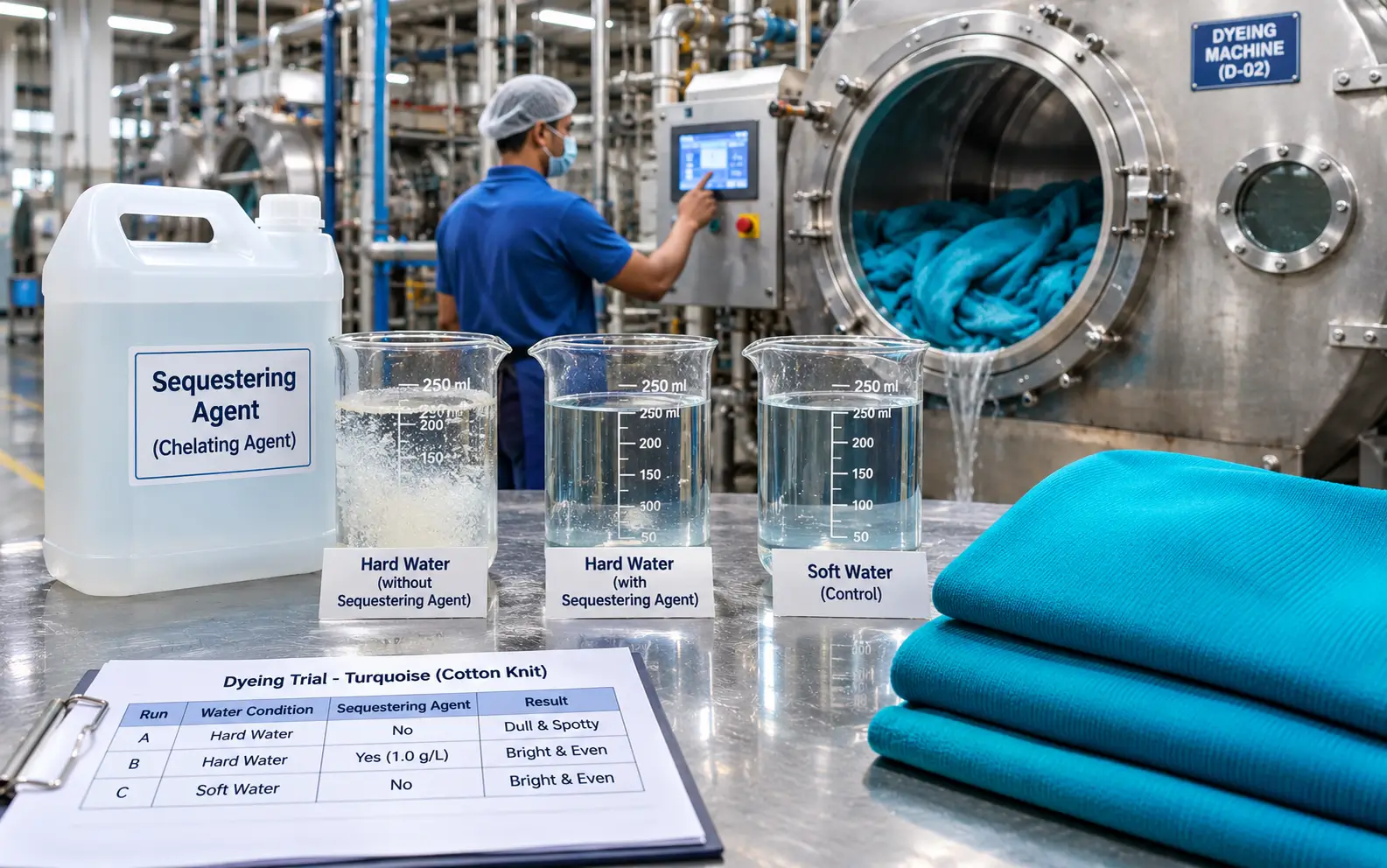
This guide explains what a sequestering agent is, why textile mills use it and how it works. It covers the main types, where to add it in scouring, bleaching and dyeing, and how to work out a dose with real numbers. We also look at the environmental side and greener alternatives. For the processes where these agents are used, see our guides on the dyeing process and the scouring process.
What is a sequestering agent
A sequestering agent is a chemical that binds metal ions in water and holds them in a stable, soluble form, so that they can no longer react with other chemicals. The word sequester means to set apart or hide away. The agent grabs the ions like a claw, which is why the process is also called chelation, from the Greek word for claw.
In textile processing, the ions that cause trouble are:
- Calcium and magnesium, which cause water hardness
- Iron, from pipes, tanks and some water sources
- Copper, from pipes, machine parts and some dyes
- Manganese and other heavy metals, in small amounts
You may also see the spelling “sequesting agent”. It means the same thing.
Why metal ions cause trouble in wet processing
| Process | What metal ions do | Result |
|---|---|---|
| Scouring | Combine with soap and detergents to form scum | Less cleaning power, sticky deposits on the fabric |
| Bleaching with hydrogen peroxide | Iron and copper speed up peroxide breakdown in an uncontrolled way | Holes in fabric (catalytic damage), uneven whiteness |
| Reactive dyeing | Hard water reacts with dye and alkali, forming insoluble particles | Dull, uneven shades, dye spots, poor reproducibility |
| Direct and acid dyeing | Some dyes form complexes with metals | Shade change, lower brightness |
| Disperse dyeing | Metal ions upset dispersion | Dye spots and tar |
| Soaping and washing-off | Hard water can leave lime soap on the fabric | Poor feel and bad rubbing fastness |
| Finishing | Metals can affect softeners and resins | Yellowing, uneven finish |
Mills usually have several water sources and the quality changes over time. Even with a softening plant, traces of metal can pass through or come from the machine itself. A sequestering agent is cheap insurance.
How a sequestering agent works
Each molecule of the agent has several sites, such as acid groups (carboxylate or phosphonate), that can latch onto a metal ion from different sides. Together they form a ring-like complex around the ion. This complex is soluble in water and does not react in the dye bath. When the bath is drained, the metals leave with it.
The strength of this bond depends on pH, temperature and the type of metal. Some agents work well in acid, some in strong alkali, and some in both. This is the main reason there are so many types.
Types of sequestering agents
| Type | Examples | Strengths | Limits |
|---|---|---|---|
| Aminocarboxylates | EDTA, DTPA, NTA | Very strong binding of many metals, widely used | Not readily biodegradable (EDTA, DTPA), restricted in some countries |
| Phosphates | Sodium hexametaphosphate, tripolyphosphate | Low cost, good for hardness and dispersing | Break down in hot alkaline baths, add phosphorus to water |
| Phosphonates | HEDP, ATMP, DTPMP | Stable in hot alkali and peroxide, good threshold effect | Contain phosphorus, slow to biodegrade |
| Polyacrylates and polycarboxylates | Sodium polyacrylate | Disperse particles and stop scale | Weak at binding iron and copper |
| Gluconates | Sodium gluconate | Strong in strong alkali (mercerising, scouring), low cost, biodegradable | Weak in acidic conditions |
| Citric and other hydroxy acids | Citric acid, tartaric acid | Safe and biodegradable, good in acid baths | Weak in alkaline baths, lower strength |
| Biodegradable chelates | MGDA, GLDA, IDS | Good performance with better biodegradability | Higher cost |
| Blends | Commercial mixes with dispersants | Balanced performance for a set job | Composition may be undisclosed, check the data sheet |
Choosing by pH
- Acid (pH below 6): Citric acid, polycarboxylates, EDTA.
- Neutral to weakly alkaline (pH 7 to 10): EDTA, DTPA, phosphonates, MGDA, GLDA.
- Strong alkali (pH above 11): Gluconate, phosphonates, DTPA (stable in alkali), polyphosphates in mild heat.
- Peroxide bleaching: Organic stabilisers based on phosphonates or polyacrylates, with magnesium silicate in some systems. Check that the product is made for peroxide.
Where to use a sequestering agent
Pretreatment: desizing, scouring and bleaching
In scouring, the agent stops hardness from forming scum and helps the alkali remove waxes and pectins. In peroxide bleaching, it ties up iron and copper, which would otherwise break the peroxide too fast and damage the cotton. Our guide on the classification and objects of scouring explains the clean-up steps, and the objectives and classification of bleaching covers the bleach side.
Dyeing
It is added at the start of the bath, before the dye and chemicals. For reactive dyes on cotton, it keeps the bath free of hardness. For polyester with disperse dyes, it keeps the dispersion stable. For wool and silk, it controls iron and copper that dull the shade.
Washing-off and soaping
After reactive dyeing, a sequestering agent in the soaping bath stops hardness from precipitating the loosened dye and helps remove it.
Finishing
Used sparingly in some finish baths to prevent metal-related yellowing.
Dosage: how much to use
Doses depend on the product, the water hardness and the process. Suppliers give ranges on their data sheets. Typical starting ranges are:
| Process | Typical dose of liquid product |
|---|---|
| Scouring and bleaching | 0.5 to 2 g/L |
| Reactive dyeing | 0.5 to 1 g/L |
| Disperse dyeing | 0.5 to 1 g/L |
| Soaping | 0.5 to 1 g/L |
| Hard water or iron-rich water | Higher, up to 2 g/L or more |
Always test on a lab dip and check with your supplier.
Water hardness in simple terms
Hardness is measured as the amount of calcium and magnesium in water, expressed as milligrams per litre (mg/L or ppm) of calcium carbonate (CaCO₃).
| Hardness (mg/L as CaCO₃) | Description |
|---|---|
| Below 60 | Soft |
| 60 to 120 | Moderately hard |
| 120 to 180 | Hard |
| Above 180 | Very hard |
Most dyers aim for water below about 50 mg/L for reactive dyeing, though the limit depends on the dye maker. If your water is harder, you can use a softening plant, a sequestering agent or both. Our guide on the water treatment plant process in industry covers softening.
Worked example 1: theoretical amount of EDTA needed
A dye bath has a liquor ratio of 1:8 and the batch is 100 kg of fabric.
- Water = 100 × 8 = 800 litres
- Water hardness = 150 mg/L as CaCO₃
Step 1: hardness in the bath.
- 150 mg/L × 800 L = 120,000 mg = 120 g of CaCO₃
Step 2: chemistry. Tetrasodium EDTA binds calcium in a one-to-one ratio by moles. The molar mass of CaCO₃ is about 100 g/mol, and that of tetrasodium EDTA (anhydrous) is about 380 g/mol.
- Moles of hardness = 120 ÷ 100 = 1.2 mol
- EDTA needed in theory = 1.2 × 380 = 456 g (as 100 percent product)
Step 3: commercial product. If the liquid product is 40 percent active:
- 456 ÷ 0.40 = 1,140 g, or about 1.14 kg of liquid
Step 4: dose per litre. 1,140 g ÷ 800 L = 1.43 g/L.
This is the amount that would bind all the hardness, with nothing left over for iron, copper or other uses. In practice, a mill with water this hard would use a softener first. The theory shows why a dose of 0.5 g/L is only enough for water of about 50 mg/L or lower. Real binding is also affected by pH and competing ions, so treat these numbers as a guide.
Worked example 2: cost of sequestering agent per batch
Suppose a mill uses 1 g/L of a liquid sequestering agent in reactive dyeing, and a second 1 g/L in soaping.
- Bath volume = 800 L for dyeing and 800 L for the one soaping bath that carries the agent
- Agent for dyeing = 1 × 800 = 800 g
- Agent for soaping = 1 × 800 = 800 g
- Total = 1,600 g = 1.6 kg per batch
If the product costs 2.5 currency units per kg, the cost is 1.6 × 2.5 = 4 units per batch of 100 kg, or 0.04 units per kg of fabric. A single re-dye of a batch, with wasted dye, chemicals, water, steam and 8 hours of machine time, would cost many times more. That is why the sequestering agent is a minor line in the cost sheet but a major shield against faults. See our guide on liquor ratio and dyeing cost for more on how the water volume drives chemical cost.
Worked example 3: peroxide bleaching with iron present
A bleach bath of 1,000 litres has 2 mg/L of dissolved iron from the water supply.
- Iron present = 2 × 1,000 = 2,000 mg = 2 g
Even 2 g of iron can speed up peroxide breakdown, with hot spots of damage on the cloth. A phosphonate-based stabiliser dosed at 1 g/L adds 1,000 g in the bath. It binds the iron and leaves a large margin. After bleaching, check the fabric by testing for catalytic damage, for example with a strength test on a treated sample.
Eco-friendly and regulatory points
- EDTA and DTPA are strong, but break down slowly in the environment and can carry metals through treatment plants. Some regions and buyer lists limit them.
- Phosphates and phosphonates add phosphorus to water, which may feed algae growth when released in large amounts.
- Better options: GLDA, MGDA and IDS are built to break down faster. Gluconate and citric acid are biodegradable and work in the right pH ranges.
- Use only what you need. Over-dosing wastes money and adds load to the effluent plant.
- Soften the water first if hardness is high. A softener costs less than very high doses of chemicals.
- Check buyer rules. Many brands have restricted substance lists that cover some chelating agents.
Common problems and fixes
| Problem | Likely cause | Fix |
|---|---|---|
| Dull or uneven reactive shade | Hard water, not enough sequestrant | Soften water, raise dose, check recipe |
| Dye spots | Insoluble dye-metal particles | Add the agent first, filter the dye |
| Holes in bleached cotton | Iron or copper caused rapid peroxide decay | Use a peroxide-stable sequestrant, check water and equipment |
| Scum on fabric | Hardness reacting with soap | Add a sequestrant, rinse well |
| Poor wash fastness | Hydrolysed dye not removed, hard water | Use a sequestrant in soaping |
| Agent does not work in the bath | Wrong pH or temperature for the type | Choose a type for your bath conditions |
| Foam | Some agents with surfactants | Use a low foam grade |
| Shade difference from batch to batch | Variable water quality | Test water each day, standardise dosage |
How to choose a product
- List your processes and the pH and temperature of each.
- Check your water source for hardness and iron.
- Ask suppliers for data sheets that show active content, pH range, safety and biodegradability.
- Run lab tests with your own dye and fabric.
- Compare the cost per batch, not only the price per kilogram.
- Check buyer chemical lists.
- Train staff on correct dosing and addition order.
Final thoughts
A sequestering agent is a small part of the recipe, but it protects every other part. It keeps hardness and metals from spoiling dyes, bleach and detergents. Choose the type for your pH and process, work out the dose from your own water, and add it first. Weigh the cost against the price of a re-dye. And where you can, choose agents that are easier on the water they leave in. Clean water in, careful chemistry and good records lead to shades that match every time.
Frequently asked questions
It is a chemical that binds metal ions such as calcium, magnesium, iron and copper in water, so they cannot harm dyeing, scouring or bleaching.
To prevent hard water and metal traces from causing dull shades, spots and uneven colour.
In textile use the words mean much the same thing. Chelation is the way the agent grips the metal ion.
Yes. EDTA is one of the strongest and most common, though it breaks down slowly in the environment.
Sodium gluconate and certain phosphonates and DTPA work well at high pH.
Usually 0.5 to 2 g/L, depending on the process and water quality. Check the supplier’s data sheet and test first.
Yes. GLDA, MGDA, IDS, gluconate and citric acid are examples with better biodegradability.