A floral shirt, a batik sarong and a white-spotted navy scarf all carry a printed pattern, yet they were made in three very different ways. In the first, colour was put straight onto white cloth. In the second, a dark cloth was dyed first and the pattern was bleached out of it. In the third, parts of the cloth were protected so the dye could not reach them. These are the three main styles of printing in the textile world: direct, discharge and resist.
This guide explains each style in simple words, how the print paste is made, which methods apply the paste and how a printed fabric is fixed and washed. It includes a worked recipe with real quantities, the faults to watch, and a comparison table to help you pick the right style. If you want a deeper look at one machine route, see our guide on digital vs rotary screen textile printing.
What is textile printing
Textile printing is the process of putting colour on fabric in a pattern, so that the design has sharp edges and stays put through washing. It is different from dyeing, which colours the whole fabric evenly. In printing, the colour is a thick paste, so it stays where it is placed and does not spread. For a short overview of both, see our article on what you need to know about fabric dyeing and printing.
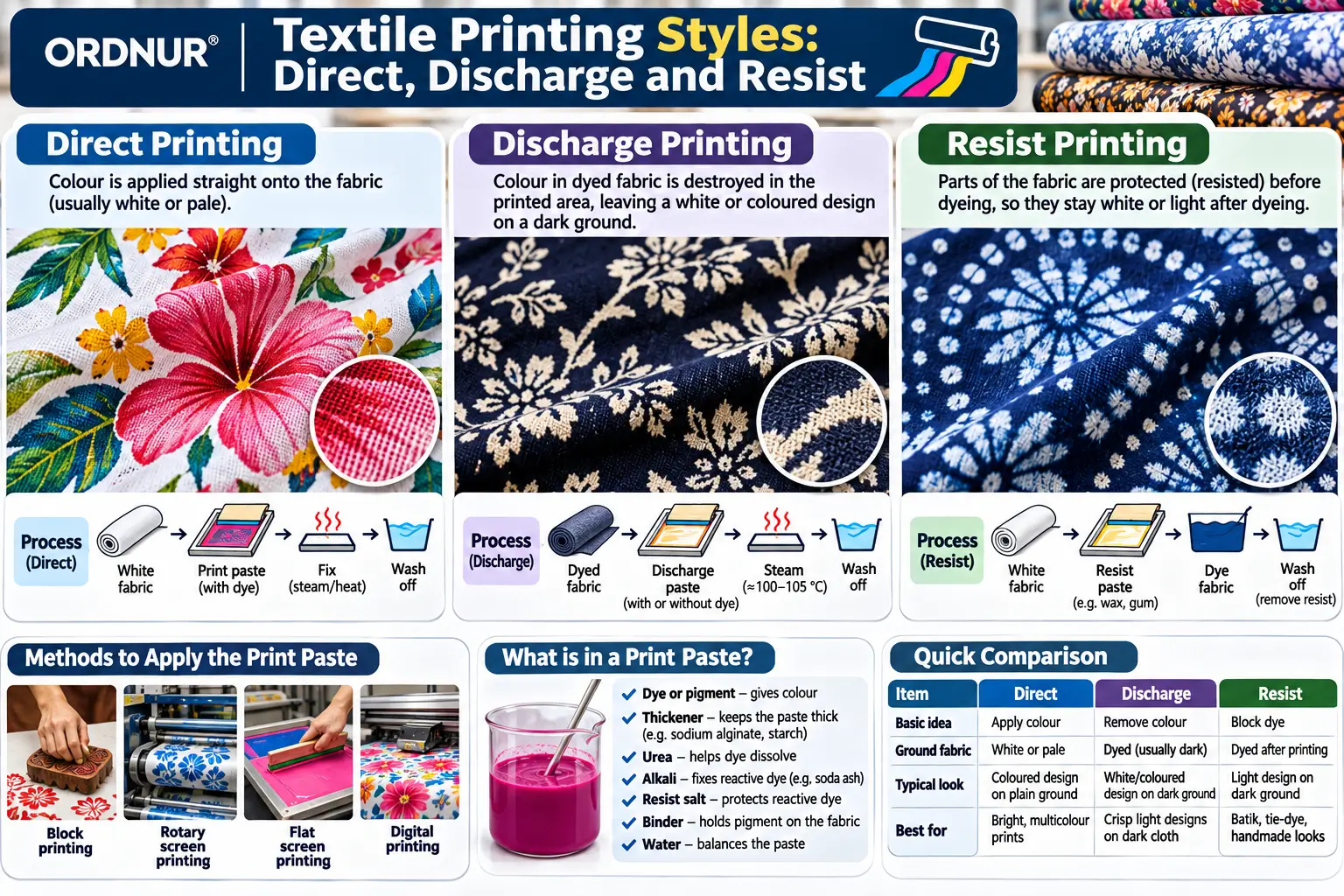
The three styles of printing
The word style means the way the pattern is created on the fabric, not the machine that applies it. The same machine can print in any of the three styles.
| Style | Idea | Ground (background) | Result |
|---|---|---|---|
| Direct | Colour is applied straight onto the fabric | White or pre-dyed pale | Coloured design on a plain ground |
| Discharge | Colour in the dyed fabric is destroyed in the design area | Dyed fabric | White or coloured design on a dark ground |
| Resist | The design area is protected before dyeing, so it stays white or light | Fabric dyed after printing | Light design on a dark ground |
Style 1: Direct printing
In direct printing, the print paste with dye or pigment is put on the fabric exactly where the colour is wanted. It is the simplest and most common style, used for most prints in the market.
How it works:
- The design is separated into colours, and a screen or roller is made for each.
- Print paste for each colour is prepared.
- The paste is printed on the fabric, usually white or pale.
- The fabric is dried.
- The colour is fixed with steam or heat.
- The fabric is washed off to remove thickener and unfixed colour.
Best for: Bright, multicolour designs on white or light fabrics, such as shirts, dress fabrics, bedsheets and scarves.
Limits: Printing a light colour on a dark ground is hard, because the dark ground shows through. A strong dark design also needs more dye than a dyed ground.
Style 2: Discharge printing
In discharge printing, the fabric is first dyed in a solid colour, then a paste with a chemical that destroys the dye is printed on it. The dye is removed where the paste touches, leaving a white pattern. This is called a white discharge.
If a dye that survives the chemical is added to the paste, it colours the design area as it destroys the ground. This is a coloured discharge, also called an illuminating colour print.
Chemicals used: Discharge agents are usually reducing agents, such as sodium or zinc formaldehyde sulfoxylate (a product of the Rongalite type). They break the colour-bearing parts of the dye under steam. Some systems use other reducing agents, because formaldehyde release is a health concern. Choose the system that meets your buyer’s restricted substances list.
Dyes that discharge well: Many azoic, direct and some reactive dyes can be discharged. Vat dyes, most pigments and some reactive dyes are hard to discharge. Always test.
Steps:
- The fabric is dyed to a dark ground. Dyes should be chosen as dischargeable.
- The discharge paste, with or without illuminating dye, is printed.
- The fabric is dried.
- It is steamed to activate the chemical, often at about 100 to 105 degrees Celsius for several minutes.
- It is washed off well to remove the broken-down dye and chemicals.
Best for: Crisp white or coloured designs on a deep ground, with a soft hand and no extra layer on the surface. It looks like the colour was woven into the cloth.
Limits: The process needs care and test runs. Chemicals can weaken the fabric if used too strongly. The effluent has to be treated, as in our guide on the water treatment plant process in industry.
Style 3: Resist printing
In resist printing, a substance that blocks the dye is applied to parts of the fabric. The fabric is then dyed, and the protected parts stay white or lighter. Afterwards the resist is washed out.
Types of resist
| Type | How it blocks the dye | Example |
|---|---|---|
| Wax resist | Hot wax stops the dye entering | Batik from Indonesia, Malaysia and parts of South Asia |
| Paste or mud resist | Thick paste of clay, gum or starch | Dabu from India, Adire from West Africa |
| Mechanical resist | Fabric is tied, folded, stitched or clamped | Tie and dye, Bandhani, Shibori |
| Chemical resist | A chemical in the print paste stops dye fixing | Acid in the paste resists alkaline reactive dye fixing |
Steps for a printed chemical resist:
- The resist paste is printed on the white fabric in the design area.
- The fabric is dried.
- The fabric is dyed or padded with dye, and the resist stops the dye from fixing in the printed spots.
- The fabric is washed off.
Best for: Pale, soft designs on dark grounds, and traditional crafts with a handmade look. Batik and tie-dye are loved because each piece is a little different.
Limits: Hard to control for fine lines, slow in handwork, and wax removal needs hot water or a solvent.
Methods of applying the print paste
Styles tell us what is done. Methods tell us how the paste gets onto the fabric.
| Method | How it works | Suited to |
|---|---|---|
| Block printing | Carved wooden or metal blocks are inked and pressed by hand | Craft prints, small runs. Sarees, home textiles |
| Roller printing | Engraved copper rollers carry paste and press it onto cloth | Very long runs, now less common |
| Flat screen printing | Paste is pushed through a mesh screen with a squeegee | Short and medium runs, T-shirts, panels. See screen printing |
| Rotary screen printing | Cylindrical screens print continuously on moving fabric | Most commercial printing of fabric by the metre |
| Digital (inkjet) printing | Inkjet heads place ink directly from a computer file | Short runs, many colours, samples. See digital printing pros and cons |
| Heat transfer and sublimation | Design printed on paper is moved by heat onto fabric | Polyester, sportswear. See sublimation printing |
| Stencil and spray | Paste or colour goes through cut openings | Simple, bold shapes |
For a wider look at garment-level printing methods, see our guide to T-shirt printing methods.
What is in a print paste
A print paste is a thick liquid. The thickness keeps the design sharp on the cloth.
| Ingredient | Job |
|---|---|
| Dye or pigment | Gives the colour |
| Thickener | Gives body so the paste does not spread. Sodium alginate, starch products, gum and synthetic thickeners are common |
| Urea | Helps dissolve reactive dyes and keeps moisture during steaming |
| Alkali | Soda ash or bicarbonate fixes reactive dye on cotton |
| Resist salt | A mild oxidising agent that protects reactive dye from being reduced in steaming |
| Binder | A resin that glues pigment onto the fibre in pigment printing |
| Water | Balances the weight |
Worked example: a reactive direct print paste
A printer needs 20 kg of paste for a cotton print. The recipe per 1,000 g is:
| Ingredient | Grams per 1,000 g |
|---|---|
| Reactive dye | 30 |
| Urea | 100 |
| Sodium alginate stock (4 percent) | 500 |
| Soda ash | 20 |
| Resist salt | 10 |
| Water | 340 |
| Total | 1,000 |
For 20 kg (20,000 g), multiply by 20:
- Dye = 30 × 20 = 600 g
- Urea = 100 × 20 = 2,000 g = 2 kg
- Alginate stock = 500 × 20 = 10,000 g = 10 kg
- Soda ash = 20 × 20 = 400 g
- Resist salt = 10 × 20 = 200 g
- Water = 340 × 20 = 6,800 g = 6.8 kg
Check the total: 0.6 + 2 + 10 + 0.4 + 0.2 + 6.8 = 20 kg.
How far does the paste go? If the paste pick-up is 60 g per square metre of fabric (a rough number for a medium coverage design), then:
- Fabric covered by 20 kg = 20,000 ÷ 60 = 333 square metres
- On a fabric 1.1 m wide, that is 333 ÷ 1.1 = 303 running metres
A mill printing 5,000 metres a day would therefore need 5,000 × 1.1 × 60 = 330,000 g, or 330 kg of paste, for one design of this coverage. The numbers change with the mesh, coverage and design, so use your own measured pick-up.
Fixation: After printing, the cloth is dried and steamed at about 102 to 105 degrees Celsius for 8 to 10 minutes. The alkali and heat make the dye bond with the cotton. It is then rinsed cold, washed hot with a soaping agent and rinsed again.
Pigment printing: a style that cuts steps
Pigment printing is often grouped with direct printing, but it uses a different chemistry. Instead of dye, it uses insoluble pigment with a binder resin. After printing, the fabric is dried and baked, typically at about 150 degrees Celsius for 3 to 5 minutes, so the binder forms a film that holds the pigment on the surface. There is no steaming and no heavy washing, so it saves water and time. The feel can be stiffer, and rubbing fastness can be lower on dark shades. To learn more about pigments, read our guide on what pigments are and our article on the difference between dyes and pigments.
Choosing a style
| Need | Best style |
|---|---|
| Colourful design on white or pale cloth | Direct |
| Fine white or light pattern on a very dark ground | Discharge |
| Soft handmade look with natural variation | Resist (batik, tie-dye) |
| Low water use and quick turnaround | Pigment direct or digital |
| Low cost, long runs | Rotary screen direct |
| Short runs with many colours | Digital |
Common faults and fixes
| Fault | Cause | Fix |
|---|---|---|
| Blurred edges (bleeding) | Paste too thin, too much pressure | Raise thickener, reduce squeegee pressure |
| Poor registration | Screens set wrongly, fabric slips | Adjust the screens and the fabric guide |
| Pale print | Not enough dye, poor fixation | Check recipe, steaming time and alkali |
| Stiff hand in pigment print | Too much binder | Reduce binder, add softener |
| Weak white in discharge | Wrong dye in the ground, low steaming | Use dischargeable dyes and correct steam time |
| Halo around the design | Paste migration | Adjust the thickener and drying |
| Poor wash fastness | Unfixed dye left on cloth | Improve wash-off. Test with colour fastness methods |
| Marks from screen | Dirty or damaged screen | Clean and check mesh |
Environmental points
Printing uses paste, water for washing off and energy for drying and steaming. Chemicals in discharge and resist styles need careful handling, and the water must be treated. Digital and pigment routes use less water. Check buyer standards on formaldehyde and other restricted substances. Keep test records for each recipe. See our guide on the dyeing process for the dye side of the story.
Final thoughts
The three styles of printing give the textile maker three different tools. Direct printing is the all-round choice for colour on light cloth. Discharge gives a soft, deep look with white or bright designs on dark ground. Resist gives the handmade character of batik and tie-dye. Pick the style for the look, the fabric and the budget, then control the paste, fixation and wash-off. Test every recipe before bulk printing, and keep a record so you can repeat the result.
Frequently asked questions
The three styles are direct, discharge and resist. Direct puts colour straight on the fabric, discharge removes colour from a dyed ground, and resist blocks the dye from reaching parts of the fabric.
Discharge printing destroys the colour after the fabric is dyed. Resist printing protects parts of the fabric before dyeing so the dye never reaches them.
Direct printing, mostly by rotary screen, is the most common in commercial production.
Batik is a wax resist style. Hot wax is applied to the fabric, the fabric is dyed, and the wax is removed to show the white pattern.
It is a thick mixture of dye or pigment, thickener, chemicals and water. It is applied to fabric in the pattern, then fixed and washed.
Urea helps dissolve the dye and holds moisture during steaming, which improves fixation.
Yes. The style depends on the paste and the process steps, not on the machine.