Pull on a pair of running tights, open a backpack, or step on a car floor mat. There is a good chance you are touching nylon. This smooth, strong and stretchy material was the first fully man-made fiber to reach the public, and it is still everywhere, nearly a century after its invention.
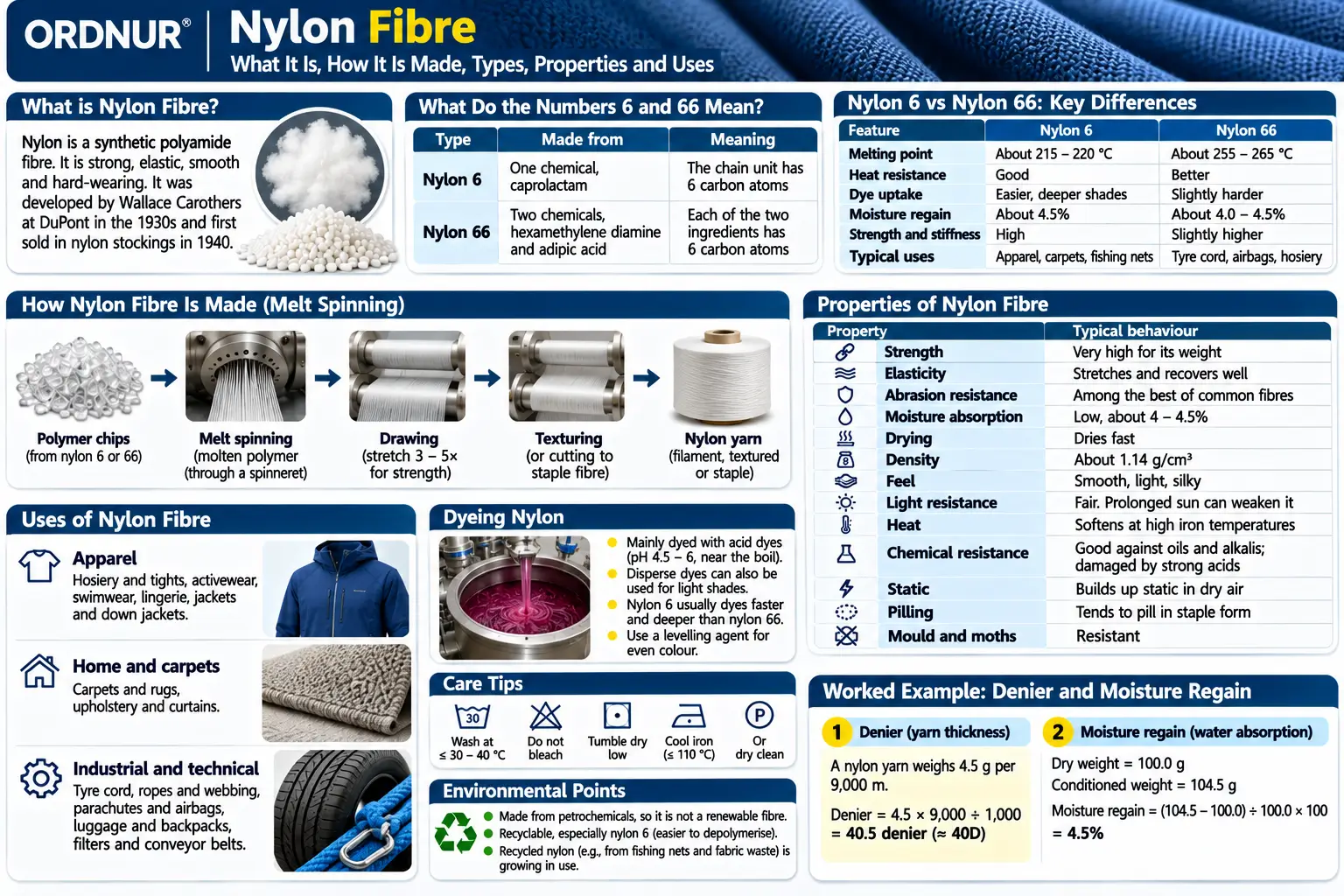
This guide explains what nylon fiber is, how it is made and what nylon 6 and nylon 66 mean. It covers properties, uses, dyeing, care and the environmental side, with a worked example on denier and moisture. If you want to see where nylon sits among man-made fibers, read our guide on the types of synthetic fibres. For the other big synthetic, see our guide on polyester fibre.
What is nylon fiber
Nylon is a family of synthetic polymers called polyamides. In a polyamide, long chains of molecules are joined by amide links, the same type of link found in natural protein fibers such as silk and wool. That is why nylon feels a little like silk and why it dyes with some of the same dyes.
Nylon was developed by Wallace Carothers and his team at DuPont in the United States in the 1930s. Nylon 66 was the first version. The fiber was first shown in nylon stockings, which went on sale to the public in 1940, and was soon used in parachutes and other war supplies. A second type, nylon 6, was made in Germany by Paul Schlack in 1938.
What do the numbers 6 and 66 mean
The numbers describe the molecules that make the polymer.
| Type | Made from | Meaning of the number |
|---|---|---|
| Nylon 6 | One chemical, caprolactam | The chain unit has 6 carbon atoms |
| Nylon 66 (also written 6,6) | Two chemicals, hexamethylene diamine and adipic acid | Each of the two ingredients has 6 carbon atoms |
Nylon 6 is made by opening a ring-shaped molecule, caprolactam, and joining the pieces into a long chain. Nylon 66 is made by reacting two different chemicals, each with six carbons, in a step called condensation polymerisation. Water is released as a by-product, and the long polymer chain forms.
Nylon 6 vs nylon 66
| Feature | Nylon 6 | Nylon 66 |
|---|---|---|
| Melting point | About 215 to 220 degrees Celsius | About 255 to 265 degrees Celsius |
| Heat resistance | Good | Better |
| Dye uptake | Easier, deeper shades | Slightly harder |
| Moisture regain | About 4.5 percent | About 4.0 to 4.5 percent |
| Strength and stiffness | High | Slightly higher |
| Abrasion resistance | Very good | Very good |
| Processing | Lower temperature | Higher temperature |
| Recycling | Easier to depolymerise and recycle | Harder to recycle chemically |
| Common uses | Apparel, carpets, fishing nets, recycled yarns | Tyre cord, airbag fabric, hosiery, industrial fabric, carpets |
Values change with the grade and the maker, so treat the figures as typical. In everyday clothing, most people cannot tell the two apart. The choice mainly matters for industrial uses where heat resistance counts, and for recycling and dyeing.
How nylon fiber is made
- Making the polymer. The raw chemicals come mostly from petroleum. They are reacted in a reactor to form long polymer chains. The molten polymer is cooled and cut into chips.
- Melt spinning. Chips are dried, melted and pushed through a spinneret, a plate with many tiny holes. Each hole makes one filament. Cool air hardens the filaments as they fall.
- Drawing. The filaments are stretched at 3 to 5 times their length. This lines up the polymer chains and gives the fiber its strength.
- Texturing or cutting. Smooth filament yarn can be used as it is. It can also be textured to make it bulky and soft, or cut into short staple fibers for spinning.
- Winding. The yarn is wound on packages for knitting or weaving.
Nylon is made by melt spinning, not by solution spinning. That is one reason it is strong and uniform.
Properties of nylon fiber
| Property | What it means |
|---|---|
| Strength | Very high strength for its weight |
| Elasticity | Stretches and recovers well |
| Abrasion resistance | Among the best of common fibers |
| Moisture absorption | Low, about 4 to 4.5 percent regain at standard conditions |
| Drying | Dries fast |
| Density | About 1.14 g/cm³, lighter than cotton and polyester |
| Feel | Smooth, light, silky |
| Light resistance | Fair. Prolonged sun can weaken and yellow it |
| Heat | Softens at high iron temperatures. Use a cool iron |
| Chemical resistance | Good against oils and alkalis, damaged by strong acids |
| Static | Builds up static in dry air |
| Pilling | Tends to pill in staple form |
| Mould and moths | Resistant |
For a way to compare these figures with other fibers, see our guide on the properties of textile fibres.
Uses of nylon fiber
Apparel
- Hosiery and tights: Sheer, stretchy and strong. The original use.
- Activewear and leggings: Often blended with elastane for stretch.
- Swimwear: Dries fast and holds colour.
- Lingerie: Smooth feel and good shape.
- Jackets and windcheaters: Light and wind-resistant, often with coatings.
- Down jackets: Ripstop nylon shells are common.
Home and carpets
- Carpets and rugs: Nylon is one of the leading carpet fibers because it wears well and springs back.
- Upholstery and curtains: Often in blends.
Industrial and technical
- Tyre cord: Nylon 66 reinforces tyres.
- Ropes, nets and webbing: Fishing lines and nets, climbing ropes, seat belts.
- Parachutes and airbags: Light, strong and able to stretch.
- Luggage and backpacks: Cordura and ballistic nylon.
- Filters and conveyor belts.
- Moulded plastic parts: Gears, bearings and fasteners are made of nylon as an engineering plastic, but that is a different form from fiber.
Dyeing nylon
Because nylon has amine end groups, like wool and silk, it takes acid dyes well. Disperse dyes can also be used for light shades, and some metal-complex dyes for fastness. A typical acid dye bath uses a pH of 4.5 to 6, a temperature close to the boil and a levelling agent. See our guide on acid dyes for the dye family, and our guide on the dyeing process for the stages. Nylon 6 usually takes dye faster and deeper than nylon 66. A fabric with both types in it can show uneven shades, so mills keep the types separate.
Worked example 1: denier and tex
Denier is the weight in grams of 9,000 metres of yarn. Tex is the weight in grams of 1,000 metres. The link is: tex = denier ÷ 9.
A nylon yarn is labelled 70 denier with 24 filaments (70D/24f).
- Tex = 70 ÷ 9 = 7.8 tex
- Denier per filament (dpf) = 70 ÷ 24 = 2.9 dpf
A dpf near 3 is typical for apparel. A finer filament, such as 1 dpf, feels softer. A 70D nylon is lighter than a 210D one, which has three times the weight per metre.
Worked example 2: moisture and commercial weight
Fibers are sold at an agreed commercial weight that allows for moisture regain. For nylon, the standard commercial regain is often taken as 4.5 percent. Check the figure in your contract.
A buyer receives 1,000 kg of oven-dry nylon yarn.
- Commercial weight = dry weight × (1 + regain) = 1,000 × 1.045 = 1,045 kg
If the supplier invoices on commercial weight, the buyer pays for 1,045 kg. If the yarn is sold at 6.50 currency units per kg, the invoice is 1,045 × 6.50 = 6,792.5 units. Without the allowance for moisture the amount would be 6,500 units, so the difference is 292.5 units, or about 4.5 percent.
Worked example 3: fabric weight of a nylon tricot
A flat warp-knit nylon fabric is made from 40 denier yarn. Suppose the knit has 38 wales per inch and 46 courses per inch, and the loop length is 3.0 mm per stitch.
- Stitches per square inch = 38 × 46 = 1,748
- Yarn per square inch = 1,748 × 3.0 mm = 5,244 mm = 5.244 m
- Square inch to square metre = 1,550 square inches in one square metre
- Yarn per square metre = 5.244 × 1,550 = 8,128 m
- Weight per metre of 40 denier yarn = 40 ÷ 9,000 g = 0.00444 g/m
- Fabric weight = 8,128 × 0.00444 = 36.1 g/m²
The answer is roughly 36 GSM, and this matches a light lingerie fabric. Warp knits use extra yarn for the underlap, so the real weight is higher. Treat the figure as an estimate and rely on a lab test for the final number.
Nylon in blends
Nylon is often mixed with other fibers to fix a weak point or add a strength.
- Nylon and cotton: Cotton gives comfort and absorbency. Nylon adds strength and wear life. Used in work shirts, military cloth and socks.
- Nylon and elastane: Gives high stretch and shape recovery for leggings, shapewear and swimwear. A common mix is 80 percent nylon and 20 percent elastane.
- Nylon and wool: A small share of nylon, often 10 to 20 percent, makes wool socks and carpets last much longer, since wool wears out at the heel and toe first.
- Nylon and polyester: Seen in some outdoor cloths where a mix of drying speed and strength is wanted.
In a blend, the care label follows the most delicate fibre. If a fabric holds both wool and nylon, wash it the way you would wash wool.
Care of nylon products
- Wash in cool or warm water with mild detergent.
- Use a gentle cycle for sheer or stretchy items.
- Avoid chlorine bleach, which can yellow and weaken nylon.
- Dry on low heat or hang dry. Nylon dries quickly.
- Iron on the lowest setting and use a pressing cloth.
- Keep out of long, strong sunlight, which weakens the fibre over time.
- Use an anti-static spray or a fabric softener to reduce cling.
Nylon vs polyester
| Point | Nylon | Polyester |
|---|---|---|
| Strength | Very high | High |
| Stretch and recovery | Better | Lower |
| Abrasion resistance | Better | Good |
| Moisture absorption | Higher (about 4 to 4.5 percent) | Lower (about 0.4 percent) |
| Drying speed | Fast | Faster |
| UV resistance | Fair | Better |
| Cost | Usually higher | Usually lower |
| Dyes | Acid dyes | Disperse dyes |
| Feel | Silky, smooth | Crisp to soft |
Nylon often wins where abrasion and stretch matter, like hosiery, swimwear and ropes. Polyester wins where cost and sun resistance matter.
Environmental points
Nylon comes from fossil fuels, and making nylon 66 releases nitrous oxide, a strong greenhouse gas, from adipic acid production, although plants now use abatement. Washing nylon garments sheds microfibres that end up in waterways. A guard bag or a filter on a washing machine can reduce this. Recycled nylon is a bright spot. Fishing nets, old carpets and fabric offcuts are collected, depolymerised and made into new yarn, with the same quality as new nylon. Nylon 6 is easier to recycle this way. When you buy recycled nylon, ask for certificates.
Advantages of nylon
- High strength and abrasion resistance
- Excellent stretch and shape recovery
- Light, smooth and quick to dry
- Does not rot, and resists moths and mould
- Can be recycled in a closed loop
Limitations of nylon
- It weakens and yellows in strong sunlight over time.
- It can melt under a hot iron.
- It can build up static and feel clammy in warm weather because it does not breathe like cotton.
- It sheds microfibres.
- It is made from fossil fuels unless recycled.
Final thoughts
Nylon fiber earned its place by being strong, smooth and stretchy. Nylon 6 and nylon 66 differ in how they are made and in a few details of heat and dyeing, but both do the same job well. Choose nylon where wear and stretch matter, check the sun and heat limits, and consider recycled yarn when you can. With a little care, nylon items last for years.
Frequently asked questions
Nylon is a strong, stretchy synthetic fiber from the polyamide family. It is made by melt spinning and used in clothing, carpets, ropes and industrial products.
Nylon 6 is made from one chemical, caprolactam. Nylon 66 is made from two chemicals, each with six carbons. Nylon 66 melts at a higher temperature, while nylon 6 dyes more easily and is easier to recycle.
Nylon 66 is slightly stiffer and more heat resistant. Both are strong, and the difference rarely matters in clothing.
Nylon is fully synthetic. It is made from chemicals, not from plants or animals.
Yes, in cool or warm water on a gentle cycle. Avoid chlorine bleach and high heat.
It absorbs little moisture, so it can feel less breathable than cotton. Blends and special fabric structures help in warm weather.
Acid dyes are most common. Disperse dyes are used for some light shades.