
What is silk made of? The short answer is protein. Silk is a natural protein fiber, made by an insect and spun into a cocoon. A silkworm turns mulberry leaves into a liquid inside its body, then pushes that liquid out as one long, thin thread. When the thread meets air, it hardens. People unwind the cocoon, twist several threads together and weave them into one of the softest, shiniest cloths in the world.
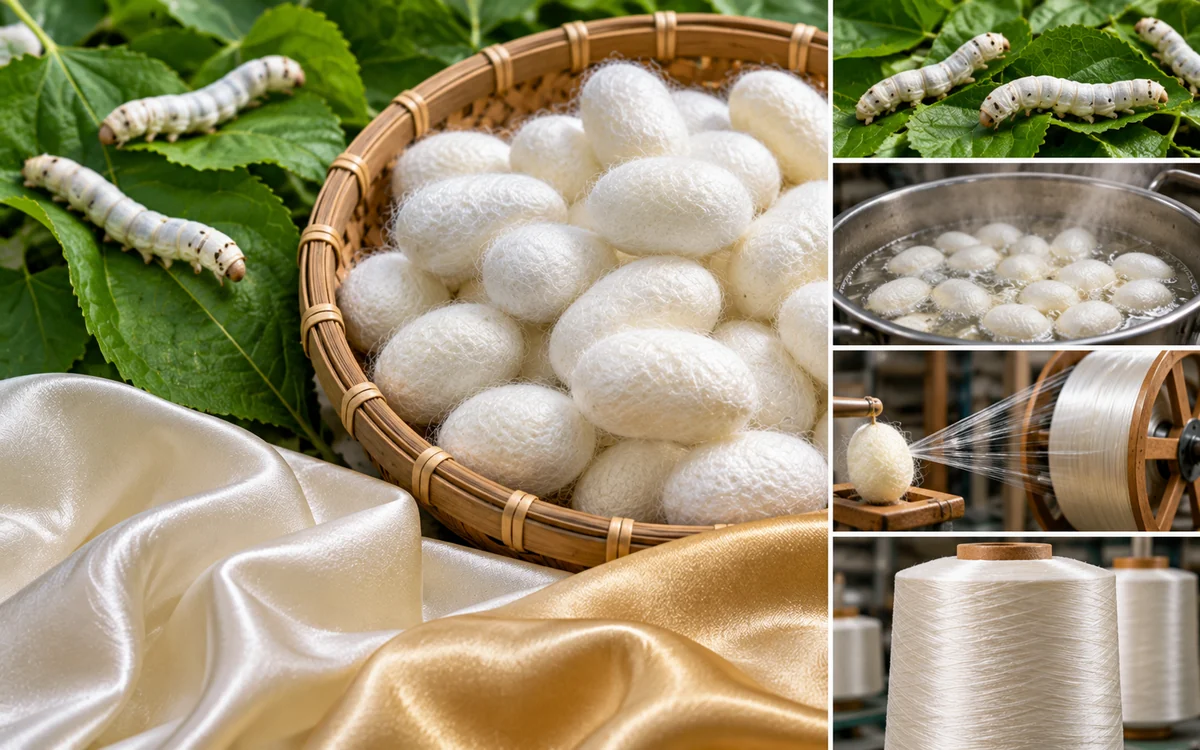
This guide explains exactly what silk is made of, how the fiber is formed, how it becomes yarn and cloth, and what the main types are. It also covers silk’s properties and uses, a worked weight example in momme and a short care guide. For the production steps in more detail, see our article on silk fiber production. If you want to know about one popular type, read our guide to mulberry silk.
What silk is made of
Silk is made of two proteins.
- Fibroin is the main protein. It forms the strong, shiny core of the thread. Fibroin is built mostly from three small amino acids: glycine, alanine and serine. They line up in tight, repeating sheets, and that order gives silk its strength.
- Sericin is a sticky protein, often called silk gum. It coats the fibroin and glues the two filaments of a cocoon together. Sericin makes up roughly a quarter of the raw silk weight.
A silkworm releases two fibroin filaments from two glands in its head. Sericin covers both as the thread comes out. So raw silk is a pair of fibroin strands wrapped in gum. Later, a process called degumming washes the sericin off, and that is when silk becomes soft and glossy.
Silk has no cellulose. That is the main difference from cotton, linen or viscose, which all come from plants. Silk is chemically closer to wool and hair, which are also proteins.
Which insect makes silk
The silk most people know comes from the larva of the domesticated silk moth, Bombyx mori. The larva is called a silkworm. It eats only mulberry leaves, which is why the farming of silkworms is called sericulture and why its best-known product is called mulberry silk.
Other moths make silk too. Their silk is called wild silk, because the insects live on other leaves and are often not fully domesticated.
How silk is made, step by step
Step 1: Raising silkworms
Eggs hatch into tiny larvae. Farmers feed them fresh mulberry leaves many times a day. In about four to five weeks, the larvae grow thousands of times in weight and shed their skin several times.
Step 2: Spinning the cocoon
When a larva is ready, it stops eating and begins to spin. It moves its head in a figure-eight shape, laying down one continuous thread. Within about two to three days, it has wrapped itself in a cocoon. The thread of a single cocoon can be hundreds of meters long.
Step 3: Stifling
If the moth were allowed to hatch, it would cut through the cocoon and break the thread. For long continuous silk, producers heat the cocoons with steam or hot air to kill the pupa inside. This is called stifling. It is the reason some people choose peace silk or other types where the moth is allowed to leave.
Step 4: Reeling
Cocoons are soaked in hot water to soften the sericin. Workers or machines find the end of the thread and unwind it. Several cocoon threads are joined together as they reel, so the final raw silk thread is even in thickness. The result is called raw silk, or reeled silk.
Step 5: Throwing
Raw silk threads are twisted and doubled to make yarn. Twisting adds strength and sets the type of yarn, such as singles, organzine or tram. Organzine is a strongly twisted yarn used for warp. Tram is a lightly twisted yarn used for weft.
Step 6: Degumming
The raw silk is boiled in mild soap or alkali, which dissolves the sericin. The fiber loses about a quarter of its weight and becomes soft, shiny and white. Some mills degum the yarn, some the fabric after weaving. Silk that keeps some gum feels stiff and is called boiled-off or not boiled-off depending on the stage.
Step 7: Dyeing and finishing
Silk takes dye well, especially acid dyes, which suit protein fibers. Finishers may add weighting, softeners or other finishes. Our guide to acid dyes and dye classes explains why acid dyes work on silk and wool.
Step 8: Weaving or knitting
Yarn is woven into fabrics like charmeuse, habotai, dupioni, georgette, chiffon and organza, or knitted into jersey for underwear and scarves.
Types of silk
| Type | Source | Features |
|---|---|---|
| Mulberry silk | Bombyx mori fed on mulberry leaves | The most common type. Smooth, fine, white and even |
| Tussar (tasar) silk | Wild moths of the Antheraea group | Coarser and golden, with a natural texture |
| Eri silk | Eri silkworm, fed on castor leaves | Soft, warm and wool-like. Often made without killing the pupa |
| Muga silk | Muga silkworm from Assam | Naturally golden and glossy, known for long wear |
| Spun silk | Short or waste fibers | Cheaper and duller, spun like cotton |
| Noil and waste silk | Combed-out short fibers | Rough texture, used in cheaper cloth |
Spider silk is also a protein fiber, but it is not farmed for fabric on a large scale. Researchers study it for strength.
Properties of silk fiber
| Property | What it means |
|---|---|
| Strength | Strong for a natural fiber, but weaker when wet |
| Luster | Natural shine from the smooth, triangular filament that bends light |
| Feel | Smooth and soft against the skin |
| Drape | Falls in fluid folds |
| Absorbency | Takes up moisture and feels comfortable in heat and cold |
| Dyeability | Takes bright, deep color |
| Elasticity | Moderate stretch and recovery |
| Wrinkling | Wrinkles easily |
| Heat | Chars and weakens at high ironing temperatures |
| Sunlight | Yellows and weakens with long sun exposure |
| Sweat and chemicals | Can be damaged by chlorine bleach and strong alkali |
Silk is a good insulator. It feels warm in winter and cool in summer, which is why people wear it all year.
Uses of silk
- Clothing: Blouses, dresses, shirts, saris, ties and scarves.
- Underwear and sleepwear: Pajamas, camisoles and slips.
- Bedding: Sheets, pillowcases and duvet covers.
- Home decor: Curtains, cushions and wall coverings.
- Accessories: Scarves, bags and hair ties.
- Medical use: Silk sutures and research on silk protein for medical materials.
- Cosmetics: Silk protein in skin and hair products.
- Technical: Parachute cloth in the past, and filters and fine sieves.
A worked example: reading silk weight in momme
Silk fabric weight is often given in momme (mm). One momme is about 4.3 grams per square meter. To convert, multiply the momme number by 4.3.
- 12 momme is about 12 × 4.3 = 52 GSM. This is a light chiffon or habotai.
- 19 momme is about 19 × 4.3 = 82 GSM. This is a common weight for shirts and sleepwear.
- 22 momme is about 22 × 4.3 = 95 GSM. A popular weight for silk pillowcases and bedding.
- 30 momme is about 30 × 4.3 = 129 GSM. A heavy silk used for upholstery or heavier dresses.
So when a seller lists a 22 momme silk pillowcase, it weighs about 95 grams per square meter. A higher momme number generally means a thicker, heavier and longer-lasting cloth. It does not tell you about the quality of the fiber itself, so check the silk grade too.
How to tell real silk from fake
Silk is often copied, so it helps to know a few simple checks.
- Feel: Real silk feels smooth and warms quickly in your hand. Cheap polyester feels slick and stays cool.
- Shine: Real silk shows a soft, shifting glow when you tilt it. Synthetic shine looks flat and white.
- Rub test: Rubbing silk between your fingers creates a little warmth and a faint rustle, sometimes called scroop.
- Water drop: Silk takes up a drop of water and darkens slightly. Many coated synthetics let the drop sit on top.
- Label: Look for the fiber content on the label. A label that says only “silk-like” or “satin” does not promise real silk. Satin describes the weave, not the fiber.
None of these is perfect on its own. For buyers placing a large order, a lab fiber test is the safe choice.
Silk compared with wild silk in the cloth
Cultivated silk is smooth and even. Wild silk is rougher and often golden or tan, because the cocoons are bigger and the thread is thicker. When wild cocoons are opened after the moth leaves, the thread is cut into short pieces, so the yarn is spun like cotton. The cloth feels dry and has small slubs. Many people like that natural look in curtains, jackets and saris, while others prefer the glossy feel of mulberry silk. Neither is better. They suit different jobs.
Silk grades
Raw silk is graded by the evenness of the thread, the cleanliness and the number of faults. A letter system such as A, B and C, or numbers like 3A and 6A, is used by some markets. The highest grade has the fewest slubs and breaks. A 6A mulberry silk is a common top grade for bedding, but the label is a trade term, not a global standard, so ask your supplier what it means.
Silk vs other fibers
| Fiber | Origin | Handle | Strength when wet | Cost |
|---|---|---|---|---|
| Silk | Protein, animal | Smooth, soft | Weaker | High |
| Cotton | Cellulose, plant | Soft, dry | Stronger | Low |
| Polyester | Synthetic | Smooth, can be slippery | Same | Low |
| Viscose | Cellulose, regenerated | Soft, silk-like | Weaker | Low to medium |
| Wool | Protein, animal | Warm, springy | Weaker | Medium to high |
Viscose and polyester are often sold as silk-like. A burn test can help tell them apart. Silk burns slowly, smells like burnt hair and leaves a crushable ash. Polyester melts into a hard bead. Be careful with flame tests and use only a tiny sample.
Care of silk
- Check the care label first.
- Hand wash in cool water with a mild, pH-neutral soap, or dry clean.
- Avoid chlorine bleach and strong detergents.
- Rinse well and do not wring. Press water out in a towel.
- Dry in shade, away from direct sun.
- Iron on the wrong side at a low temperature while the cloth is still slightly damp.
- Store in a cool, dry place with some airflow, away from moths.
Is silk sustainable and ethical
The answer depends on the type and the farm. Silk is natural and biodegradable. Mulberry trees can help soil and the farming can support rural incomes. But conventional silk reeling uses a lot of water and heat, and the stifling of pupae raises animal welfare concerns for some buyers. Peace silk and eri silk let the moth leave the cocoon, though the fiber is shorter and softer. Brands should be clear about their methods and avoid absolute claims.
Final thoughts
Silk is made of two proteins, fibroin and sericin, spun by a silkworm into a single long thread. From that thread come the smooth shirts, scarves and sheets that people prize. Knowing the source helps you buy and care for silk better. Look at the type, check the weight in momme, ask about the grade and follow the care label. A well-chosen piece of silk can last for many years.
Frequently asked questions
Silk is made of protein. The core is fibroin, and it is coated with a sticky protein called sericin. Silkworms make both.
Yes. Most silk comes from the cocoon of the domesticated silkworm, Bombyx mori, which eats mulberry leaves.
Fibroin is the strong, shiny core of the silk thread. Sericin is the gummy coating that holds the filaments together. It is washed off in degumming.
Silk is a natural protein fiber of animal origin.
A single cocoon can give hundreds of meters of continuous thread. The exact length depends on the strain and the care of the farm.
No. Silk comes from an insect. Some people choose peace silk, where the moth leaves the cocoon, but it is still an animal product.
It takes a lot of cocoons, labor and careful processing to make a small amount of silk. The reeling, throwing and degumming steps need skill.


