A textile mill is a big drinker. Cloth must be washed, bleached, dyed and rinsed again and again, and each step needs clean water. Then the dirty water has to go somewhere. If it leaves the factory untreated, it can colour a canal, kill fish and harm the farmers downstream. That is why every serious mill runs a water treatment plant, and why buyers now ask to see the numbers.
This guide explains the water treatment plant process in plain words. It covers the two sides of the job, which are treating the water that comes in and treating the water that goes out. It then walks through each step, shows how a textile mill treats its dye house effluent, and gives worked examples for tank size, chemical dose and recovery. For the wet processing steps that create the dirty water, see our guide on the dyeing process and our article on the classification and objects of scouring.
Two kinds of plants in a factory
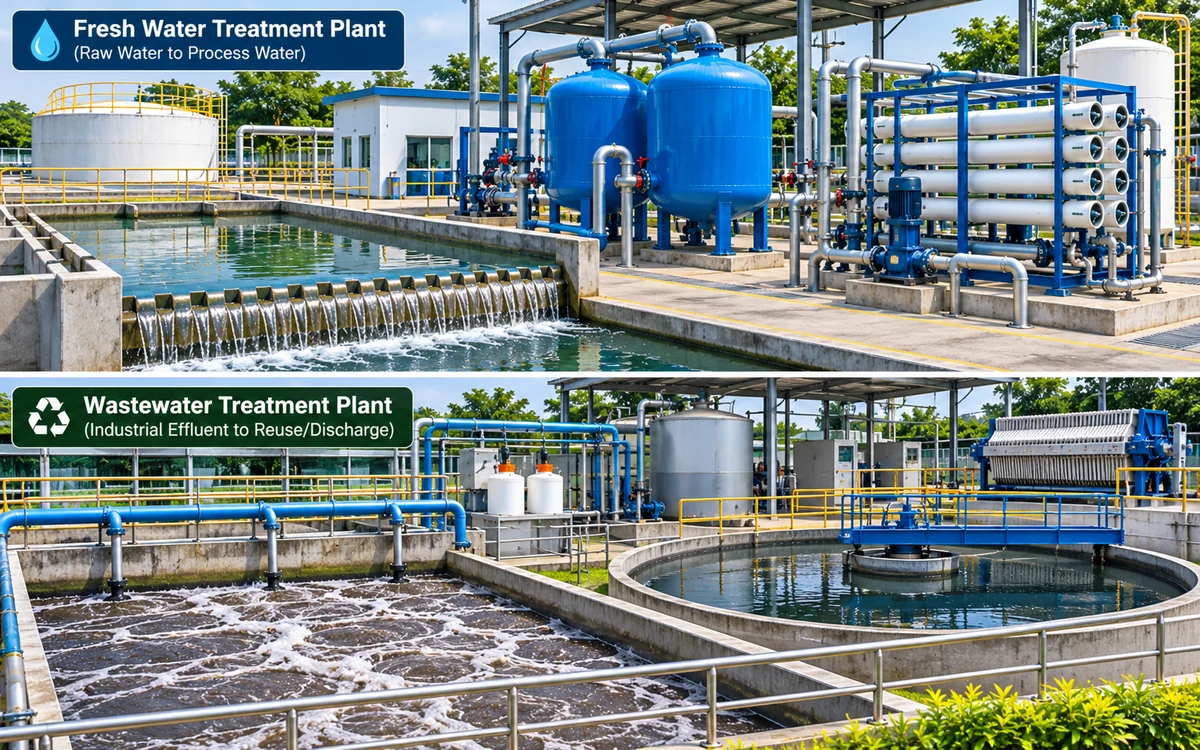
Industry uses two different treatment systems. People often mix them up, so it helps to separate them first.
| Plant | Also called | Job | Water goes |
|---|---|---|---|
| Water treatment plant (WTP) | Raw water plant, softening plant | Cleans incoming water so it is fit for machines and processes | From source (well, river) into the mill |
| Effluent treatment plant (ETP) | Wastewater plant | Cleans used water before it is released or reused | From the mill to the drain or back to the process |
Both use similar ideas. Both remove solids, adjust chemistry and kill germs. But the ETP faces dirtier and more complex water, with dyes, salts and chemicals mixed in. This article covers the general process and then looks at the textile case.
Why textile mills need treatment
Textile wet processing uses a lot of water. Depending on the fabric, the machine and the shade, a mill might use somewhere around 50 to 200 litres of water for each kilogram of fabric. The number varies widely, so use your own meter readings. Most of that water leaves as effluent that carries:
- Dyes and pigments, which colour the water
- Salt and alkali, used in reactive dyeing
- Sizing agents and starch, washed out in desizing
- Detergents and wetting agents
- Oils, waxes and natural impurities from the fibre
- Heavy metals in small amounts, from some dyes and mordants
- Heat, because baths are often hot
Untreated, this water has high BOD, COD, colour, pH and total dissolved solids. BOD stands for biochemical oxygen demand, which is how much oxygen microbes use to break down the waste. COD is chemical oxygen demand, a quicker test of how much oxygen the waste would use chemically. High values rob rivers of oxygen.
The water treatment plant process: main steps
The exact line-up changes with the source and the use, but most plants follow this order.
1. Screening
Water first passes through bar screens or fine screens. They catch rags, plastic, leaves, lint and fibre. In a textile ETP, a fine screen at the inlet saves the pumps and pipes from being blocked by yarn and cloth waste.
2. Equalisation
Dye houses release water in bursts. One hour it is hot, strong and alkaline. The next it is cool and mild. An equalisation tank holds the flow and mixes it with air or a mixer, so the later steps get a steady mix. It is often the most useful tank in a plant.
3. pH adjustment
Most treatment steps work best in a narrow pH range. Acid or alkali is dosed to bring the water to the target, usually near neutral for biology and around 6 to 7.5 for many coagulants. Textile effluent is often alkaline, so acid dosing is common.
4. Coagulation and flocculation
Fine particles and many dyes carry a small electric charge, and that keeps them floating apart. A coagulant such as alum (aluminium sulfate), ferric chloride or poly aluminium chloride (PAC) cancels the charge. In a fast-mix tank, the particles stick into tiny clumps. Then, in a slow-mix tank, a polymer flocculant is added and the clumps grow into larger, heavier flocs.
5. Sedimentation or flotation
The water enters a clarifier where flocs settle to the bottom as sludge. Clear water leaves from the top. In some plants, dissolved air flotation (DAF) is used instead. Tiny air bubbles lift the flocs to the surface where a scraper removes them. DAF works well for light, oily flocs.
6. Biological treatment
Microbes eat the dissolved organic matter that coagulation cannot remove. The most common method is the activated sludge process. Air is blown into an aeration tank where a mix of bacteria breaks down the waste. The mixture then flows to a secondary clarifier, where the biomass settles. Part of it returns to the aeration tank and the rest leaves as waste sludge. Other options include moving bed biofilm reactors (MBBR) and sequencing batch reactors (SBR).
7. Tertiary treatment
If the water must meet strict limits or be reused, more steps follow:
- Sand and carbon filters: Remove fine particles and some colour.
- Ozone or advanced oxidation: Breaks dye molecules into smaller pieces and removes colour.
- Activated carbon: Adsorbs remaining organics and dye.
- Membrane filtration: Ultrafiltration (UF) and reverse osmosis (RO) remove particles and dissolved salts.
8. Disinfection
Chlorine, ultraviolet light or ozone kills germs. For incoming process water this matters for health. For recycled water in a dye house, a light dose keeps slime from growing in the pipes.
9. Sludge handling
Every step above leaves sludge. It is thickened, then dewatered with a filter press or centrifuge, then dried. Sludge from a textile plant may carry dyes and metals, so it should be stored and disposed of as the local law requires. Never dump it on open land or in a canal.
The treatment train in one picture
Screen, then equalise, then adjust pH, then coagulate and flocculate, then settle, then treat biologically, then settle again, then filter, then disinfect. For reuse, add membranes at the end. Sludge from the settling steps goes to the dewatering unit.
Raw water treatment before it enters the mill
Incoming water has its own checks.
- Iron removal: Groundwater often carries iron that can stain white fabric. Aeration and filtration remove it.
- Softening: Hardness from calcium and magnesium forms scum with soap and spoils some dyes. Ion exchange resin softeners swap hardness ions for sodium.
- Filtration: Sand and cartridge filters stop suspended matter.
- Demineralisation or RO: Used where very pure water is needed, such as in boilers and some finishing steps.
Hardness matters in dyeing. A sequestering agent can hold the hardness ions in solution, but softened water is the cleaner fix.
Worked example 1: equalisation tank size
A dye house produces 1,000 cubic metres of effluent per day. The plant designer wants 8 hours of hold-up in the equalisation tank.
- Flow per hour = 1,000 ÷ 24 = 41.7 m³/h
- Tank volume = 41.7 × 8 = 333 m³
With a water depth of 4 metres, the tank floor area is 333 ÷ 4 = 83 m². A tank about 9 metres by 9 metres will do. Add some extra height for freeboard.
Worked example 2: coagulant dose
Jar tests in the lab show that 50 mg/L of alum gives the best colour and turbidity removal.
- Flow = 1,000 m³ per day = 1,000,000 litres per day
- Alum needed = 50 mg/L × 1,000,000 L = 50,000,000 mg = 50 kg per day
At 30 days a month, the plant uses about 1,500 kg of alum a month. If the lab finds that PAC at 25 mg/L works as well, the chemical use halves, and the sludge usually drops too. That is why jar tests are done before every change in dye or season.
Worked example 3: clarifier size
A settling tank works well if the water rises through it slowly enough for flocs to sink. Designers use a surface overflow rate, which is flow divided by surface area. Suppose the design rate is 20 m³ per m² per day.
- Area needed = 1,000 ÷ 20 = 50 m²
- For a round tank, area = π × r², so r = √(50 ÷ 3.14) = √15.9 = 4.0 m
- The diameter is about 8 metres.
Worked example 4: removal efficiency and reuse
The raw effluent has a BOD of 300 mg/L. After the biological stage, it is 30 mg/L.
- Removal = (300 − 30) ÷ 300 × 100 = 90 percent
Now the mill adds RO to reuse part of the water. The RO unit has a recovery of 75 percent. That means 75 percent of the feed becomes clean water, and 25 percent leaves as a salty reject.
- Feed = 800 m³ per day of treated effluent
- Clean water recovered = 800 × 0.75 = 600 m³ per day
- Reject = 800 − 600 = 200 m³ per day
Recovering 600 m³ a day means the mill buys 600 m³ less fresh water. The reject stream is salty and needs careful handling. Mills aiming for zero liquid discharge (ZLD) send reject to an evaporator and crystalliser, which cuts liquid discharge to nearly nothing but uses a lot of energy. Check the energy cost and your local law before choosing it.
Colour removal: the hard part
Colour is the toughest problem in textile effluent. Dyes are made to resist breakdown. Reactive dyes, especially, stay in the bath as hydrolysed dye that has not fixed to the fibre. Three routes help:
- Coagulation: Works well for disperse and sulfur dyes, less well for reactive and acid dyes.
- Oxidation: Ozone, Fenton’s reagent or hypochlorite break the colour-bearing parts of the dye molecule.
- Adsorption and membranes: Activated carbon and nanofiltration hold dyes back.
The best fix is to waste less dye in the first place. Right-first-time dyeing, lower liquor ratios and high-fixation dyes cut the load on the plant. Our articles on natural dyes and on reactive, disperse and vat dye selection can help you choose better.
Typical limits and testing
Countries set limits on pH, BOD, COD, suspended solids, colour, temperature and certain metals. These limits differ by country and change over time, so always read the current rule that applies to your site. Mills usually test:
| Test | What it shows |
|---|---|
| pH | Acid or alkaline |
| BOD and COD | Organic load |
| TSS | Suspended solids |
| TDS | Dissolved salts |
| Colour | Dye in the water |
| Temperature | Heat load |
| Oil and grease | Fibre oils, machine leaks |
| Heavy metals | Chromium, copper, zinc and others |
Brands also ask for wastewater test reports from their suppliers. Many mills keep daily logs for pH and flow, and weekly or monthly lab reports for the rest.
Running the plant well
A treatment plant fails less from bad design and more from poor daily care. These habits help:
- Check pH meters and flow meters on a schedule.
- Keep the aeration tank’s dissolved oxygen steady, often around 2 mg/L as a starting target.
- Watch the sludge. If it floats or smells, find out why.
- Keep spare dosing pumps, because a dead pump can stop the plant.
- Train operators to read the plant, not only the dials.
- Keep records so you can show a buyer or an inspector.
- Separate strong streams, such as caustic or very hot waste, so they can be treated or cooled before mixing.
Cost and benefits
A water treatment plant costs money to build and run. Power for aeration is often the largest running cost, followed by chemicals, sludge disposal and labour. But treatment pays back in several ways. It avoids fines and shutdowns, helps win orders from brands that demand clean supply chains, and cuts water bills when part of the water is reused. Many mills find that heat recovered from hot effluent also saves fuel.
Final thoughts
The water treatment plant process is a chain of simple ideas: catch the big things, even out the flow, make the small things clump, let them settle, let microbes eat the rest and polish the water if you want to reuse it. The best plants are built on good measurement and steady care. If you run or buy from a textile mill, ask for the numbers, from the litres used per kilogram of fabric to the test report on the final discharge. Clean water at the end of the pipe starts with careful choices at the dyeing machine.
Frequently asked questions
It is a series of steps that clean water by removing solids, chemicals and germs. The main steps are screening, coagulation, settling, filtration and disinfection.
A water treatment plant cleans incoming water for use. An effluent treatment plant cleans used wastewater before it is released or reused.
It carries dyes, salts, chemicals and heat, and many dyes are made to resist breakdown. Colour and dissolved salts are the hardest to remove.
Coagulation cancels the charge on tiny particles so they clump together. Flocculation then grows the clumps so they settle.
BOD means biochemical oxygen demand. It measures how much oxygen microbes need to break down the organic waste in water.
Yes, after proper treatment such as filtration and RO. Reuse cuts fresh water use, but the water must meet the quality that dyeing needs.
It is a system that recovers almost all water for reuse and leaves only solid waste. It needs evaporators and crystallisers and uses a lot of energy.