A finish that’s been the industry default for two decades doesn’t get replaced quickly, and water repellent finishing chemistry has been unusually slow to change given how effective PFAS-based formulations were at their job. That’s changing fast now, not because a better-performing alternative suddenly appeared, but because regulation has closed the door on the old chemistry faster than performance parity has fully caught up.
Why PFAS Dominated Water Repellent Finishing
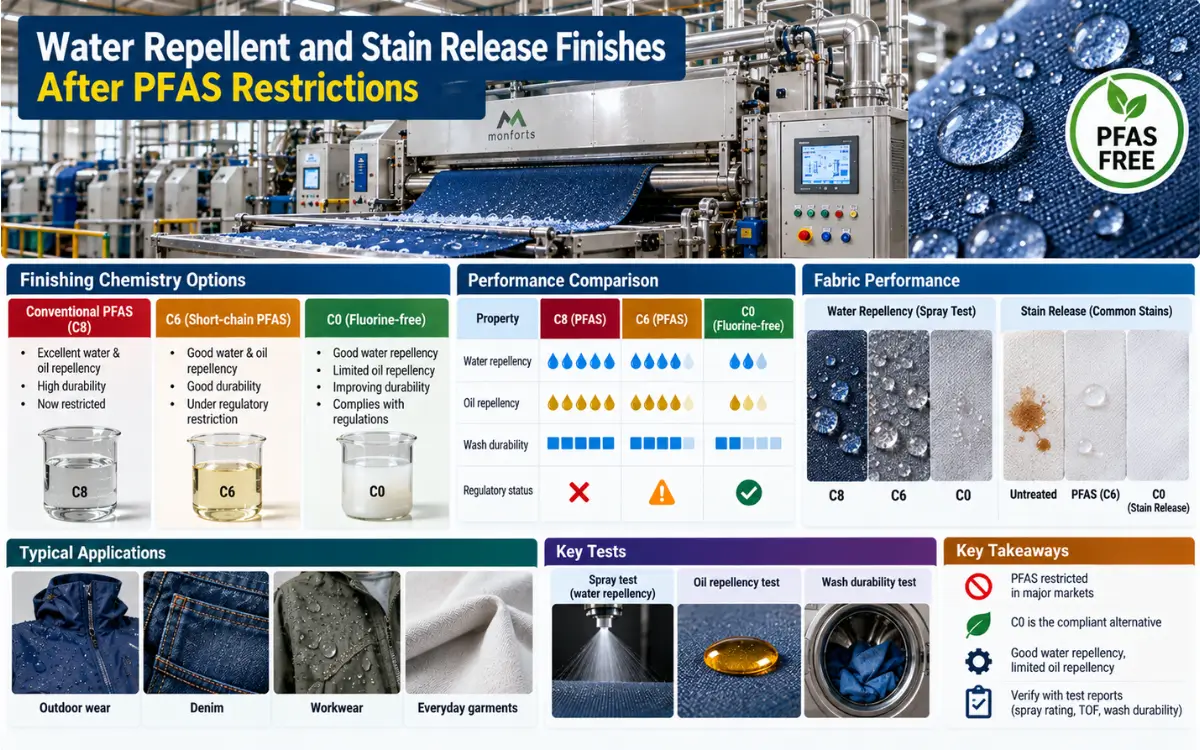
Fluorocarbon-based durable water repellent (DWR) chemistry earned its dominant position for a real reason: it delivers both water and oil repellency simultaneously, and it’s remarkably durable through repeated washing compared to most alternatives available at the time. Long-chain C8 chemistry was the original industry standard, offering the strongest performance but also the most persistent and bioaccumulative environmental profile, which is exactly what drew the earliest regulatory attention. C6 chemistry emerged as a shorter-chain replacement, preserving most of the oil repellency performance while reducing, though not eliminating, the environmental persistence concern.
Where Regulation Actually Stands
PFAS regulation in textiles has moved from a slow-building concern to active, enforced law in multiple jurisdictions. In the United States, California’s AB 1817 bans intentionally added PFAS in textile articles above a defined total organic fluorine threshold, with that threshold set to tighten further on a phased timeline. New York has enacted a similar in-force restriction on PFAS in apparel. Several additional US states have restrictions taking effect on their own timelines, and the pattern across US state-level regulation has consistently been toward tighter thresholds over time rather than looser ones.
In the European Union, PFHxA, the substance C6 chemistry breaks down into, is subject to a restriction under REACH, and a broader EU-wide restriction covering the wider PFAS family as a group, rather than substance by substance, has moved through formal evaluation and adoption stages. Beyond government regulation, industry compliance programs like bluesign have moved to restrict PFAS in approved materials on their own timeline, which functions as a de facto market requirement for suppliers serving brands that require bluesign approval regardless of what government regulation technically requires in a given market.
Given how quickly this regulatory landscape has moved and continues to move, any supplier or buyer making a compliance decision should verify current requirements against the specific regulation text for their target market rather than relying on a general summary, since thresholds and effective dates have changed more than once already and are likely to keep evolving.
C6 Versus C0: What Actually Changes in Performance
C6 chemistry remains a PFAS-based fluorocarbon finish, delivering strong combined water and oil repellency with good wash durability, but it’s now a chemistry under active and expanding regulatory restriction rather than a stable long-term option, particularly for products destined for markets with in-force or upcoming bans.
C0 chemistry, entirely fluorine-free, relies on non-fluorinated polymer systems, commonly silicone, hydrocarbon-based, or dendrimer chemistry, to achieve water repellency. Water repellency performance under C0 systems has improved considerably and is now considered broadly comparable to fluorinated alternatives for many applications. Oil and stain repellency remains the harder problem: fluorine’s molecular structure is unusually effective at repelling oil in a way non-fluorinated chemistry hasn’t yet fully replicated, so C0 finishes generally offer weaker oil repellency than C6, a gap that matters more for some product categories (workwear exposed to oils and industrial fluids, food service uniforms) than others (general outerwear, everyday rainwear).
Wash durability is a further consideration. Fluorine-free DWR finishes have historically shown somewhat lower durability through repeated laundering compared to fluorinated finishes, though this gap has also narrowed with newer C0 formulations. Products transitioning to C0 finishing sometimes need updated care instructions, recommending lower wash temperatures or periodic reproofing, to help close the durability gap through proper garment care rather than through the finish chemistry alone.
What Buyers Are Now Asking Suppliers to Prove
The shift away from PFAS has changed what documentation buyers expect from finishing chemical suppliers and from mills applying these finishes. A simple product claim of “PFAS-free” is no longer sufficient for most serious buyers, who increasingly expect third-party test data confirming total organic fluorine content below the relevant regulatory or brand-specific threshold, using a recognized test method. Test methodology itself matters here, since testing standards for PFAS content have themselves been updated, and a test report using an outdated extraction method may not satisfy current compliance declarations even if the underlying finish genuinely is PFAS-free.
Beyond fluorine content testing, buyers sourcing for markets with functional performance requirements (technical outerwear brands, workwear specifiers) increasingly ask for actual performance data on the specific C0 formulation in use: spray rating test results for water repellency, and where oil resistance is genuinely required, whatever oil repellency data the supplier can provide, since C0 performance varies more between specific formulations than C6 performance historically did.
Standard Tests Worth Understanding
The spray rating test evaluates a fabric’s water repellency by applying a controlled spray pattern and rating how well the surface beads and sheds water rather than wetting through, on a standard numerical scale. The hydrostatic head test measures the water pressure a fabric can withstand before water penetrates, relevant for products with genuine waterproofing requirements beyond surface repellency alone, like technical outerwear membranes. Both tests are typically run before and after a specified number of wash cycles to evaluate durability, not just initial performance, since a finish that performs well only when new isn’t meeting a durable water repellent product’s actual functional promise.
A Worked Example: Weighing the Switch Cost
Consider a mill currently running C6 finish at an illustrative cost of $3.50 per kilogram of fabric treated, serving a buyer base split 60 percent EU and US market destined, where PFAS restriction exposure is real and growing, and 40 percent markets without current restriction. A qualified C0 alternative costs an illustrative $4.20 per kilogram, a $0.70 per kilogram premium, but eliminates the compliance risk entirely for the EU and US-destined 60 percent of production.
On pure per-kilogram cost, switching fully to C0 costs an additional $0.70 per kilogram across all production. But the alternative, continuing C6 only for the non-restricted 40 percent while switching the EU and US-destined 60 percent, requires running two separate finishing recipes in parallel, adding real production complexity, batch tracking risk (a C6-finished batch mistakenly shipped to a restricted market creates genuine compliance exposure), and the ongoing cost of maintaining two qualified recipes rather than one. Many mills conclude that a single, fully converted C0 recipe, despite its higher per-kilogram cost, is worth the premium purely to eliminate the operational complexity and compliance risk of running two parallel systems, treating the \$0.70 per kilogram gap as a manageable cost of simplification rather than trying to optimize cost by market segment. Run this comparison with your own actual quoted costs and buyer market mix before deciding which path fits your specific situation.
Interpreting Test Results Correctly
A total organic fluorine (TOF) test result needs interpretation against the specific regulatory threshold it’s being compared to, and this is a step worth understanding rather than treating a lab report as a simple pass or fail on its own. Different jurisdictions and different buyer standards set different threshold levels, and a result that clears one market’s threshold may not clear another’s stricter limit, which means a single test report doesn’t necessarily answer the compliance question for every market a mill’s fabric might ship to. Mills serving multiple markets with different PFAS thresholds need to evaluate test results against the strictest applicable threshold across their actual buyer and market mix, rather than the most lenient one, if a single finish is meant to serve all of those markets without market-specific formulation variants.
It’s also worth understanding the difference between a screening-level test, often faster and less expensive, and a full quantitative analytical test capable of detecting down to a specific low threshold. A screening test is often adequate for routine ongoing verification once a formulation has been fully qualified through more rigorous initial testing, but relying on screening-level testing alone for initial qualification of a new PFAS-free finish risks missing a low-level contamination that a full quantitative test would catch, which matters given how tight some of the newer regulatory thresholds have become.
For mills and finishers currently running C6 or older fluorochemistry, the practical path forward involves qualifying C0 alternatives now rather than waiting for a specific regulatory deadline to force the change, since qualification, testing, adjusting process parameters, and building buyer confidence in the new chemistry’s performance, takes real time that’s better spent ahead of a hard compliance deadline than scrambling against one. For product categories where oil repellency remains a genuine functional requirement, tracking the ongoing development of PFAS-free oil-repellent chemistry is worth doing directly with chemical suppliers, since this remains an active area of formulation development rather than a fully solved problem, and new options are entering the market on a rolling basis rather than through a single clean transition point.
Communicating the Change to Buyers
Beyond the technical qualification work covered above, mills transitioning to C0 chemistry benefit from proactively communicating that transition to buyers, rather than waiting for a buyer’s own testing to discover a formulation change on a product they may already have approved under the old chemistry. Buyers generally respond well to a mill demonstrating it’s ahead of regulatory requirements rather than reactively scrambling to meet them, and a mill that can present its own testing data and Gateway or bluesign documentation proactively, alongside a clear explanation of any performance trade-offs a specific C0 formulation carries, builds the kind of trust that pays off well beyond this specific chemistry transition.
Frequently Asked Questions
Is C6 water repellent finish now banned everywhere?
Not universally, but it’s under active and expanding restriction across California, New York, several other US states, and the EU, with thresholds generally tightening over time rather than loosening.
How does C0 finish performance compare to C6?
Water repellency is now broadly comparable, but oil and stain repellency generally remains weaker under C0 chemistry, since fluorine is unusually effective at repelling oil in a way non-fluorinated alternatives haven’t fully replicated yet.
What should a mill ask a supplier to prove PFAS-free claims?
Third-party test data confirming total organic fluorine content below the relevant threshold, using a current, recognized test method, not just a marketing claim of “PFAS-free” on a product data sheet.
Should a mill switch to C0 chemistry before it’s legally required to?
Generally yes. Qualification, testing, and building buyer confidence in new chemistry takes real time, and starting that process ahead of a hard compliance deadline avoids a rushed scramble later.