A poorly fused collar doesn’t announce itself on the cutting table or even at final inspection. It shows up weeks later, after a customer’s first wash, as bubbling or a soft, lifeless collar that’s lost its structure. By then the garment is long gone and the return is expensive. Getting fusing settings right the first time matters more than almost any other single setting on the sewing floor, precisely because fusing defects are so slow to surface.
What a Fusing Machine Actually Does
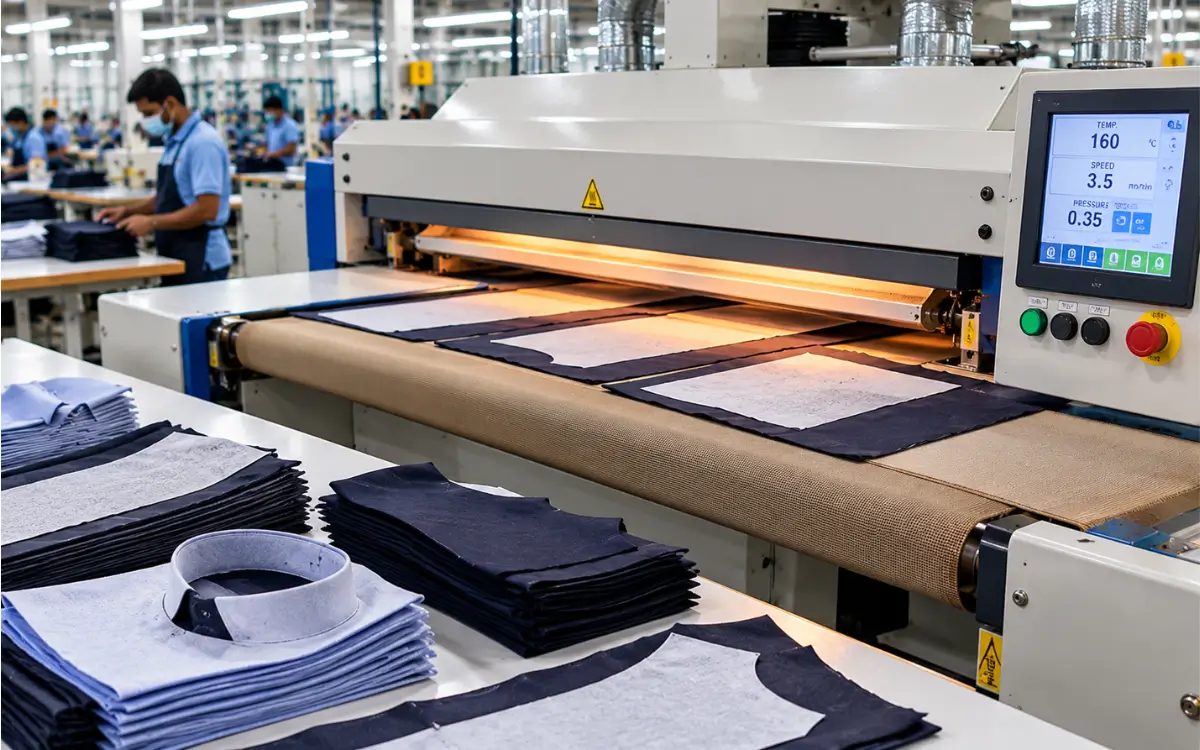
A continuous fusing machine bonds interlining to fabric using a combination of heat, pressure, and dwell time, and this fusing process quality inspection guide covers the inspection side of this process in more depth as the fabric-interlining sandwich passes between heated rollers or plates on a conveyor belt. The interlining’s adhesive coating melts under heat and bonds to the base fabric under pressure, and dwell time, how long the fabric spends in the heated zone, determines how completely that bond forms before the fabric exits and cools.
Get any one of these three variables wrong and the bond either fails to form properly (too little heat, pressure, or time) or damages the fabric and interlining (too much of any of them, particularly heat, which can scorch delicate fabrics or over-melt adhesive past the point where it bonds cleanly).
Selecting a Fusing Machine
Machine selection depends primarily on production volume and the range of fabrics a factory runs. Smaller operations or those running low fusing volume sometimes use flatbed fusing presses, which handle one panel at a time and offer more direct control over pressure distribution, useful for smaller-batch or sample work. Higher-volume operations need continuous fusing machines, which process panels in a constant flow and offer far higher throughput, at the cost of somewhat less granular control per individual panel compared to a flatbed press.
Belt width and the number of heating zones also matter for selection. A wider belt accommodates larger panels or higher throughput per pass, and multiple independently controlled heating zones let a factory run different temperature profiles for different fabric types without a full machine changeover between styles.
Setting Temperature, Time and Pressure for Wovens
Woven fabrics generally tolerate higher fusing temperatures than knits, since the tighter, more stable weave structure is less prone to distortion under heat and pressure. Typical woven fusing runs at higher temperature with moderate dwell time, though the exact figures depend entirely on the specific interlining adhesive type and the fabric’s heat sensitivity, which is why interlining suppliers provide recommended fusing parameters that should be treated as the starting point for any new fabric-interlining combination, not a universal constant.
Setting Temperature, Time and Pressure for Knits
Knit fabrics are more heat-sensitive and more prone to distortion under pressure than wovens, given their looser, more elastic structure. Fusing settings for knits typically run at somewhat lower temperature with adjusted pressure to avoid stretching or permanently marking the fabric surface, and dwell time sometimes needs to increase slightly to compensate for the lower temperature while still achieving a complete bond.
The real risk with knits isn’t just an incomplete bond. Excess pressure on a knit fabric during fusing can leave a permanent surface impression or distort the fabric’s stretch recovery in the fused area, which shows up as a stiffer, less flexible panel that behaves differently from the rest of the unfused garment.
Illustrative Starting Parameters
The table below gives illustrative starting points for a first settings trial, useful as a rough reference before consulting the specific interlining supplier’s data sheet, which should always take precedence over generic figures like these once available.
| Fabric Type | Starting Temperature | Starting Dwell Time | Starting Pressure |
|---|---|---|---|
| Woven, medium weight (cotton/poly blend) | Moderate-high | Standard | Medium-high |
| Woven, lightweight (shirting) | Moderate | Shorter | Medium |
| Knit, mid-weight jersey | Moderate | Standard, slightly extended | Medium, reduced from woven |
| Knit, lightweight or delicate | Lower | Extended | Light |
Treat every cell in this table as a starting point for a trial, not a setting to run in full production without verification. The bond strength and wash testing covered below is what actually confirms whether a given starting point, adjusted from this table or taken directly from a supplier’s data sheet, is producing an acceptable result on the specific fabric-interlining combination in front of you.
Standard Bond Strength and Quality Tests
Fusing quality gets verified through a handful of standard tests rather than visual inspection alone, since a bond that looks fine immediately after fusing can still fail after washing. A peel bond strength test measures the force needed to separate the interlining from the base fabric, giving a quantifiable pass or fail threshold rather than a subjective judgment. Wash testing, running fused samples through the garment’s intended wash and care cycle before full production begins, catches delamination issues that wouldn’t show up in a same-day bond test. Visual inspection for strike-through, where adhesive melts through to the fabric face and creates a visible shine or stiffness, and for bubbling, where an incomplete bond leaves air pockets between fabric and interlining, rounds out a proper fusing quality check.
Getting New Fabric-Interlining Combinations Right
Every new fabric or interlining entering production deserves a settings trial before full production runs, rather than assuming previous settings for a “similar” fabric will transfer cleanly. Run a small batch at the interlining supplier’s recommended starting parameters, test bond strength and wash performance, and adjust incrementally from there. The time this trial takes is small compared to the cost of a full production run discovered to have delamination problems after the fact, when the fabric has already been cut, sewn, and often shipped.
Frequently Asked Questions
What causes bubbling in a fused collar after washing?
Usually an incomplete bond from insufficient heat, pressure, or dwell time during fusing, which doesn’t show up until the garment is later stressed by washing and wear, not at the point of fusing itself.
Do knit and woven fabrics need different fusing settings?
Yes. Knits generally need lower temperature and adjusted pressure than wovens to avoid distortion or permanent surface marking, given their looser, more elastic structure.
How do I know if a new fabric-interlining combination needs a fresh trial?
Any new fabric or interlining entering production deserves its own trial rather than assuming a previous similar fabric’s settings will transfer, since bond performance varies enough between combinations that skipping this step risks a full production run with a defect that only shows up after the first wash.
What test actually confirms a fusing bond is strong enough?
A peel bond strength test gives a quantifiable pass or fail threshold, and wash testing on a sample run through the garment’s intended care cycle catches delamination issues a same-day bond check wouldn’t reveal.