I still remember standing in a fitting room years ago, holding three pairs of pants that looked nearly identical on the hanger. One pinched at the waist. One pooled around my ankles like I was borrowing my dad’s suit. The third — finally — just worked. Same size label, three completely different garments. If that scene feels familiar, you’ve already learned the hard way that “pants are pants” isn’t quite true.
The cut, fabric, and rise of a trouser change everything about how an outfit looks and moves, and once you know what separates one style from another, shopping stops being a guessing game. This guide walks through how trousers are classified, the fits worth knowing by name, the most common styles for both men and women, and the fit and fabric details that actually matter when you shop. Whether you’re rebuilding your closet from scratch or just trying to figure out what to wear this weekend, having a clear picture of your options makes the whole process a lot simpler.
Pants vs. Trousers: What’s the Difference?
The two words often get used interchangeably, but there’s a subtle distinction worth knowing. “Pants” is the broad, everyday term for any lower-body garment with separate legs. “Trousers” usually points to something more structured and tailored — dress pants, suiting, workwear. So while all trousers are technically pants, not all pants are trousers: jeans and joggers, for instance, are pants but rarely get called trousers in casual conversation.
With that cleared up, let’s get into the styles.
Why Understanding Trouser Types Actually Matters
It’s tempting to think one pair of black pants covers every situation. In practice, the wrong cut can make a great shirt look sloppy, while the right one turns a basic tee into a finished outfit. There’s also a practical, money-saving argument here: instead of buying pants that “sort of” work for everything, a few well-chosen, purpose-built pairs end up doing more for less — because each one is actually suited to the occasion it’s worn for, rather than being a compromise.
Below, the styles are split into men’s and women’s, since sizing conventions and naming differ slightly between the two — though several of these cuts (wide-leg, joggers, cropped) work well regardless of who’s wearing them. Think of this as a reference to come back to before you shop, so you walk in knowing exactly what to look for instead of relying on a salesperson’s best guess.
How Trousers Are Classified
Before getting into individual styles, it helps to know the handful of factors that actually define a pair of trousers. Most style names are really just shorthand for a combination of these traits.
By Occasion
Trousers generally fall into four occasion categories: formal (suiting, tuxedo trousers), business casual (dress trousers, chinos), everyday casual (jeans, cargo pants), and athletic or loungewear (joggers, track pants). Many styles can shift categories depending on fabric and fit — a wool-blend jogger, for example, can edge into business-casual territory in a way a mesh athletic jogger can’t.
By Rise
“Rise” refers to the distance between the crotch seam and the waistband. Low-rise sits below the natural waist, mid-rise sits at or slightly below it, and high-rise sits at or above the natural waistline (roughly level with the belly button). Rise affects comfort, silhouette, and how a top tucks in, often more than the leg cut does.
By Fit
Fit describes how the fabric moves from hip to hem — slim, straight, tapered, relaxed, wide-leg, bootcut, or flared. Because fit is its own detailed topic, it gets a full breakdown in the next section.
By Fabric and Construction
Beyond cut, construction details change how trousers perform and look. Flat-front vs. pleated changes how the fabric sits through the hip and thigh. Cuffed vs. uncuffed hems change the visual weight at the ankle. Stretch-blend vs. rigid fabric changes comfort and how well the garment holds its shape over a day of wear. Lined vs. unlined affects warmth and structure, especially in wool trousers.
Trouser Fits Explained
“Fit” and “style” get used interchangeably, but they’re not quite the same thing — a chino can come in a slim fit or a relaxed fit, for example. Here’s what each fit term actually means.
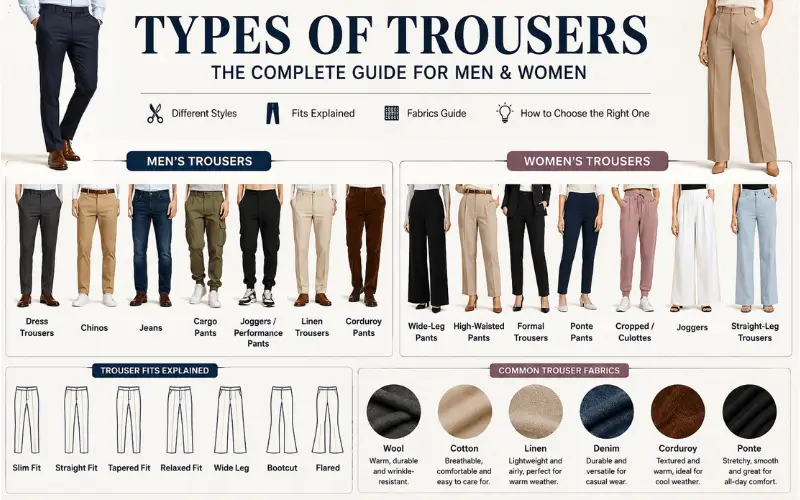
Slim Fit
A close, streamlined cut through the hip, thigh, and leg without being restrictive. Slim fit works well for a tailored, modern look but requires more attention to sizing, since there’s less room to compensate for a slightly-off measurement.
Straight Fit
Consistent width from hip to hem with no taper or flare. This is the most broadly wearable fit on this list — it’s forgiving through the leg and works across nearly every trouser style, from jeans to dress trousers.
Tapered Fit
Fuller through the hip and thigh, then narrowing toward the ankle. Tapered fits give a modern silhouette while still leaving room to move, which is why they’re common in chinos and cargo pants.
Relaxed Fit
Extra room throughout the hip, thigh, and leg for maximum comfort and movement. Relaxed fits work well for casual and athletic contexts but can read as sloppy in formal settings if the fabric is too soft or the hem too long.
Wide-Leg Fit
Significant width from hip to hem that stays roomy rather than narrowing. Wide-leg trousers rely on fabric drape more than tailoring for their shape, which is why fabric choice matters more here than in most other fits.
Bootcut
A fit that stays close through the hip and thigh, then flares slightly from the knee down — originally designed to fit over boots. It’s a subtler flare than a true flared pant, and it tends to be one of the more versatile options for balancing proportions.
Flared
A more dramatic version of bootcut, where the leg widens noticeably from the knee or thigh down to the hem. Flared trousers are a strong style statement rather than a neutral, everyday choice, and they tend to work best with a fitted top to balance the silhouette.
Types of Trousers for Men
1. Dress Trousers
The classic go-to for office days, interviews, and formal events. Dress trousers are tailored with clean lines, a flat or pleated front, and a structured fabric like wool or wool-blend, usually in the 9–12 oz weight range — heavy enough to hold a crease, light enough not to feel stiff. The flat-front version gives a slimmer, more modern silhouette, while pleated styles offer more room through the thigh and a slightly more traditional look. One detail worth checking before buying: the break at the ankle. A slight break (where the hem just touches the top of the shoe) is generally considered more modern and tailored, while a full break bunching over the shoe tends to look dated by current style standards. Pair them with a button-down and loafers for an easy business-casual look, or dress them up further with a blazer for client meetings and interviews.
2. Chinos
Chinos are the sweet spot between formal and casual. Made from cotton twill, they’re straight or slightly tapered, and they work just as well with a blazer as they do with a t-shirt. They come in a wider range of colors than dress trousers — navy, khaki, olive, and even burgundy — which makes them easy to mix into a rotation without feeling repetitive. A common mistake is sizing chinos too loose in the waist since the fabric has minimal stretch; if you’re between sizes, size down and let a tailor take in the leg rather than living with a gapping waistband. Chinos are a reliable starting point if you’re building out a “smart casual” wardrobe from scratch.
3. Jeans
One of the most-worn pants in most men’s closets, and for good reason: they go with almost everything. A dark, straight-leg or slim-fit pair tends to be one of the more versatile options — good for weekend errands, a casual Friday, or a night out with a bold tee. Raw or dark-wash denim tends to look more polished, while lighter washes and distressed styles lean more casual and weekend-focused.
4. Cargo Pants
Recognizable by their patch pockets, cargo pants have shifted from purely functional wear to a legitimate style statement. Modern cuts come tapered or slim, so they no longer read as “baggy” by default. They’re a great option when you want a look with a bit more edge than chinos but still want something wearable outside of a purely athletic context.
5. Joggers / Performance Pants
Built with stretch fabric, elastic hems, and moisture-wicking material, joggers blend comfort with a put-together look — well suited to travel days or elevated athleisure. The best modern joggers are cut slim enough that they don’t scream “gym,” making them a solid choice for errands, casual Fridays, or light travel days when comfort matters more than formality.
6. Linen Trousers
The warm-weather MVP. Linen’s loose weave keeps you cool during summer events, and a little wrinkling is part of the charm — it’s meant to look relaxed, not pressed to perfection. Pair sand or soft blue linen trousers with a camp-collar shirt for an easy summer outfit, whether that’s a beach wedding or a warm-weather dinner out.
7. Corduroy Pants
A textured cousin of chinos, corduroy pants add visual interest through their ribbed fabric while still functioning as an everyday casual pant. They’re especially popular in fall and winter, pairing well with sweaters, flannels, and boots.
Types of Trousers for Women
1. Wide-Leg Pants
A wardrobe favorite for good reason — wide-leg trousers offer comfort and movement while still looking polished. Depending on the fabric, they can go from a casual daytime look to a dressed-up evening one. A flowy, lightweight wide-leg pant works well for summer, while a structured wool version can anchor a fall or winter outfit just as well as a skirt or dress would. The detail that makes or breaks this style is hem length: wide-leg trousers should just skim the top of the shoe, since too much extra fabric pooling at the ankle can shorten the leg line rather than elongate it.
2. High-Waisted Pants
High-waisted styles are loved for how they define the waist and elongate the leg line. They work across nearly every other category on this list, from jeans to trousers to joggers, which makes “high-waisted” more of a fit descriptor than a standalone style. A quick way to check the rise before buying: the waistband should sit at or above the natural waistline, not below it — anything lower is technically mid-rise, even if it’s marketed as high-waisted. High-waisted is a popular starting point if you’re unsure where to begin, though the most flattering rise ultimately comes down to personal preference and body shape.
3. Formal Trousers
Tailored, structured, and built for the office or dressier occasions. Clean lines and a polished fabric make these a staple for professional wardrobes. Look for a slight taper at the ankle for a modern silhouette, or a straight-leg cut for a more classic, timeless look that pairs well with blazers and structured tops.
4. Ponte Pants
Made from a stretch-knit fabric, ponte pants offer the comfort of leggings with the structure of trousers — ideal for travel days or work-from-home looks that still need to look “finished.” They hold their shape better than leggings and often come tailored with a slight bootcut or straight-leg silhouette, so they read as “pants” rather than athleisure.
5. Cropped Trousers / Culottes
Hitting at or above the ankle, cropped trousers and culottes are a warm-weather staple that pair well with flats, sandals, or sneakers. They’re a great option if you want a trouser silhouette without the extra fabric around your ankles. Culottes in particular have a wider, skirt-like flare, while cropped trousers tend to keep a slimmer, more tailored line.
6. Jogger Pants
Just like the men’s version, women’s joggers combine an elasticized hem with comfort-driven fabric — a relaxed option that still feels intentional rather than sloppy. Look for joggers with a tapered ankle and a slightly higher rise if you want the look to read more “elevated casual” than “loungewear.”
7. Palazzo Pants
Flowy and dramatic, palazzo pants are wide from hip to hem and often made from lightweight, breathable fabric. They’re a favorite for summer events and vacations, offering the comfort of a maxi skirt with the practicality of pants.
8. Straight-Leg Pants
A no-fuss, broadly wearable cut that runs the same width from hip to hem. Straight-leg pants work in nearly any fabric — denim, cotton twill, or wool — making them one of the more versatile silhouettes on this list.
Other Notable Trouser Styles
A handful of additional styles come up often enough to be worth knowing, even if they’re less common as everyday staples.
Capri Pants
Cropped between the knee and ankle, capris sit shorter than cropped trousers and are typically more fitted through the leg. They’re a warm-weather option that splits the difference between shorts and full-length pants.
Harem Pants
Defined by a dropped crotch and a fabric that gathers before tapering at the ankle, harem pants prioritize movement and comfort over structure. They’re common in loungewear and in styles influenced by South and Southeast Asian dress.
Track Pants / Sweatpants
Distinct from joggers, traditional track pants and sweatpants typically have a looser, straighter leg with a drawstring waist, often without the tapered, elastic-hem shaping joggers have. They lean more purely athletic or loungewear than joggers, which are usually cut with a more finished silhouette.
Carpenter Pants
A workwear style built with a hammer loop, reinforced knees, and extra utility pockets along the thigh. Originally functional for tradespeople, carpenter pants have also cycled through as a streetwear staple.
Overalls / Dungarees
Trousers with an attached bib and shoulder straps, traditionally workwear but also worn as a standalone casual outfit over a t-shirt or sweater.
Tuxedo Trousers
Formal trousers finished with a satin or grosgrain stripe down the outer seam, worn as part of formalwear or black-tie outfits. They’re a more specific subset of formal trousers, reserved for the most dressed-up occasions.
A Quick Guide to Trouser Fabrics
The fabric a pair of trousers is made from affects everything from how formal they look to how they hold up over time.
| Fabric | Feel & Structure | Best For |
| Wool & Wool-Blend | Warm, structured, holds a crease | Cooler months, formal settings |
| Cotton Twill | Breathable, casual, slight sheen | Everyday chinos, smart-casual |
| Linen | Lightweight, breathable, wrinkles easily | Hot weather |
| Denim | Durable, ranges from stiff to stretch-blend | Everyday casual wear |
| Ponte Knit | Stretch-knit, holds its shape well | Travel, work-from-home |
| Corduroy | Textured, ribbed cotton | Fall and winter casual wear |
Knowing the fabric behind a style helps you predict not just how it’ll look, but how it’ll perform — whether that’s breathability in summer heat or durability for everyday wear.
Common Fit Mistakes Worth Avoiding
A few issues come up again and again, regardless of style:
- Buying by waist size alone. Two pairs labeled the same size can fit completely differently depending on rise, fabric stretch, and cut. Try before you commit whenever possible, or check a brand’s specific size chart rather than assuming sizing is consistent across labels.
- Ignoring the rise. Low, mid, and high rise change how a pant sits relative to your natural waist — and that single measurement affects comfort and silhouette more than almost anything else on this list.
- Skipping tailoring. A small hem or waist adjustment can transform an off-the-rack pair into something that looks custom-fit. Many fit complaints about trousers are actually length or waist issues a tailor can fix in a day.
- Choosing fabric based on looks alone. A linen trouser that looks great in a product photo will wrinkle within an hour of sitting. Match the fabric to how you’ll actually use the pants, not just how they photograph.
How to Choose the Right Trousers for You
A few quick questions to narrow it down:
- What’s the occasion? Office and formal events call for dress trousers or tailored formal pants. Weekends lean toward jeans, joggers, or cargo pants.
- What’s the weather? Linen and lightweight cotton chinos breathe better in summer; wool-blend dress trousers hold up better in cooler months.
- What fit flatters you? High-waisted and wide-leg styles tend to elongate the leg line for many people, while slim or tapered cuts create a more streamlined silhouette — though the right fit ultimately comes down to personal preference.
- How much stretch do you need? If you’re sitting for long stretches at a desk or traveling, ponte knit, joggers, or stretch-blend chinos will likely feel more comfortable than rigid wool or denim.
- What’s your build? Straight and wide-leg cuts tend to balance proportions for a wide range of body types, while slim and tapered styles work well for those who want a closer, more streamlined fit through the leg.
Trouser Care Tips
Once you’ve built out a solid trouser rotation, a little care goes a long way:
- Wool and wool-blend trousers should be dry-cleaned or steamed rather than machine washed, to avoid shrinking or losing their shape.
- Cotton chinos and jeans can be machine washed on cold and hung to dry, which helps them keep their color and structure longer.
- Linen benefits from a gentle wash cycle and air drying — skip the dryer’s high heat, which can cause excessive wrinkling and shrinkage.
- Ponte knit and performance fabrics typically do well in a cold, gentle wash cycle, but always check the care label since blends vary.
Frequently Asked Questions
Are chinos and khakis the same thing?
Mostly, yes — “khakis” often refers specifically to the tan-colored version of chinos, while “chinos” is the broader term covering the style in any color.
What’s the difference between wide-leg and palazzo pants?
Wide-leg pants maintain a consistent width from hip to hem, while palazzo pants flare out even more dramatically and are typically made from lighter, more flowing fabric.
Can joggers be worn in a business-casual setting?
Tailored, slim-cut joggers in a matte fabric (rather than shiny athletic material) can work in relaxed business-casual environments, especially when paired with a blazer or structured top. Traditional sweatpant-style joggers are best kept casual.
What’s the difference between trousers and slacks?
“Slacks” is largely a synonym for casual-to-dressy trousers, most often used for flat-front or pleated pants worn in business-casual settings. There’s no strict technical difference — it’s mostly a regional and generational naming preference.
Are jeans considered a type of trousers?
In everyday conversation, jeans are usually called “jeans” or “pants” rather than “trousers,” since “trousers” tends to imply a more tailored, structured garment. Technically, though, jeans do fit the broader definition of trousers as a separate-legged lower-body garment.
What’s the difference between bootcut and flared trousers?
Bootcut trousers stay close through the hip and thigh with only a slight flare from the knee down, while flared trousers widen more dramatically, often starting higher up the leg. Bootcut is generally the more subtle, everyday-wearable version of the two.
What’s the difference between capri pants and cropped trousers?
Capri pants typically hit between the knee and mid-calf and are more fitted through the leg, while cropped trousers usually end closer to the ankle and follow the silhouette of a full-length pant that’s simply been shortened.
Final Thoughts
You don’t need a closet full of every style listed here — just a few well-chosen pairs that cover your regular occasions: something tailored for work, something casual for weekends, and something comfortable for in-between days. Once you know the names, the fit details, and the fabric trade-offs, shopping for trousers stops being trial and error.
Start by taking stock of what you already own, then fill in the gaps based on the occasions you actually dress for most often — not the ones you’re shopping for aspirationally. The fitting-room lesson from the start of this guide holds true no matter how many pairs you own: fit, not size on the label, is what actually makes a pair of trousers work. A well-rounded rotation isn’t about owning the most pairs — it’s about owning the right ones for how you really live, work, and spend your time.