That drawer full of old band tees, race shirts, and college merch isn’t just clutter. It’s raw material for something you’ll actually keep. A t-shirt quilt takes garments you can’t bring yourself to donate and turns them into a blanket that tells your story.
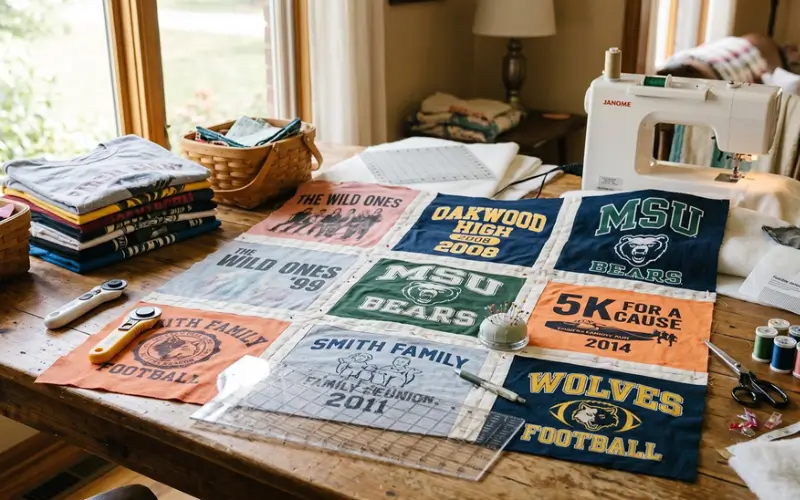
This guide covers what a t-shirt quilt actually is, how to make one, what materials matter, and how much it costs to hire a pro instead.
What is a T-Shirt Quilt?
A t-shirt quilt is a keepsake quilt made by cutting the graphic panels off old t-shirts and sewing them into a quilted blanket. Simply put, it’s wearable memories transformed into something you can wrap yourself in.
Traditional quilts start with yardage, which is fabric bought specifically for the project. T-shirt quilts work backward. The fabric already exists and already has meaning, so the design has to work around it. One is built from intention, the other from memory.
The process is practically simple. It relies on basic patchwork construction. Each shirt’s front graphic, and sometimes the back, gets cut into a block. Blocks get arranged, sewn together, layered with batting and backing, then quilted and bound. The result preserves dozens of shirts that would otherwise sit in a closet or end up in a landfill.
Types of T-Shirt Quilts
There are two main styles, and the right one depends on your shirts and your skill level.
● Traditional (Sampler Style)
This is the beginner-friendly approach where all blocks are first cut to a uniform size, typically 12 to 15 inches square. Sashing, or strips of fabric between blocks, frames each shirt and gives the quilt a clean, grid-like look. Interfacing stabilizes the stretchy knit before cutting. This style forgives mismatched shirt sizes since everything trims to the same block dimension.
● Puzzle / Mosaic Style
This is the advanced option where block sizes vary based on each shirt’s graphic, fitted together like a puzzle with no sashing between them. The visual effect is more dynamic and modern, but it needs more planning. Cutting irregular shapes that still fit together cleanly takes practice, and the lack of sashing means seams have to be precise from the start.
How to Make a T-Shirt Quilt (Step-by-Step Guide)
Here’s the full process from raw t-shirts to finished quilt.
Supplies checklist:
- Customized t-shirts in bulk (8 to 30, depending on quilt size)
- Fusible interfacing (Pellon brand recommended)
- Rotary cutter and quilting ruler
- Sewing machine with a ballpoint or stretch needle
- Batting (cotton or cotton-poly blend)
- Backing fabric
- Pins and quilting thread
Step-by-step process:
- Wash all shirts: Skip fabric softener as it could leave residue that blocks interfacing from bonding.
- Plan your layout: Group shirts by color, story, or timeline before cutting.
- Apply interfacing: Fuse it to each graphic panel while the shirt is whole, to stabilize the knit before cutting.
- Cut your blocks: Use a rotary cutter and ruler for clean edges.
- Arrange the layout: Lay every block out before sewing so you can adjust placement.
- Sew rows, then add sashing: Stitch blocks into rows, then join rows with sashing if using the sampler style.
- Add borders: A finished border frames the quilt and gives it a polished edge.
- Build the quilt sandwich: Layer backing, batting, and the pieced top, then baste together.
- Quilt the layers: Stitch through all three layers to hold everything permanently.
- Bind the edges: Fold and stitch binding around the perimeter to finish raw edges.
How Many Shirts Do You Need for a T-Shirt Quilt?
Shirt count depends on quilt size and block dimensions. Here’s a general estimate.
- Lap quilt: 8-12 shirts
- Twin/Full: 16-20 shirts
- Queen: 20-30 shirts
- King: 30-42 shirts
These numbers shift with graphic size. Shirts with large front-and-back prints, like concert tees, cover more area than shirts with small chest logos. So you may need fewer to reach the same finished size.
T-Shirt Quilt Materials Guide
The right materials decide if a quilt holds up for decades or stretches out of shape.
Interfacing: Pellon 906F is sheer-weight, good for lightweight or delicate tees. Pellon 911FF is slightly heavier and the most recommended choice for standard cotton tees, offering stability without stiffness. Pellon P44F performs similarly at lower cost. For heavier knits or jerseys, midweight Pellon 931TD holds up better.
Batting: Cotton batting is breathable with a traditional, flatter drape. Polyester batting is lighter, warmer, and resists shifting. Cotton-poly blends split the difference and suit t-shirt quilts well, since t-shirt fabric already runs heavier than standard quilting cotton.
Needle type: Use a ballpoint or stretch needle. Many beginners often start with a standard sharp needle, which is a big mistake. A sharp needle can pierce and damage knit fibers instead of sliding between them.
Sashing width: Most sampler-style quilts use 2 to 3 inch sashing. Narrower sashing keeps focus on the graphics, while wider sashing gives a more spacious layout.
Block size standards: 12 to 15 inches is the most common. But smaller blocks fit more shirts. Larger blocks are on trend as they showcase bigger graphics with less cropping.
Can You Make a T-Shirt Quilt Without Sewing?
Yes. There is a route for beginners or anyone without a sewing machine. It’s a different project than the sewn quilt above, closer to a tied throw than a true quilted piece, but it still gets old shirts off the shelf.
- No-sew fleece method: Sandwich shirt panels between two layers of fleece, then tie the edges together instead of stitching.
- Fabric glue method: Specialty adhesive bonds blocks to a backing layer. Fast, but less durable over time.
- Hand-sewing option: A middle ground with no machine required, but genuinely hand-stitched and sturdier than glue.
Best Fabric for Quilt Backing
The backing is the quilt’s underside, and the right choice depends on the feel you want. Here are a few options and their benefits.
- Fleece – Soft and beginner-friendly, it’s common for no-sew and casual sewn quilts.
- Cotton – The traditional choice, it’s breathable and easiest to match with standard batting.
- Minky – This is a premium, ultra-plush option which is noticeably soft though heavier and trickier to sew.
- Flannel – Warm and casual, it offers a cozy texture for everyday-use quilts.
Who Makes T-Shirt Quilts & Why
T-shirt quilts get made by two kinds of makers. Hobbyist crafters take on the project themselves, often as a gift for a graduate, parent, or sibling. Professional quilters and custom quilt companies handle the same job at scale for customers who have the shirts but not the time, skill, or sewing machine to do it themselves.
The reasons span a wide range of life moments:
- Graduation quilts – Built from years of school spirit wear and club shirts
- Athlete and race shirts – Marathon bibs, 5K tees, and team jerseys collected over seasons
- Concert merch – Tour shirts from decades of shows
- Sports teams – Youth league or rec team shirts kids outgrow every year
- Memorial quilts – Made from a loved one’s clothing after they’ve passed
- Baby clothes quilts – Onesies too small to keep but too sentimental to toss
- Sorority and fraternity collections – Formal and event shirts from years of Greek life
Why T-Shirt Quilts Are Trending
A few forces are driving renewed interest in this once-niche craft project.
- Sustainability and upcycling: The fashion industry generates roughly 92 million tons of textile waste every year. T-shirt quilts are a practical upcycling project that needs no special equipment beyond a sewing machine.
- Sentimental gifting: Quilts made from a graduate’s, athlete’s, or family member’s shirts carry emotional weight a store-bought blanket can’t replicate. Custom quilt companies see consistent demand around graduation season, the holidays, and as memorial gifts.
- Social media and DIY culture: TikTok and Pinterest have turned upcycled fashion and patchwork projects into a visible, shareable trend, especially among younger crafters discovering quilting through short tutorials.
- Growth in event apparel: As people accumulate shirts from races, concerts, and team sports, the raw material for these quilts keeps growing. Stocking up on Wholesale T-shirts and quality event tees now means more material for a meaningful quilt project later. This is worth keeping in mind when ordering custom event apparel for a season or series of events.
- Rise of custom quilt services: Companies specializing in t-shirt quilts have grown substantially, giving people who want the sentimental result without the 15-to-25-hour time investment a real alternative.
DIY vs Professional T-Shirt Quilt
DIY:
- Cost: $30-$80 in materials
- Time: 15-25 hours, depending on skill level and size
Professional:
- Cost: $75-$500+, depending on size and complexity
- Turnaround: 4–8 weeks on average, sometimes longer in peak gifting seasons
DIY makes sense if you already sew or want the process as much as the result. Professional services make sense if you have the shirts but not the time, or want a more complex layout like the mosaic style.
How Much Does a T-Shirt Quilt Cost?
Pricing comes down to materials plus labor, scaled by size and design complexity.
- Lap quilt (8-12 shirts): Roughly $75-$350
- Full/Twin (16-20 shirts): Roughly $350-$525
- Queen (20-36 shirts): Roughly $525-$700+
- Custom or premium designs: $500 and up, especially for mosaic layouts, double-sided quilts, or rush orders
Most professional quilters price per block rather than a flat fee, so adding shirts, combining multiple shirts into one block, or requesting a wide border shifts the final cost. Rush orders typically carry an added fee for turnaround under a month.
Frequently Asked Questions
Q: What is a t-shirt quilt?
A: A quilt made by cutting graphic panels from old t-shirts and sewing them into a patchwork blanket, preserving the shirts as a wearable keepsake.
Q: Do I need interfacing?
A: Yes, in almost every case. T-shirt knit stretches in ways quilting cotton doesn’t, and interfacing stabilizes it so blocks stay square while cutting and sewing.
Q: How long does it take?
A: A DIY quilt typically takes 15-25 hours. Professional services usually quote a 4–8 week turnaround.
Q: Can I use jerseys or sweatshirts to make quilts?
A: Yes. Both work, though thicker fabrics may need a different interfacing weight and can affect pricing at a professional service.
Q: What backing is best when making a t-shirt quilt?
A: Depends on priority. Fleece is easiest for beginners, cotton is most traditional, a minky is the softest premium option, and flannel adds a cozy texture.
Q: Can I skip the sewing machine to make quilts?
A: Yes, with the no-sew fleece-tie method or fabric glue. Though these are faster and beginner-friendly, the result is a tied throw rather than a true quilted piece, and won’t hold up as long as machine-stitched seams.