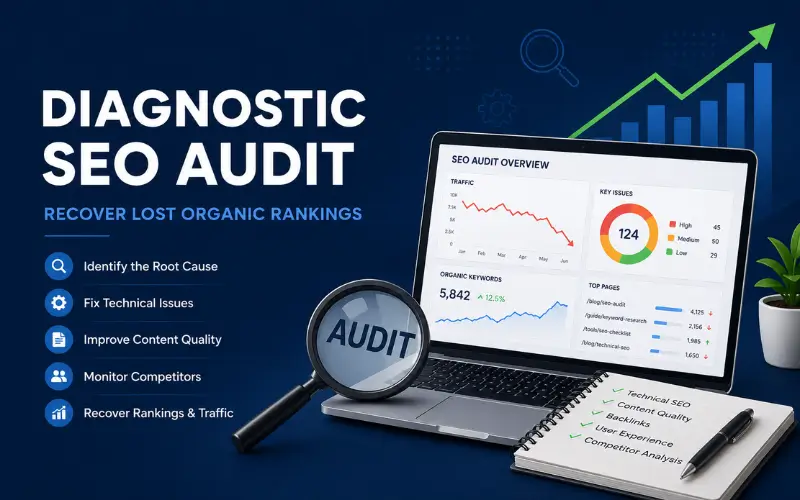
For any business owner or marketer, waking up to a steep, downward spike in your organic traffic chart is a stomach-churning experience. Months or years of steady growth can seemingly disappear overnight, leaving you scrambling for answers.
When rankings fall, the knee-jerk reaction is often panic. In an effort to please search engines, marketers will often start randomly changing meta tags, buying cheap backlinks, or rewriting perfectly good content.
This haphazard approach almost always backfires. A drop in search visibility is not a riddle to be solved by guessing, it’s a clinical problem that requires a systematic diagnosis.
A diagnostic SEO audit is a specific audit that pinpoints the specific variables that caused your traffic loss. Whether it’s a technical infrastructure crash, an aggressive competitor outflanking your positions, or a sweeping search engine algorithm update, this guide provides the exact blueprint you need to identify the root cause and make a full recovery.
Timeline of Events: When and How the Damage Occurred
You can’t fix a problem until you know precisely when it started. The shape and speed of your traffic drop can give you instant clues about the underlying problem.
Sudden Drop vs. Gradual Erosion
Open your Google Analytics and Google Search Console dashboards and chart your organic traffic over a rolling 12-month period. “Watch the decline curve closely.
A sudden vertical cliff-face drop (traffic down 30% or more in a 48-hour window) usually signals a serious technical problem or a manual penalty.
But if impressions and clicks have been slowly and steadily eroding over a few months then that signals a different problem. This slow decline means your content is rotting, your competitor ecosystem is actively building better assets, or a series of small search updates is slowly pushing other layouts.
Matching Trends with Search Engine Updates
If your traffic change coincides with a particular date range, cross-reference that window with known algorithmic changes. Big algo updates change the way search engines measure quality signals like user engagement, content depth, and backlink authority. Record the exact date your decline began, so you can determine what exactly on your site is not up to the date.
Revealing Hidden Technical Self-Sabotage
Before you go assuming a search engine hates your content, check that your own site template isn’t actively locking search bots out of your system.
Indexation Leakage and Unintended Directives
A common cause of rapid ranking loss happens during routine website maintenance, plugin updates, or migration to a new server. Sometimes web development teams leave a simple line of code in the live environment that causes search engine crawlers to be completely blind.
Go check your robots.txt file right now and see if someone accidentally added a directive to block access to your core folders. Then you can run a site crawler to scan your high-traffic pages for unexpected noindex tags in the HTML headers. If a search bot finds a page with a noindex tag that was previously generating a lot of revenue, then that page will be removed from the index in a matter of days.
Monitoring the Impact of Broken Redirect Patterns
If you have recently restructured your site, changed your domain, or changed product URLs without executing a detailed 311 or 301 redirect plan, you have likely broken your internal equity paths.
It’s an immediate shutdown of the traffic pipeline, because when high authority pages with thousands of external links suddenly return a 404 error, the search engine removes those URLs from the search engine results.
Variations in Quality and Content Devaluation
Search engine algorithms apply deep learning models trained to match a user’s query with the most helpful, reliable and expert content available. If your content hasn’t been updated in years, the perceived value of it decreases.
How to Spot Content Decay and Topic Obsolescence
If the information is old, an older piece of content with a stable top three position can be quickly knocked out of that position. If your page still quotes stats from 5 years ago and a query requires new data, e.g. financial regulations, software guides, or industry trends, search engines will slowly push your rank in favor of fresher and more accurate resources.
Loops to Fix Keyword Cannibalization
As websites grow and publish hundreds of blog posts, pages will often start to overlap. Cannibalization occurs when you have more than one URL on your domain targeting the same search intent. Search engine bots get confused as they don’t know which page is the definitive authority. Instead of pushing one page to the top, the algorithm may flip-flop between the URLs, wreaking havoc on your rankings and dragging down your average positions.
Monitor competitor movements and changes to SERP features
Sometimes, your traffic drops not because your website did something wrong, but because your competitors did something much better.
Competitor Outreach Gains Reversed
A direct competitor can naturally take your top rankings if they run an aggressive digital marketing campaign, build a more comprehensive content asset, or earn powerful contextual links on authoritative industry publications. Look at the URLs that got in front of you. Look at their media integrations, their structural readability and how well they’re serving user intent vs. your layout.
The Growth of No Click Search Results
Look closely at the actual search results page for your main target keywords. Search engines are constantly updating their layouts with native features like AI overviews, expanded featured snippets, local map packs, and interactive product grids.
Rich visuals can bury your plain text results way below the fold, even if you are ranking organically. This restructuring is a massive hit to your click through rate . This means you lose traffic even if your numerical rank is the same .
The Recovery Framework check list
To regain your lost organic visibility you require a logical, orderly plan of attack. Use this step-by-step diagnostic checklist to systematically identify and fix the specific problems sucking your traffic.
- Review Search Console Security Logs: Check your site against the explicit penalties for web spam guidelines by visiting GSC and navigating directly to the “Manual Actions” tab.
- Audit Status Code Responses: Do a full site crawl on your top landing pages to find any 5xx server drops or 404s that pop up out of nowhere.
- Validate Mobile Rendering Stability: Check to see if recent layout shifts or uncompressed heavy image scripts have affected your mobile Core Web Vitals scores.
- Perform an Intent Realignment Check: Check pages with high bounce rates to ensure the headings and text are exactly what the user is searching for.
- Rebuild Internal Equity Distribution: Use descriptive, contextual anchor text to tie your declining informational assets back to your core authority pages.
Restoring Trust and Algorithmic Authoritativeness
Ultimately, a successful recovery strategy will need to be directly tied to Google’s core quality evaluation framework, which assesses websites in terms of real-world experience, expertise, authoritativeness and trustworthiness (E-E-A-T).
If an algorithm update lowered the value of your site, it means that the system determined that it did not have verifiable trust signals, compared to other domains. If you want to turn this around, you must make your expertise irrefutable. Make sure all informational assets have a linkable author bio that includes their professional credentials. Maintain transparent editorial policies, cite reputable primary data sources, and include clear contact information across your footer.
Diagnosing complex structural script errors, picking out subtle content decay patterns and moving site architecture around safely takes a very special set of skills. If your in-house team lacks the technical resources to conduct a thorough data forensic review without risking further traffic losses, working with a veteran digital marketing agency such as Authority Lighthouse can safely speed your return to the first page of search results.
Conclusion
If your website’s search engine rankings drop, it’s a sure sign that your site’s structural health or content depth is out of sync with the latest search guidelines. Don’t think of the drop as some mysterious event, think of it as a technical diagnostic exercise. You can work your way back and find the exact code block, content overlap or competitor shift that caused the drop. Implement your fixes step-by-step, focus on user experience and you will convert your temporary traffic loss into a sustainable framework for long-term organic growth.
Frequently Asked Questions
How long does it typically take to recover lost rankings after an SEO audit?
How quickly you recover will depend a lot on what’s causing the drop. Fixing technical issues like a broken robots.txt file can bring positive results within a few days. However, it usually takes search engine bots weeks or even months to systematically recrawl, re-evaluate, and re-rank your updated content after a major algorithm update or deep content decay.
What are the most common tools used to diagnose a sudden traffic drop?
To diagnose a drop quickly, start with tracking indexation errors, crawl anomalies and explicit security actions with Google Search Console. Use this data along with Google Analytics to understand how user behavior has shifted and run a full desktop crawler like Screaming Frog to find hidden status code errors and redirect chains.
Can an algorithmic update completely de-index my website?
No. Algorithmic updates just change how content quality and authority is calculated, which may cause your pages to shift. If your site disappears overnight from the search results, it is probably due to a serious technical crawl block, a server crash, or a rare manual action for violating webmaster guidelines.
What is the difference between an algorithmic devaluation and a manual action?
A manual action occurs when a Google human reviewer finds your site to be in violation of their official guidelines. You receive an explicit notification and your rankings drop. An algorithmic devaluation is automated; the search engine’s software simply recalculates its quality metrics and adjusts search results dynamically without issuing any formal warnings.
How can I prevent keyword cannibalization from ruining my rankings?
Before you publish new pages, avoid cannibalization by designing a clean, logical content architecture. Ensure that each URL is targeting a completely different, unique search intent. If you find pages that compete with each other, combine them into one definitive guide and implement a clean 301 redirect from the older URL.