Marketing used to be all about trying to keep someone’s attention for as long as possible. Advertisers crafted those 30-second television commercials, took out whole pages in magazines, and constructed expansive digital efforts all operating under the assumption that people had time to pay attention. Those days are completely over. The best marketing happens in micro-moments when someone pulls out their phone for a quick check.
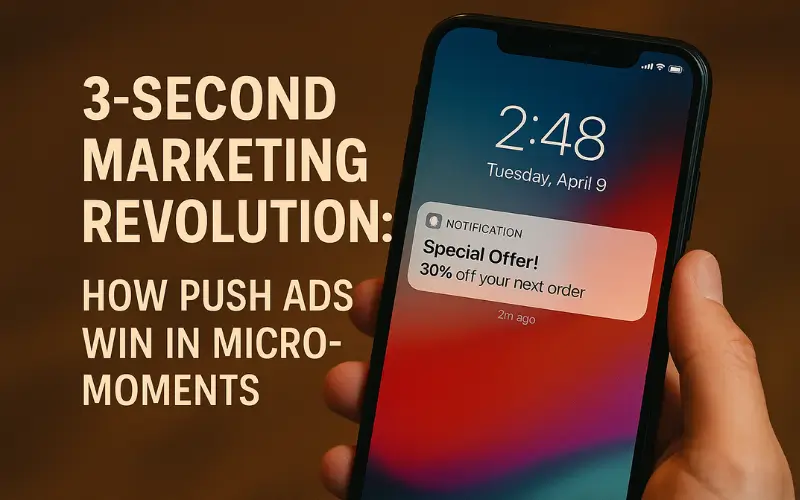
Push ads have figured out how to win these fleeting moments better than anything else. Other ad formats still attempt to squeeze comprehensive messages on small screens; push ads have perfected getting their message across all in the span of a fraction of a second. Push notifications literally encompass the entirety of marketing within the seconds it takes someone to glance at their phone. An ad text generator free tool can make this process even easier by helping you craft concise, high-impact messages in seconds.
Why Time-Consuming Attention No Longer Works
There was a time when advertisers banked on not just capturing someone’s attention but also cultivating it for a fair amount of time. Television commercials told stories, magazine advertisements walked consumers through the benefits of products, and internet marketing mimicked these too in older, antiquated formats for desktops.
Mobile phones decimated this approach. People now check their phones many times throughout the day—in brief bursts—during which they might check notifications, scroll quickly through social media, or glance at their emails to see if anything truly matters to them. These interactions last mere seconds—sometimes merely fractions of a second—creating an entirely new set of parameters under which marketing can function.
Yet most marketing has never adapted to this reality. Banner ads still try to cram too much information into small spots. Video ads bank on people’s attention spans for more than two seconds. Social media posts fight against countless other entries in timelines, with most users scrolling right past everything.
How Push Ads Win the Quick Glance
Push advertising is successful because it was cultivated for super-brief interactions from the very beginning. When people utilize push ads platforms, they can send notifications that align beautifully with how people use their phones in the small moments between other activities.
The format alone necessitates brevity and clarity. There’s no room for frills, pretty graphics, or convoluted explanations. Push notifications have to convey the proposition, entice interest, and encourage action within one brief glance. Therefore, any perceived disadvantage turns out to be a colossal boon.
People already know how to process these things incredibly fast through a million push notifications. When push notifications appear, everyone instinctively glances to see who sent it, what it’s about, and if action is warranted immediately. Push advertising hijacks these cognitive shortcuts that people naturally have.
The Brain Science Behind Quick Understanding
Push notifications work so well in micro-moments because they tap into how humans naturally operate when processing information quickly. Humans evolved to digest incoming information as important or unimportant; pertinent or tangential; urgent or do-it-later.
Push advertising fits beautifully into this system. They appear in the same place as genuinely worthwhile messages, automatically elevating credibility. Additionally, the push format creates an assumption that something might actually warrant attention, giving people reason to read it instead of completely ignoring it.
Even better, without excessive verbiage, people don’t experience cognitive overload trying to figure out if they should care. It’s either interesting enough to warrant immediate action or it’s simple enough to dismiss without feeling guilty about it.
Saying More with Less
However, the true skill with push advertising comes from figuring out how to condense comprehensive marketing concepts into instantly digestible messaging without sacrificing persuasiveness. This challenge requires a reinvention of how marketing communication works.
Regular advertising assumes you have time to woo interest, present benefits and counter objections. With push notifications, all that’s possible in a matter of words and immediate opportunity when the time comes. The best push campaigns identify the single most persuasive reason why someone would want what they’re offering and deliver that message at the precise moment people are most likely to give a damn.
This compression also makes push advertising stronger than longer-form marketing in many cases. By forcing marketers to hone in on what truly matters most, push notifications eliminate the confusion and distractions that make other campaigns less effective.
Timing Is Everything
It’s not just better messaging that works in micro-moments; it’s timing. Unlike other methods of advertising that simply hope someone glances at something good at some point, push notifications can be sent at times when someone would be most interested and ready to engage.
Timing tactics within push advertising allow for contextualized messaging that feels intuitive and helpful instead of annoying. From where someone is at the moment and where they are going next to the time of day and even the weather—there are countless signals that indicate access could be relevant.
This access makes even simple messages feel remarkably urgent and beneficial. A basic coupon becomes compelling when it appears right when someone is about to check out. A simple announcement becomes urgent if it applies to something needed right this minute.
Getting People to Act Instantly
Push notifications are exceptional at encouraging instant action because they eliminate all the hoops that come with seeing something later down the line and making a move. Traditional advertising requires several steps: see an advertisement, recall it later on down the line, search for it in stores or online, and maybe then a purchase will be made.
Push advertising collapses this entire structure into one instant transaction. People see the push notification, understand what’s being offered, and can act on it immediately without shifting gears or losing their train of thought. This notion of inertia exponentially increases how many people actually follow through with whatever’s been offered—even if it’s not a great offer.
This ability also allows push advertising to capitalize on impulse decisions and time-sensitive demands entirely lost on other methods.
Why This Will Work Going Forward
As attention spans continue to dwindle down and mobile device usage becomes more fragmented, focusing on micro-moment improvements makes push advertising an invaluable addition. The centering around brevity, timing and instant understanding aligns perfectly with where user behavior is going next.
While other forms of advertising chase after newer platforms that seem trendy and exciting, push advertising has solved a core dilemma of marketing: successfully communicating when nobody has time or energy to pay attention. Therefore, pushing advertising’s focus on fundamentals makes it more reliable and predictable than choices contingent upon what’s most popular at any given moment.
This three-second revolution isn’t just about faster communication; it’s about finally acknowledging how devices work and how people use them in such a mobile-first world that engaging successfully aligns with what people need right now anyway.