Rooftop solar for garment factories has moved from a niche sustainability gesture to a genuine capital planning decision over the past several years, helped along by falling panel costs and, more recently, meaningful changes to how Bangladesh’s net metering policy treats commercial and industrial installations. A factory owner evaluating this today is working with a considerably more favorable policy environment than existed even a couple of years ago, which makes revisiting the payback calculation worthwhile even for factories that looked at solar previously and passed.
How Net Metering Works in Bangladesh
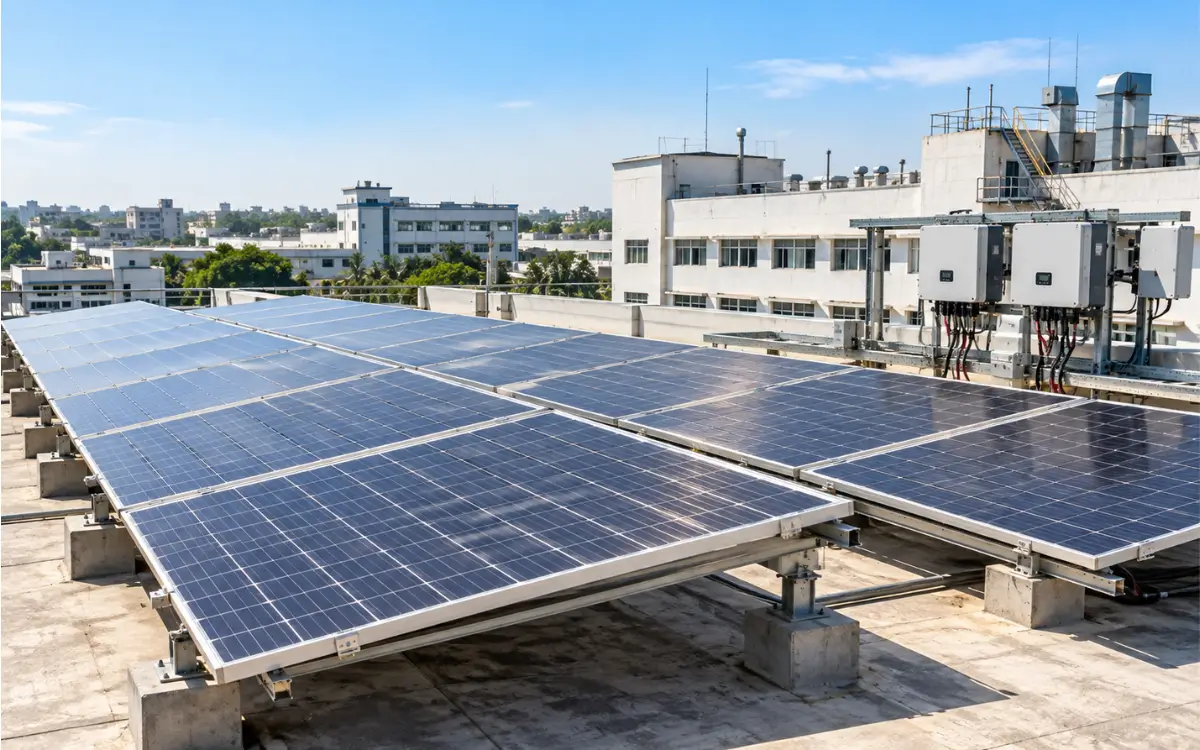
Net metering allows a rooftop solar system owner to consume the power they generate directly and feed any surplus back into the grid, with the connected utility crediting that exported power against the owner’s consumption from the grid. Bangladesh’s Sustainable and Renewable Energy Development Authority (SREDA) administers the net metering framework, and the policy has been meaningfully revised recently: under the current guidelines, up to 100 percent of a connection’s sanctioned load can now be installed as net-metered rooftop solar capacity, a meaningful increase from the 70 percent limit that applied under the previous rules. Single-phase consumers are now eligible for net metering as well, a change from the previous rules that restricted net metering to three-phase connections only.
For garment factories specifically, it’s worth noting that the current rules include what amounts to a mandatory solar clause in some circumstances. Factories applying to increase their sanctioned load through utilities like DESCO or BREB, where the existing connection already carries a three-phase load at or above a defined threshold, may now be required to install net-metered rooftop solar as a condition of approving that load increase. This changes solar from a purely optional investment decision into, in some cases, a practical requirement tied to a factory’s own expansion plans, which is worth checking directly with the relevant utility before assuming solar remains entirely discretionary for a specific expansion project.
Equipment and Installation Requirements
Under current guidelines, solar modules and inverters used in a net-metered installation need to be SREDA-approved and meet specified Bangladesh Standards (BDS) or equivalent IEC international standards. This isn’t a formality to skip past. Using non-compliant equipment risks the installation being rejected during the net metering application and approval process, which runs through a defined application portal and requires proper engineering documentation, including a single line diagram showing the system’s full configuration from the solar array through the inverter and metering equipment to the grid connection. Working with an experienced local solar engineering firm familiar with the current documentation requirements meaningfully reduces the risk of application delays or rejections that a DIY or unfamiliar-contractor approach is more prone to.
What Rooftop Solar Costs Per kW
Installed cost per kW for commercial and industrial rooftop solar in Bangladesh depends on system size (larger systems generally achieve somewhat lower cost per kW through scale efficiencies), panel and inverter specification, and current equipment market pricing, which has moved considerably in recent years as global solar panel pricing has shifted with changing trade and manufacturing conditions. Given how much this figure moves, any factory evaluating a specific project should get current, detailed quotations from two or three qualified installers rather than relying on a general industry cost figure that may not reflect current market pricing by the time a decision is actually made.
Building the Payback Calculation
A realistic payback calculation for a garment factory’s rooftop solar installation needs several inputs specific to that factory: total installed system cost, the factory’s actual current electricity rate (since payback depends directly on how much grid electricity cost the solar installation actually offsets), the system’s expected annual generation based on Bangladesh’s solar resource for the specific location and any rooftop shading or orientation constraints, and the proportion of that generation the factory can actually self-consume directly versus export to the grid under net metering, since self-consumed power generally offsets electricity cost more directly than exported power depending on the specific net metering credit structure in place.
Payback period, in its simplest form, divides total installed cost by annual electricity cost savings. A garment factory with high daytime electricity consumption, which describes most garment factories given standard daytime shift operating patterns, is well positioned to self-consume a large share of solar generation directly, since solar output naturally peaks during the same daytime hours a factory’s production shift is running, which improves the payback calculation compared to a facility with a more evening-weighted consumption pattern that would rely more heavily on grid export credit.
Factors That Move the Payback Period
A few factors most directly affect where a specific factory’s payback period actually lands. Roof condition and available unshaded area set a hard ceiling on system size regardless of budget, and a factory with limited usable roof area simply can’t scale a solar installation to offset a large share of total consumption no matter how attractive the payback math looks for the space that is available. Current electricity tariff matters directly, since a higher grid electricity rate makes any given amount of solar generation worth more in avoided cost, improving payback. And self-consumption rate, as noted above, generally improves payback compared to a system that exports a larger share of its generation, which is part of why sizing a system to match a factory’s actual daytime consumption pattern, rather than simply maximizing installed capacity to fill available roof space, often produces a better financial outcome even if it means a somewhat smaller system.
Ongoing Maintenance and Performance Monitoring
A rooftop solar system’s payback calculation assumes the system actually delivers its projected generation year over year, and that requires basic ongoing maintenance most factories underestimate at the planning stage. Panel soiling from dust and airborne particulates, a real factor in many Bangladeshi industrial areas, can measurably reduce output if panels aren’t cleaned on a reasonable schedule, and the appropriate cleaning frequency depends on local dust conditions and rainfall patterns rather than a single universal schedule. Inverter monitoring, checking that the system’s actual generation tracks reasonably close to expected output given weather conditions, catches underperformance or component failure considerably faster than discovering a problem only when someone eventually notices the electricity bill hasn’t dropped as much as expected. Most commercial installations now come with some form of remote monitoring dashboard as standard, and actually reviewing that data periodically, rather than treating the system as a fully passive, install-and-forget asset, is what keeps actual performance tracking the payback projection built at the planning stage.
Financing Structures Beyond Direct Purchase
Beyond outright purchase, some factories access rooftop solar through a power purchase agreement (PPA) structure, where a third-party developer installs, owns, and maintains the system, and the factory purchases the generated power at an agreed rate, typically lower than the prevailing grid tariff, without carrying the upfront capital cost themselves. This shifts the payback calculation entirely, since there’s no capital outlay to recover, replaced instead by an ongoing comparison between the PPA rate and the grid tariff it’s replacing. For factories prioritizing capital preservation over long-term cost minimization, a PPA structure is worth evaluating alongside a direct purchase and net metering approach, since the two represent genuinely different financial structures suited to different capital planning priorities.
What Rooftop Solar Actually Costs and Saves Right Now
Current reporting gives a genuinely useful starting reference here, rather than relying purely on illustrative figures. Industrial grid electricity in Bangladesh currently runs around BDT 8.45 per kWh, against a levelized cost of rooftop solar generation estimated around BDT 3.04 to 5.5 per kWh depending on system size and financing structure, a gap wide enough that self-generated solar power meaningfully undercuts grid electricity on a per-unit basis even before accounting for grid tariff volatility. Real installed projects in the sector back this up: Rising Group’s 9 MW rooftop system now supplies roughly 15 percent of that company’s total electricity demand, and Pacific Jeans’ 7 MW installation covers close to 12 percent of its energy needs, both cited as strengthening energy resilience alongside the direct cost savings.
Payback periods reported across recent industry analysis for Bangladeshi garment sector installations commonly fall in the four-to-eight-year range, with financial modeling research on actual installed systems in the country finding internal rates of return as high as 36 percent under favorable conditions. IDCOL, the state-backed infrastructure financing body, offers rooftop solar project financing at around 6 percent interest, and Bangladesh Bank’s green refinance scheme offers similarly low-cost financing in the 5 to 6 percent range, both of which meaningfully improve project economics compared to financing at standard commercial lending rates.
A Worked Payback Example
Here’s an illustrative payback calculation, built to demonstrate the method using the current market figures cited above, which you should still confirm against actual site-specific quotations before making a decision.
Say a factory installs a 500 kW rooftop system at an illustrative installed cost of $600 per kW, for a total capital cost of $300,000. Bangladesh’s solar resource supports an estimated annual generation of roughly 1,400 kWh per installed kW in a well-sited system with minimal shading, giving this system an estimated annual generation of 500 × 1,400 = 700,000 kWh.
Say the factory’s daytime shift operating pattern allows it to self-consume 85 percent of that generation directly, offsetting grid electricity at the factory’s actual tariff of an illustrative $0.09 per kWh, with the remaining 15 percent exported to the grid under net metering credit at a somewhat lower effective rate of $0.07 per kWh.
Self-consumed savings: 700,000 × 0.85 × $0.09 = $53,550 per year.
Exported credit: 700,000 × 0.15 × $0.07 = $7,350 per year.
Total annual savings: $53,550 + $7,350 = $60,900 per year.
Payback period: $300,000 ÷ $60,900 ≈ 4.9 years.
Against a typical solar panel warranty and expected system life well beyond that payback period, often 20 to 25 years for panels specifically, this leaves the factory with roughly 15 to 20 years of largely free electricity generation after the system has paid for itself, which is the real long-term financial case for solar beyond the payback period alone. Notice how sensitive this calculation is to the self-consumption rate: if the same system only achieved 60 percent self-consumption instead of 85 percent (perhaps due to a less daytime-weighted operating pattern), annual savings would drop to (700,000 × 0.60 × $0.09) + (700,000 × 0.40 × $0.07) = $37,800 + $19,600 = $57,400, only a modest change in this case since the export rate isn’t dramatically lower than the self-consumption rate, but the gap would be considerably larger in a market where export credit rates sit well below the retail tariff self-consumption actually offsets. Rebuild this calculation with your own site’s actual quoted installed cost, confirmed generation estimate, and actual tariff and net metering credit structure before finalizing an investment decision.
A Practical Starting Point
For a factory seriously evaluating rooftop solar today, the practical next step is getting an actual site assessment, covering available roof area, shading conditions, and the factory’s real hourly consumption pattern, paired with current quotations from qualified, SREDA-compliant installers. General payback figures circulating in industry conversation are a reasonable starting expectation, but the policy environment and equipment cost have moved enough in recent periods that a project-specific assessment, run against current numbers rather than a remembered figure from a previous evaluation, is what actually determines whether a specific factory’s rooftop solar payback looks attractive today.
Frequently Asked Questions
What’s a realistic payback period for rooftop solar on a Bangladeshi garment factory?
Recent industry analysis commonly cites four to eight years, with some individual projects achieving payback within four years depending on system size, financing, and self-consumption rate.
How has Bangladesh’s net metering policy changed recently?
Current guidelines allow up to 100 percent of a connection’s sanctioned load as net-metered solar capacity, up from a previous 70 percent limit, and single-phase consumers are now eligible where they weren’t before.
Is rooftop solar mandatory for garment factories in Bangladesh?
Not universally, but factories applying to increase sanctioned load above a certain three-phase threshold through utilities like DESCO or BREB may now be required to install net-metered solar as a condition of approval.
Does self-consumption rate really change the payback calculation that much?
Yes. Since solar generation typically peaks during daytime hours matching a garment factory’s shift pattern, higher self-consumption generally improves payback compared to relying more heavily on lower-value grid export credit.