
Silk has a reputation that few fibres can match. It feels cool and smooth, it catches the light in a soft glow and it has been worn for thousands of years. But silk is more than a luxury cloth for special days. Once you know what the fibre can do, the list of uses of silk gets surprisingly long, and it reaches well beyond the wardrobe. This article lists the main uses of silk fabric in daily life and explains why each one works.
This guide covers the main uses of silk in clothing, home textiles, medicine and industry. It also explains the properties that make those uses possible, how silk is made, what the weight unit “momme” means, how to care for silk and when another fibre is a better choice. A worked example at the end converts momme to GSM and works out the fabric weight in a silk pillowcase, so you can see how the numbers on a label connect to what you feel. For a deeper look at the fibre itself, see our guides on what silk is made of and on protein fibres such as wool and silk.
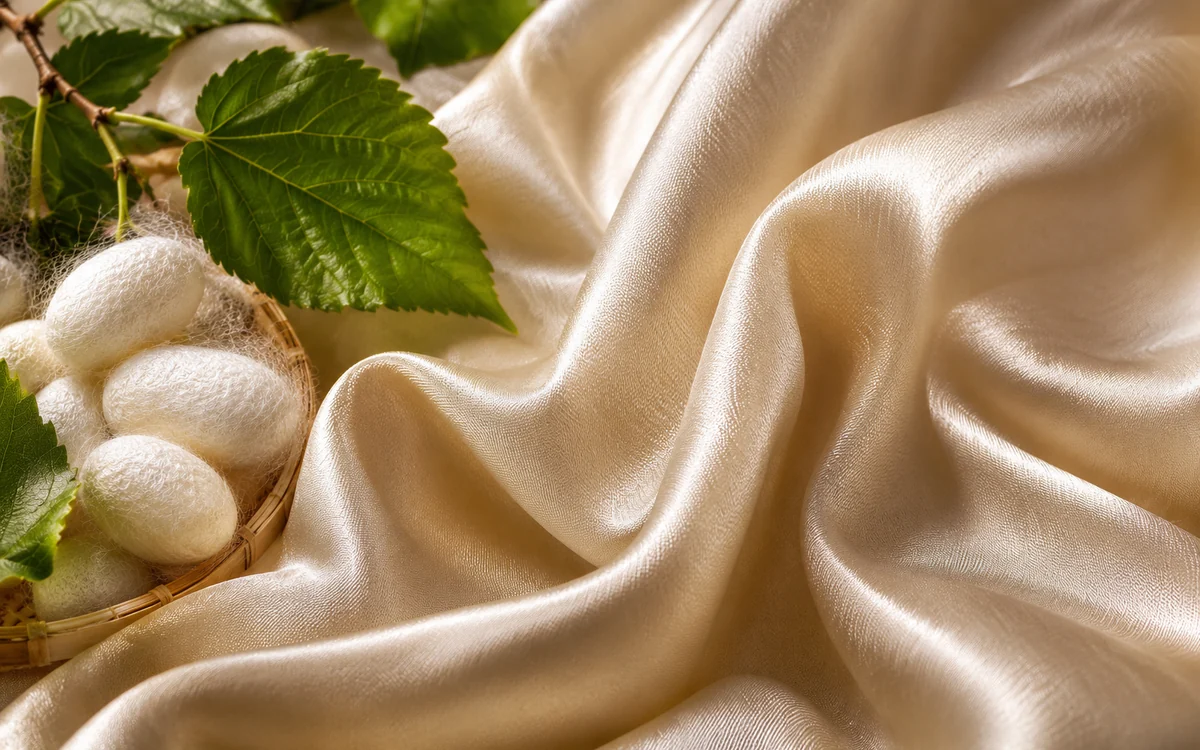
What silk is, in brief
Silk is a natural protein fibre. The most common kind comes from the cocoon of the silkworm Bombyx mori, which feeds on mulberry leaves. The caterpillar makes a cocoon from a sticky liquid made of two proteins, fibroin and sericin. The liquid hardens into a fine filament when it meets the air. A single cocoon can unwind into a continuous filament of up to about 900 metres.
To make thread, cocoons are softened in hot water and the filaments are reeled together. Around six filaments are commonly combined into one raw silk thread. The thread is then boiled in a soap solution to remove the sericin, or silk gum, which leaves the fibre soft and shiny. You can read the full process in our page on silk fibre production.
Silk is also unusual because it is the only common natural fibre that comes as a very long continuous filament. Cotton and wool are short staple fibres that must be spun. Silk can be reeled straight from the cocoon.
Main types of silk
| Type | Source | Character |
|---|---|---|
| Mulberry silk | Bombyx mori fed on mulberry leaves | The finest and most common. Smooth and even |
| Tussah (tusser) silk | Wild silkworms feeding on oak and other leaves | Coarser, brownish, with a natural slubby look |
| Eri silk | Eri silkworm. The cocoon is not boiled, so the moth can leave | Soft and matte. Often marketed as “peace silk” |
| Dupioni | Two silkworms spin one cocoon | Uneven threads with a crisp, textured look |
Our guide to mulberry silk has more on the most popular type.
Properties that decide where silk is used
- Lustre and smoothness. The long, smooth filament reflects light, which gives the glow.
- Strength. Silk is strong for its fineness, and it is often called one of the strongest natural fibres. It is weaker when wet.
- Comfort. It feels cool in warm weather and gives some insulation in cold weather.
- Moisture. Silk absorbs moisture, though it does not wick it away like synthetic sportswear fabric, and it dries slowly.
- Drape. It hangs softly and flows with movement.
- Dye uptake. Silk takes dyes well and gives deep, rich colours.
- Weak points. It can water-spot, wrinkle, fade in strong sun and lose strength with repeated harsh washing. It also costs more than most fibres.
Uses of silk in clothing
Clothing is the best known use and the largest.
| Product | Why silk works |
|---|---|
| Sarees and traditional dress | Drape, shine and rich dye colours |
| Shirts and blouses | Soft feel, breathable in warm weather |
| Dresses and skirts | Flowing drape |
| Suits and ties | Lustre, crisp feel in heavier weaves |
| Scarves and shawls | Light weight, strong colour |
| Pyjamas and nightwear | Smooth feel on skin |
| Lingerie | Soft, smooth and lightweight |
| Linings | Slides easily over other fabric |
Different weaves suit different products. Chiffon and georgette are sheer and light, charmeuse is smooth and shiny on one side, crepe de chine has a fine pebbly surface, dupioni is crisp and textured, and raw silk is heavy and slubby. Choose the weave, not just the fibre. A silk shirt in crepe de chine behaves very differently from a silk scarf in chiffon.
Uses of silk at home
- Bedding. Silk pillowcases, sheets and duvet covers are popular. Many sellers highlight smooth feel and a cool touch, though claims about hair and skin benefits vary and are not the same for everyone.
- Curtains and drapes. Silk gives a rich look, but sunlight can fade and weaken it, so it is usually lined.
- Upholstery and cushions. Dupioni and brocades are used on accent pieces rather than heavy-use sofas.
- Rugs and wall hangings. Hand-knotted silk rugs and wall pieces are valued for fine detail.
- Quilt filling. Silk floss is used as a lightweight, warm filling in some quilts.
Medical and industrial uses of silk
- Surgical sutures. Silk thread has long been used to stitch wounds because it is strong and easy to handle.
- Parachutes. Before nylon came along, parachutes were commonly made from silk.
- Research. Silk proteins are studied for medical and materials uses.
Many of these uses have moved to synthetic fibres, which are cheaper and more consistent. Silk remains in use where its feel, strength or tradition matters.
Other uses
- Embroidery thread. Silk floss gives bright colour and high shine.
- Craft and art. Silk painting, silk flowers and decorative items.
- Handloom and cottage industry. Silk weaving supports craft communities in several countries.
- Silk blends. Silk is often mixed with cotton, wool or viscose for a better price or performance.
Momme: the weight unit of silk fabric
Silk fabric weight is often stated in momme (abbreviated mm), a Japanese unit. A higher number means a denser, heavier fabric. Sources give the conversion to grams per square metre (GSM) as about 4.3 to 4.34, depending on how they round, so a quick rule is 1 momme is about 4.3 GSM.
| Silk fabric | Common momme range |
|---|---|
| Gauze | 3 to 5 |
| Organza | 4 to 6 |
| Chiffon | 6 to 8 |
| Crepe de chine | 12 to 16 |
| Charmeuse | 12 to 30 |
| Raw silk | 35 to 40 |
Pyjamas often use 12 to 19 momme, and bedding is often sold at 19 momme and above. These ranges come from seller guides and are not a fixed standard. Our page on GSM shows how fabric weight is measured and compared.
A worked example: from cocoon to pillowcase
Let us run two quick calculations. The numbers are examples and the real yield depends on the cocoon, the reeling method and the weave.
Part 1: How long is the thread?
Suppose each cocoon gives a filament of 900 m (the upper end). A raw silk thread is made of 6 filaments reeled together. As one cocoon’s filament runs out, a new one is joined in.
The total filament from 6 cocoons = 6 × 900 = 5,400 m. Because 6 filaments run side by side, the thread length = 5,400 ÷ 6 = 900 m.
So six cocoons give about 900 m of thread in this ideal case. Real figures are lower, because broken filaments, waste and outer layers of the cocoon are not reeled.
Part 2: How heavy is the fabric in a pillowcase?
A silk pillowcase is sold as 19 momme. A pillowcase measures 51 cm by 76 cm, and the case has two panels.
- Convert momme to GSM: 19 × 4.3 = 81.7 GSM (some sources give about 82)
- Area of one panel: 0.51 × 0.76 = 0.3876 m²
- Area of two panels: 0.3876 × 2 = 0.775 m²
- Weight of fabric: 0.775 × 81.7 = 63.3 g
A finished pillowcase will weigh a little more, since hems and seams add fabric. A 22 momme version weighs about 95 GSM (22 × 4.3 = 94.6), which gives 0.775 × 94.6 = 73.3 g of fabric. That is about 16 percent more fabric than 19 momme (22 ÷ 19 = 1.158), and the price usually rises with it.
How to care for silk
- Check the care label first. Many silk items need dry cleaning or gentle hand washing.
- Use cool water and a mild detergent made for delicates.
- Do not wring or twist. Wet silk fibres weaken and can stretch or distort.
- Dry flat or hang in the shade. Direct sun and hot dryers can fade and damage it.
- Iron on a low setting, on the wrong side, or use a pressing cloth.
- Test a hidden spot before treating stains. Tap water can leave mineral spots, and blotting gently with a cloth dampened in distilled water can help.
Our page on how to prevent clothes from shrinking has general tips for natural fibres too.
When not to choose silk
Silk is not the answer to every job. Skip it when:
- The item will be washed hard and often, as with children’s play clothes or work uniforms.
- You need fabric that dries fast after sweat, such as running tops.
- The product sits in strong sun for long periods, for example unlined curtains by a south-facing window.
- Budget is tight and the item will wear out quickly.
In these cases cotton, polyester or a blend usually gives better value and fewer headaches.
Silk compared with other fibres
| Feature | Silk | Cotton | Polyester |
|---|---|---|---|
| Source | Animal protein | Plant cellulose | Synthetic |
| Feel | Smooth, cool | Soft, dry | Varies, often slick |
| Shine | High | Low | Medium to high |
| Moisture | Absorbs, dries slowly | Absorbs, dries slowly | Absorbs little, dries fast |
| Care | Delicate | Easy | Easy |
| Price | High | Low to medium | Low |
If you wear one for sports, silk is a poor choice. For a dress or a sleep shirt, it is lovely. For a deeper look at the other two, read our guide to cotton vs polyester.
Buying tips
- Look at the label for fibre content. “Silk” should mean 100 percent silk, or the blend percentage should be shown.
- Check the momme or the GSM for bedding and shirts.
- Ask for the weave name, such as charmeuse or crepe de chine.
- Feel the fabric. Real silk feels smooth and warms quickly in your hand, though many imitations are made to feel similar.
- Be careful with very low prices. The cost of silk makes extreme discounts a warning sign.
- Ask about colourfastness if you plan to wash it often. Our guide to colour fastness tests explains how it is graded.
Final thoughts
The uses of silk run from sarees, shirts and ties to bedding, thread and surgical sutures. The same traits drive them all: a long smooth filament, good strength for its weight, easy dyeing and a pleasant feel on the skin. Silk is delicate and costs more, so it fits best where its feel and look matter.
Our worked example showed that a 19 momme pillowcase uses about 63 g of fabric, and that a move to 22 momme adds about 16 percent more silk. Read the momme, ask for the weave and check the care label, and you will know what you are buying.
Frequently asked questions
Clothing such as sarees, shirts, dresses, ties and scarves, home items such as bedding and curtains, embroidery thread, surgical sutures and other special uses.
It is smooth, strong for its weight, drapes well, takes dye well and feels comfortable against the skin.
Momme is a unit of silk fabric weight. One momme is about 4.3 grams per square metre, so a higher number means a heavier, denser fabric.
It can feel cool and breathable, but it does not wick sweat well and shows water marks. Many people prefer it for dressy summer wear, and cotton or linen for heavy sweating.
Silkworms spin cocoons. The cocoons are softened and reeled into thread, and the sericin gum is boiled off. The thread is then woven or knitted.
Some silk can be hand washed in cool water with a mild detergent, but many items are labelled dry clean only. Always follow the care label.
Mulberry silk comes from silkworms fed on mulberry leaves and is fine and smooth. Tussah silk comes from wild silkworms and is coarser, with a natural brownish colour.


