Shirt collars might seem like a small detail, but they play one of the biggest roles in shaping your overall appearance. Whether you’re dressing for a formal event, a professional setting or a relaxed weekend hangout, the right collar can instantly elevate your look. Because different occasions and outfits call for different shirt designs, understanding the different style of shirt collar is essential for anyone who wants to dress with confidence and personality.
Collars influence everything—from how your face looks to how your tie sits to how polished or casual your outfit appears. Some collars create a sharp, business-ready look, while others lean casual, relaxed or even fashion-forward. And with so many variations available today—point, spread, cutaway, mandarin, button-down, club, wing and more—it can be overwhelming to know which collar style works best for you.
This comprehensive guide breaks down every major and minor collar style in simple, easy-to-understand language. You’ll learn what each collar looks like, when to wear it, what body or face shapes it flatters and how to pair it with ties, suits and accessories. Whether you’re refining your personal wardrobe or looking to dress smarter for work or special occasions, this article will help you navigate all the key collar types with clarity and confidence.
Let’s dive into the world of shirt collars and discover how the right style can transform even your simplest outfits.
Understanding Shirt Collars: Function & Form
Before exploring the different styles of shirt collars, it’s important to understand why collars matter in the first place. A collar is not just a decorative detail—it shapes the entire personality of a shirt. The right collar can balance your facial features, match the formality of your outfit and elevate your overall style effortlessly.
Below, we’ll break down how collars are structured, why they influence your appearance and the basic categories every collar style belongs to.
Anatomy of a Shirt Collar
Even though shirt collars come in many shapes and variations, they all share a few main components. Understanding these will make it easier to compare different collar styles and identify what sets them apart.
Collar Band (or Stand)
This is the part that wraps around your neck.
- It affects comfort and how the collar sits.
- A taller collar band creates a more formal or structured look.
Collar Points
These are the two ends that extend downward from the collar.
- The length and angle of the points determine the collar’s style.
- Longer points tend to elongate the face.
Collar Spread
The distance between the two collar points.
- Narrow spread = traditional and formal.
- Wide spread = modern and stylish.
Collar Leaf
The front, visible part of the collar.
- Its height and shape affect how the collar frames your face.
When you understand these parts, identifying collar types becomes much easier.
Why Collar Style Matters
A collar does more than simply hold a tie in place. It influences:
How Your Face Appears
Collars can visually lengthen, slim, widen or balance your facial proportions.
- Narrow faces look fuller with wide-spread collars.
- Round faces look slimmer with pointed collars.
The Formality of Your Outfit
Every collar style has an inherent dress code.
- Button-down = casual or smart casual.
- Wing collar = formal black-tie and white-tie events.
Tie Compatibility
Some collars are designed for specific tie knots.
- Spread collars pair well with wider knots like the Windsor.
- Point collars work with simple knots like the Four-in-Hand.
Your Overall Style Message
Your collar expresses your personality:
- Structured collars signal professionalism.
- Soft collars feel relaxed and effortless.
In short: your collar speaks before you do.
Basic Categories of Shirt Collars
Though shirt collars come in dozens of variations, they generally fall into three main categories:
Stand Collars
These collars stand upright and do not fold over.
Examples:
- Mandarin collar
- Band collar
These have a minimalistic, modern look and are typically worn without a tie.
Turn-Down Collars
The most common type—these collars fold down around the neck.
Examples:
- Point collar
- Spread collar
- Button-down collar
- Club collar
They include both formal and casual options.
Flat Collars
These lie flat against the garment rather than standing up.
Examples:
- Sailor collar
- Peter Pan collar
- Camp/Revere collar
These are mostly seen on casual or vintage-style shirts.
This foundational understanding sets the stage for exploring every major collar style—what it looks like, when to wear it and how to style it.
Key Collar Styles Explained
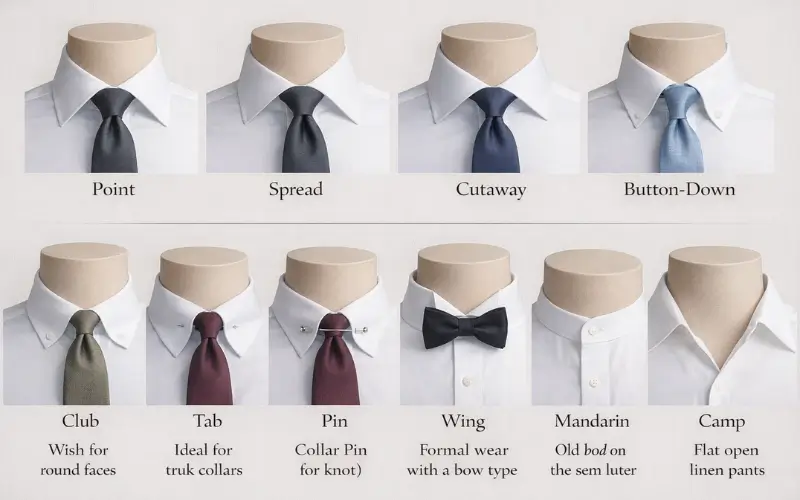
Shirt collars come in a wide variety of shapes, angles, spreads and structures. Each one has its own personality, level of formality and ideal use case. Below is a detailed guide to the most popular and timeless collar styles you’ll encounter. For each collar, you’ll learn what it looks like, when to wear it and how to style it for maximum impact.
Point (Forward Point) Collar
Description & History
The point collar is the most classic and universally recognized shirt collar.
- The collar points angle downward.
- The spread between the points is narrow (typically 1.5 to 3 inches).
- The points are longer and more vertical than other collars.
Historically, it became popular in traditional business environments and is still the go-to collar for formal or conservative dress codes.
Best Occasions & Styling Tips
- Perfect for office wear, corporate settings and professional meetings.
- Works great with a simple tie knot like the Four-in-Hand.
- Complements narrow or classic-width lapels.
Face Shape Compatibility
- Best for round or wide faces because it creates an elongating effect.
Spread Collar
Description & Variations
The spread collar features a wider distance between the collar points.
- Spread angles range from moderate to very wide.
- Common variations: semi-spread, full spread, wide-spread.
It has a modern, stylish appearance and is popular in both business and smart-casual outfits.
Tie Knots & Formality
- Pairs beautifully with larger tie knots like the Windsor or Half Windsor.
- Looks clean with suits featuring wide or medium lapels.
- Works for business, weddings, events and general formal wear.
Face Shape Compatibility
- Ideal for narrow or long faces because it adds horizontal balance.
Cutaway Collar
How It Differs from a Spread Collar
A cutaway collar has points angled outward even more dramatically than a wide-spread collar.
- Sometimes the points angle almost toward the shoulders.
- Very modern, fashion-forward and stylish.
When to Wear This Style
- Ideal for dressy events, business settings and high-fashion looks.
- Best with large, symmetrical tie knots.
- Works well with tailored suits and bold styles.
Face Shape Compatibility
- Best for long, oval or narrow faces.
- Avoid if you already have a very broad or rounded face unless balanced by a strong suit.
Button-Down Collar
Origins & Casual Usage
Originally invented for polo players, the button-down collar features small buttons fastening the points to the shirt body.
- Prevents collar flapping.
- More casual than traditional turn-down collars.
When to Wear It
- Perfect for casual and smart-casual outfits.
- Works well with sports jackets, chinos and denim.
- Can be worn with a tie, but avoid for formal events.
Face Shape Compatibility
- Universally flattering because of its soft roll and balanced proportions.
Club Collar (Rounded)
Retro Appeal & Suit Pairing
The club collar features rounded collar points instead of sharp ones.
- Creates a vintage, old-school aesthetic.
- Popular in early 20th-century fashion and making a comeback today.
How to Wear It
- Pairs well with suits, especially slim-fit or retro-inspired designs.
- Works with small tie knots or no tie.
Best For
- Oval or slim faces.
- Fashion-forward, elegant or vintage-styled outfits.
Tab Collar
How the Tab Works
A tab collar has a small tab under the tie knot that fastens across the collar points.
- This lifts the tie knot upward.
- Creates a neat, elevated look.
When It’s Appropriate
- Ideal for business dress and formal settings.
- Works exclusively with a tie—never worn open.
Styling Notes
- Best with medium-sized tie knots.
- Great for tailored, classic suits.
Pin Collar
How It Works
A pin collar uses a small bar or collar pin pushed through the holes in the collar points.
- Lifts the tie knot, similar to the tab collar.
- Gives a polished, vintage and elite appearance.
When It’s Appropriate
- Suitable for formal wear, business attire and stylish evening looks.
- Always worn with a tie.
Styling Notes
- Works beautifully with small tie knots to highlight the raised shape.
- Avoid with very thick ties.
Wing Collar
The Formal Classic
A wing collar is the most formal shirt collar style.
- Features small, pointed “wing” tips standing upright.
- Designed exclusively for tuxedos and evening wear.
When to Wear It
- Black-tie or white-tie events.
- Formal galas, balls and weddings.
Styling Notes
- Always worn with a bow tie.
- Should never be worn casually.
Band / Mandarin Collar
Collarless Illusion
This collar has no collar points.
- Stands upright around the neck.
- Minimalist, clean and modern style.
Cultural & Fashion Roots
- Inspired by traditional East Asian garments.
- Now widely used in fashion-forward casual wear.
When to Wear It
- Suitable for casual and semi-formal occasions.
- Never worn with a tie.
Convertible Collar (Camp/Revere)
Casual & Relaxed
Also known as a camp collar or revere collar, this style folds open and creates a V-shaped neckline.
- Seen on Hawaiian shirts, Cuban shirts and resort wear.
Ideal Occasions
- Beach, vacation, summer outings and relaxed weekends.
Styling Tips
- Wear without a tie.
- Great with shorts, linen pants and loafers.
Other Noteworthy Collar Styles
Bertha Collar
Wide, flat collar used mainly in women’s fashion.
Sailor Collar
U-shaped flat collar found on nautical-inspired shirts.
Detachable Collar
A vintage-style collar that can be removed and replaced; seen in classic menswear.
How to Choose the Right Collar Style
Choosing the right shirt collar can instantly transform your look. While each collar type brings its own personality, the best choice depends on your face shape, body proportions, outfit and the occasion. This section breaks down everything you need to know to make the right decision every time you get dressed.
Choosing Based on Face Shape & Neck Size
Your collar plays a big role in how your face appears. The right collar can balance your proportions, while the wrong one can exaggerate features.
For Round or Wide Faces
Choose collars that create vertical balance.
- Point collar ⇒ elongates the face
- Narrow spread collar ⇒ adds height
Avoid: wide or cutaway collars—they make the face look wider.
For Long or Narrow Faces
Choose collars that add horizontal balance.
- Spread collar
- Semi-spread collar
- Cutaway collar
Avoid: narrow point collars—they lengthen the face even more.
For Oval Faces (Balanced Proportions)
You can wear almost any collar style.
Best picks:
- Spread
- Semi-spread
- Button-down
For Short Necks
Choose low-profile collars to avoid crowding the neck.
- Low stand collar
- Point collar
Avoid tall collar bands.
For Long Necks
You can handle higher collar stands.
- High band collars
- Spread collars with height
Choosing Based on Tie Usage & Jacket Lapels
Your collar must pair harmoniously with your tie and the lapels of your jacket. The wrong combination can look awkward or disproportionate.
With Narrow Lapels
Choose narrow point or semi-spread collars.
Stick with smaller tie knots like:
- Four-in-Hand
- Simple knot
With Wide Lapels
Use collars that match the width:
- Spread
- Cutaway
These look best with larger tie knots like:
- Windsor
- Half-Windsor
When Not Wearing a Tie
Avoid collars meant for ties (wing, pin, tab).
Best choices:
- Button-down
- Band/Mandarin
- Camp/revere collar
- Club collar
- Open semi-spread
Choosing Based on Occasion
Each collar style has its own dress code. Matching the collar to the occasion is essential for looking polished and intentional.
For Formal Events
- Wing collar
- Cutaway collar
- Spread collar (with tie)
- Pin collar
- Tab collar
For Business & Work
- Point collar
- Semi-spread
- Spread collar
- Button-down (business casual)
For Smart-Casual
- Button-down
- Club collar
- Semi-spread collar
- Band collar
For Casual or Relaxed Outfits
- Camp/Revere collar
- Band/Mandarin collar
- Soft button-down
- No collar stays needed
Choosing Based on Body Proportions & Jacket Style
Your upper-body proportions also influence which collar looks best.
For Broad Shoulders or Larger Body Frames
Choose collars that balance width.
- Spread or semi-spread
- Stronger collar structures
Avoid tiny, narrow collars—they can look disproportionate.
For Slim or Narrow Frames
Choose softer, narrower collars.
- Button-down
- Point collar
Jacket Style Matters
- Wide lapels pair with wide collars.
- Slim lapels pair with narrow collars.
This keeps your silhouette harmonious.
Collar Styling Tips & Common Mistakes
Even the best-designed shirt collar can look sloppy if it isn’t styled correctly. On the other hand, small adjustments in collar structure, tie choice and maintenance can make your outfit look instantly sharper. Below are essential tips and common mistakes to avoid so your collar always looks clean, crisp and intentional.
Collar Stand Height & Fit Matters
Why the Collar Stand Is Important
The collar stand (or band) determines how the collar sits around your neck.
- A tall stand gives a bold, structured, formal appearance.
- A shorter stand feels more casual and relaxed.
Signs Your Collar Fit Is Wrong
- It feels tight around the neck.
- You see gaps between your collar and neck.
- The collar collapses under your jacket lapels.
- The points flare outward instead of lying flat.
A Perfect Collar Fit
- Comfortable enough to slide one finger inside.
- Sits cleanly under the lapels without bunching.
- Points lie flat against the shirt.
Your shirt should support your posture—not restrict it or appear sloppy.
Collar Stays & Maintaining Point Sharpness
Why Collar Stays Matter
Collar stays (plastic or metal strips inserted into the collar points) help:
- Keep the points crisp and straight.
- Prevent curling or flaring.
- Maintain a clean, professional look.
When to Use Collar Stays
- Use collar stays for point, spread, cutaway and semi-spread collars.
- Remove collar stays before washing or ironing to prevent damage.
Types of Collar Stays
- Plastic (basic and flexible)
- Metal (durable and weighted for extra sharpness)
- Magnetic (for adjustable control)
Tiny details like these improve the entire outfit’s appearance.
Mismatching Collar, Tie Knot or Lapel Width
A common mistake is pairing the wrong collar with the wrong tie knot or jacket.
Collar + Tie Knot Pairings
- Spread or Cutaway → larger knots (Windsor, Half-Windsor)
- Point collar → smaller knots (Four-in-Hand)
- Button-down → optional tie, but use a small knot if needed
Using the wrong knot size can cause your collar points to bend or float.
Collar + Lapel Pairings
- Wide lapels pair with wide-spread collars.
- Slim lapels pair with narrow collars.
A mismatch makes the upper body look disproportionate.
When a Collar Looks Too Casual for the Outfit
Common Casual/Formal Conflicts
- Wearing a button-down collar with a tuxedo.
- Pairing a camp collar shirt under a blazer.
- Wearing a soft, unstructured collar in formal business meetings.
How to Avoid These Mistakes
Ask yourself: “Does the collar match the occasion?”
- Formal events → cutaway, spread, wing or pin collars.
- Business settings → point, semi-spread, spread.
- Casual outfits → button-down, band collar, camp collar.
Dress codes matter—not just for clothes, but collars too.
Ironing & Laundry Mistakes That Ruin Collars
Avoid These Common Errors
- Overusing hot starch (can make collars brittle).
- Not removing collar stays before washing.
- Folding collars incorrectly.
- Storing shirts without proper support.
Best Practices
- Iron collar from the outside toward the center to prevent creasing.
- Keep collars lightly starched for crispness, unless the style is naturally soft.
- Hang shirts on quality hangers to maintain shape.
This section helps readers keep their collars looking sharp and intentional — every time they get dressed.
Maintenance & Alterations
A shirt collar might seem like a small part of your wardrobe, but it is also one of the quickest to show wear and tear. Proper maintenance ensures your collars stay crisp, sharp and long-lasting. When needed, small alterations can also dramatically improve the overall fit and appearance of your shirts. Below is a practical guide to caring for your collars and understanding when tailoring is worth it.
How to Care for Shirt Collars
Caring for your collar properly helps extend the life of your shirts and keeps them looking polished.
Wash With Care
Collars absorb sweat, oil and dirt more than most parts of a shirt.
Best practices:
- Pre-treat the inside of the collar (the “collar band”) with a gentle stain remover.
- Use warm water—not hot—to preserve the fabric.
- Avoid harsh detergents, especially on delicate or high-quality cotton.
Avoid Over-Starching
While starch can give a collar a crisp, clean look, too much starch can:
- Make collars brittle
- Cause cracking along the folds
- Shorten the lifespan of the fabric
Use starch only for structured collars and only when necessary.
Ironing Techniques for a Perfect Finish
- Always iron the collar first before the rest of the shirt.
- Start from the outer tips and move toward the center.
- Iron the underside first, then the top side for a smooth finish.
- Use steam to eliminate stubborn wrinkles without damaging the fabric.
Proper Storage
How you store shirts matters.
- Keep shirts buttoned up to the second button to maintain collar shape.
- Use high-quality wooden or shaped hangers.
- Avoid overcrowding in your closet to prevent crushing the collar.
These small steps prevent curled or misshapen collars.
Collar Stay Management
Collar stays keep your collar looking crisp and pointed, but improper use can cause damage.
Remove Stays Before Washing
Leaving stays inside the collar during laundry can:
- Tear the collar fabric
- Warp the pockets that hold stays
- Damage the washing machine
Always remove them before washing or ironing.
Replace Worn-Out Stays
If stays bend, crack or lose shape, replace them immediately.
- Metal stays last longer and keep collars sharper
- Plastic stays are flexible but wear out faster
Investing in better stays gives shirts a more refined look.
When to Alter or Tailor a Collar
Most people focus on altering the body or sleeves of a shirt, but collars can also be tailored to improve fit and appearance. Here are signs that tailoring may be needed.
The Collar Is Too Tight
If you feel pressure around your neck or the collar leaves marks:
- A tailor can sometimes widen the collar slightly.
- If the shirt is too small overall, replacement is better than alteration.
The Collar Is Too Loose
If you can fit more than two fingers comfortably between the shirt and neck:
- A tailor can take in the collar band for a snugger fit.
Points Are Too Long or Too Short
Overly long points can look outdated, while short points can look disproportional.
- A tailor can reshape or shorten collar points on some shirt styles.
Collar Is Warped or Losing Structure
Soft, collapsing collars ruin the look of a suit or tie.
A tailor may:
- Add inner lining
- Reinforce the collar band
- Replace collar interfacing
Replacing a Damaged Collar
If the collar is stained or worn out but the shirt body is still in good condition:
- A tailor can replace the collar entirely
- This is common for high-quality dress shirts
Extending the Life of Your Collars
Rotate Your Shirts
Wearing the same shirt too frequently wears out the collar faster.
Aim for at least 5–7 shirts in your weekly rotation.
Use Gentle Laundry Cycles
Fast spin cycles can twist collars and weaken stitching.
Avoid Sun-Drying for Too Long
Excessive heat from prolonged sun drying can fade and weaken collar fabric.
Shirt collars are far more than decorative details — they influence the entire character of your outfit. Whether you’re dressing for a business meeting, a casual day out or a formal event, choosing the right collar style can make a powerful impact on how polished, confident and well-proportioned you look.
From classic options like the point and spread collar to modern choices like the mandarin or camp collar, each style brings its own level of formality and personality. Understanding how different collar shapes complement your face, suit your body proportions and match your outfit helps you dress with intention rather than guesswork.
As you build or refine your wardrobe, start paying closer attention to your collars. Try new styles, rotate your favorites and consider factors like tie compatibility, lapel width and the occasion you’re dressing for. With the right collar, even a simple shirt can elevate your entire look — proving that sometimes the smallest details make the biggest difference.
FAQs About Different Styles of Shirt Collars
1. What is the most formal shirt collar style?
The wing collar is considered the most formal style. It’s traditionally worn with tuxedos, bow ties and white-tie or black-tie attire.
2. Which collar style is best for everyday business wear?
Point collars and semi-spread collars are the most versatile and professional for everyday office or corporate business settings.
3. Can you wear a tie with a button-down collar?
Yes, you can wear a tie with a button-down collar, but it creates a more casual or sporty look. It’s not recommended for formal occasions.
4. How do I know if a spread collar suits my face shape?
Spread and wide-spread collars look best on narrow or long faces because they add horizontal balance. If you have a round face, choose point collars instead.
5. What collar style looks best without a tie?
Button-down, mandarin/band collars, camp/revere collars and open spread collars look great without a tie.
6. Which collar is best for people with a short neck?
Choose collars with a shorter stand and narrow points, such as point collars or low-profile spread collars.
7. Can I wear a mandarin collar to a formal event?
Mandarin collars are generally casual or semi-formal. They’re ideal for modern, minimalist outfits but not suitable for traditional formal events.
8. What collar style is best for a large or broad face?
Point collars or narrow-spread collars work best because they visually elongate the face.
9. Are collar stays necessary?
Collar stays help keep the points sharp and prevent the collar from curling. They’re recommended for point, spread, semi-spread and cutaway collars.
10. How do I prevent my shirt collar from rolling or curling?
Use collar stays, iron correctly, avoid over-starching and store shirts properly. Rotating your shirts also helps reduce collar wear.