
Check the label inside your shirt, your sports socks or your curtains. There is a very good chance that at least one of the fibres listed was made in a factory, not grown on a plant or shorn from an animal. Man-made fibres are now the largest share of everything the world spins into textiles, and most people could not name more than two or three of them. Here are the main types of man-made fibres with examples you will recognise.
This guide explains what man-made fibres are, how they split into two families, which examples you meet every day and what each one is good and bad at. It also looks at how much of the world’s fibre supply they now make up, and ends with a worked example that shows how to read a fibre label and sort the fibres by type. If you want a wider view of every fibre group, our page on the classification of textile fibres is a useful companion.
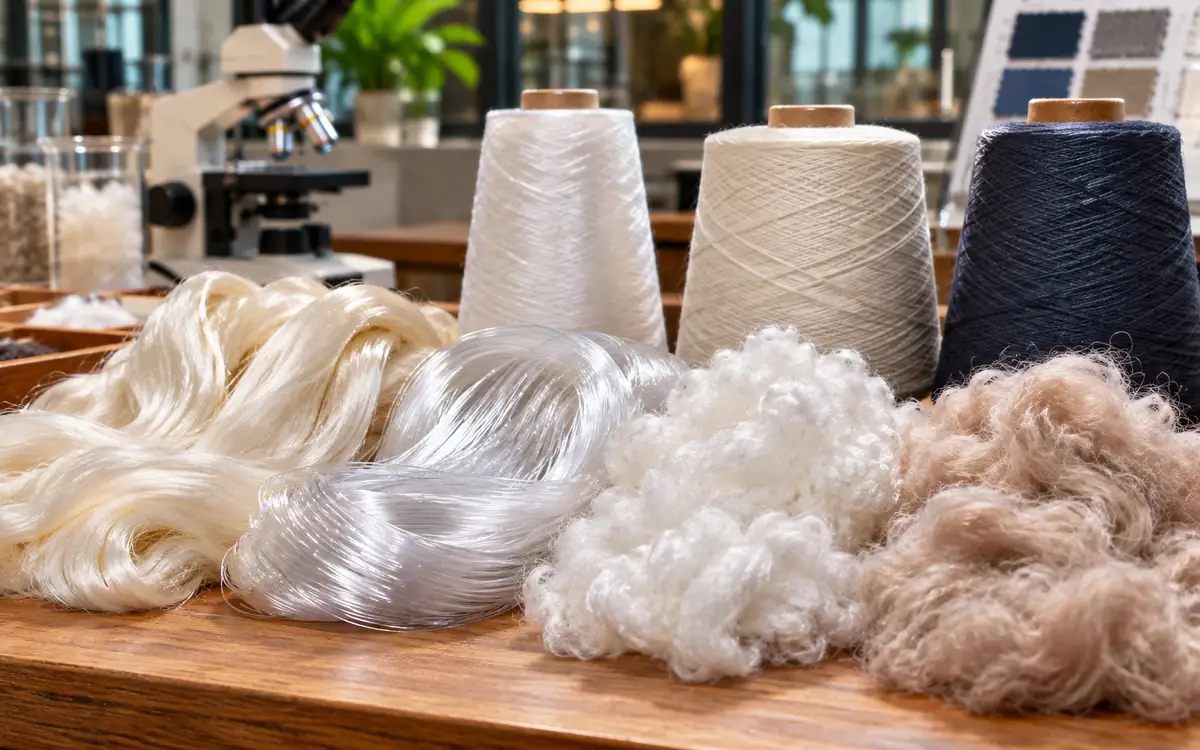
What are man-made fibres?
A man-made fibre is one that is produced by a manufacturing process instead of being collected as a fibre from nature. The basic recipe is the same for most of them. A liquid polymer (a long-chain molecule) is pushed through a plate with many tiny holes, called a spinneret. The thin streams harden into long filaments. These can be used as continuous filament yarn or cut into short lengths (staple) and spun like cotton.
The word “man-made” covers two families.
| Family | Raw material | Examples |
|---|---|---|
| Regenerated (cellulosic) | Natural polymer, usually wood pulp or other plant cellulose, dissolved and re-formed | Viscose rayon, modal, lyocell, acetate, cupro |
| Synthetic | Chemicals made from petroleum, natural gas or similar sources | Polyester, nylon (polyamide), acrylic, polypropylene, elastane (spandex) |
A third group sits beside these: high-performance fibres such as aramid, carbon and glass. They are man-made too, and they are made for strength, heat resistance or special jobs, not for everyday clothing.
Regenerated fibres are sometimes called semi-synthetic, since they start from a natural material but are heavily processed. Some textbooks and trade bodies group them with synthetics as man-made fibres, and others list them separately. Check which definition a source uses before comparing numbers.
Man-made vs natural fibres
| Feature | Natural fibres | Man-made fibres |
|---|---|---|
| Source | Plants, animals, minerals | Chemical or regenerated processes |
| Length | Staple, apart from silk | Any length, since filaments are made to order |
| Fineness and shape | Set by nature | Controlled by the spinneret and process |
| Consistency | Varies by crop and season | Very even |
| Special features | Limited | Can be made stretchy, flame resistant, wicking, shiny and more |
| Supply | Depends on harvests | Depends on plants and raw materials |
You can read a longer comparison in our guide to natural and synthetic fibre differences.
The main man-made fibres, one by one
Viscose rayon (regenerated)
Viscose, usually called rayon in the United States, is made from cellulose dissolved in chemicals and spun back into fibre. It is soft, drapes well and absorbs moisture. A commonly quoted moisture regain for viscose is about 13 percent, higher than cotton. It weakens when wet and wrinkles easily. It is used in dresses, blouses, linings and soft shirts. The first commercial rayon plant opened in France around 1890. Read more in our guide to rayon fabric.
Modal and lyocell (regenerated)
Both are improved cellulosic fibres. They are generally smoother and stronger than basic viscose and are often used in underwear, T-shirts and bed linen. Our page on modal fabric explains it in more detail.
Acetate (regenerated)
Acetate has a silky shine and a smooth drape, and it is used in linings, evening wear and some ribbons. It is weaker than other fibres and can be damaged by some solvents such as nail polish remover.
Polyester (synthetic)
Polyester is the world’s most produced fibre. It is strong, wrinkle resistant, quick drying and takes colour well with disperse dyes. It absorbs very little moisture, with a commonly quoted regain of about 0.4 percent. It is used in shirts, sportswear, jackets, home textiles, fill and industrial fabrics. See our guide to polyester fibre properties and uses, and our comparison of cotton vs polyester.
Nylon (polyamide) (synthetic)
Nylon is strong, elastic and resists abrasion. It is used in hosiery, activewear, swimwear, bags, ropes, carpets and parachutes. The two main types are nylon 6 and nylon 6,6. In one summary, nylon 6 accounts for about 60 percent of output and nylon 6,6 for about 40 percent. Commercial nylon production began in 1939 at DuPont. Our page on nylon 6 vs nylon 66 compares the two.
Acrylic (synthetic)
Acrylic feels soft and warm, like wool, and is lighter and cheaper. It is used in sweaters, blankets, socks and faux fur. It is prone to pilling and builds up static. Learn more in our guide to acrylic fibre.
Polypropylene (synthetic)
Polypropylene is very light, floats on water, absorbs almost no moisture and resists many chemicals. It is used in nonwovens, carpets, ropes and sportswear base layers. See polypropylene fibre properties and uses.
Elastane or spandex (synthetic)
Elastane can stretch several times its length and snap back. It is almost never used alone. A small share, often a few percent, is blended with other fibres for stretch in jeans, underwear, leggings and socks. Our guide to spandex, elastane and Lycra covers the details.
High-performance fibres
Aramid (Kevlar, Nomex), carbon and glass fibres are made for strength and heat. They appear in protective clothing, composites, filters and sports equipment. Our pages on what Kevlar is made of and glass fibre and high-performance fibres look at them.
Quick comparison
| Fibre | Family | Strength | Moisture uptake | Typical use |
|---|---|---|---|---|
| Viscose | Regenerated | Medium, weaker when wet | High | Dresses, linings, soft shirts |
| Modal / lyocell | Regenerated | Medium to good | High | Underwear, T-shirts, bedding |
| Acetate | Regenerated | Low | Medium | Linings, eveningwear |
| Polyester | Synthetic | High | Very low | Everyday wear, sport, home |
| Nylon | Synthetic | Very high | Low to medium | Hosiery, active, bags, rope |
| Acrylic | Synthetic | Medium | Low | Sweaters, blankets |
| Polypropylene | Synthetic | Medium | Almost none | Nonwovens, carpets |
| Elastane | Synthetic | Elastic | Low | Stretch in blends |
The ratings are general. Specific grades vary, so check the supplier’s data sheet.
A short timeline
- About 1890: the first commercial rayon plant opens in France.
- 1893: cellulose acetate is invented, and it reaches textile use in the 1920s.
- 1939: DuPont starts commercial nylon production.
- By the 1950s: polyester and acrylic are in production.
- 1960s: spandex and aramid fibres appear.
Dates come from fibre history summaries, and sources differ on some details, such as who first discovered a process. Treat the years as a guide.
How much of the world’s fibre is man-made?
A lot. The Textile Exchange Materials Market Report reports global fibre production of about 132 million tonnes in 2024, up 6.5 percent on 2023. The main shares were:
- Polyester: about 59 percent, or around 78 million tonnes
- Cotton: about 19 percent
- Man-made cellulosic fibres: about 6 percent, or 8.4 million tonnes
- Nylon: about 5 percent
- Wool: under 1 percent
Figures like these are updated each year, so check the latest report before you quote them in a plan or a presentation. Our page on man-made fibre demand and polyester spinners looks at the market side.
Add the man-made groups that the report names separately.
- Polyester: 78 million tonnes
- Man-made cellulosics: 8.4 million tonnes
- Nylon: 5 percent of 132 = 0.05 × 132 = 6.6 million tonnes
Total = 78 + 8.4 + 6.6 = 93.0 million tonnes
Share = 93.0 ÷ 132 = 70.5 percent
So at least about 70 percent of the world’s fibre is man-made, and the real figure is a little higher, because acrylic, polypropylene, elastane and other man-made fibres are not in this sum. It shows why any textile professional needs to understand them.
How to read a label: a worked example
Many garments mix fibres. Let us sort one label into fibre families.
Label: 60% polyester, 35% viscose, 5% elastane
| Fibre | Share | Family |
|---|---|---|
| Polyester | 60% | Synthetic |
| Viscose | 35% | Regenerated |
| Elastane | 5% | Synthetic |
- Synthetic share = 60 + 5 = 65%
- Regenerated share = 35%
- Natural share = 0%
- Man-made total = 65 + 35 = 100%
In a 200 g sample of this fabric, that is 120 g polyester, 70 g viscose and 10 g elastane.
Now compare a second label: 50% cotton, 50% polyester. The man-made share is 50 percent, all of it synthetic, and the natural share is 50 percent. If you buy for a business, ask for exact blend ratios, because they affect price, performance and care. Our page on why blended fibres are so popular explains the logic.
Worked example 2: moisture and comfort
Moisture regain is the water a fibre holds at room conditions as a percentage of its dry weight. Using commonly quoted values:
- Viscose: about 13 percent
- Nylon: about 4 percent
- Polyester: about 0.4 percent
For 100 g of dry fibre, that is about 13 g of water in viscose, 4 g in nylon and 0.4 g in polyester. Published tables differ a little, and some give nylon as 4.5 percent. The point is the gap. Viscose feels cool and damp against the skin, and polyester stays dry on the surface. That gap is why blends are used to balance comfort and performance.
Advantages and drawbacks
Advantages
- Consistent quality from batch to batch
- Can be engineered for strength, stretch, shine or flame resistance
- Often lower in price per kilogram than natural fibres
- Not tied to a harvest, so supply is steadier
- Easy to blend with natural fibres
Drawbacks
- Synthetic fibres come from fossil resources and do not break down easily
- Washing can release microfibres into water
- Some feel warm or clammy in heat
- Regenerated fibres use chemicals and water in production, so the process matters as much as the fibre
- Static, pilling and odour build-up are more common in some synthetics
Recycled options are growing. See our comparison of recycled polyester vs recycled cotton for the trade-offs.
Tips for buyers and students
- Learn the two families, regenerated and synthetic, before you memorise names.
- Read labels in full and add the percentages.
- Match the fibre to the use. Do not pick polyester for a hot-weather shirt on price alone, and do not pick viscose for a rain jacket.
- Ask for care and wash data on blends, since the weakest fibre often sets the limit.
- Check the date and source of any production statistics you use.
Final thoughts
Man-made fibres fall into two families, regenerated and synthetic, plus a group of high-performance fibres. Polyester leads by a wide margin, nylon and viscose follow, and elastane gives stretch in small amounts. Our worked examples showed that man-made fibres make up at least 70 percent of world production, and that a simple label can be sorted into families in a minute.
Knowing the fibre is the first step in judging a fabric. Once you know what a fibre is, how it is made and what it is good at, you can pick better materials, write clearer specs and spot weak claims on a label.
Frequently asked questions
They are fibres produced by manufacturing processes. Regenerated fibres such as viscose start from natural cellulose. Synthetic fibres such as polyester and nylon are made from chemicals.
Polyester, nylon, acrylic, polypropylene, elastane, viscose rayon, modal, lyocell, acetate, aramid, carbon and glass.
Synthetic fibres are built from chemicals. Regenerated fibres start from a natural polymer such as wood pulp, which is dissolved and re-formed.
Rayon (viscose) is man-made. It comes from natural cellulose but goes through heavy chemical processing.
Polyester. Textile Exchange reports it at about 59 percent of global fibre production in 2024.
It depends on the fibre and how it is made. Synthetics use fossil resources and shed microfibres. Regenerated fibres use chemicals and water. Recycling and better processes can reduce the impact.
Blending adds strength, shape retention, quick drying or stretch to cotton’s comfort, and it can lower cost.


