Most textile fibres come from plants, animals or oil. A small and very useful group comes from rock. Mineral fibers, also spelled mineral fibres, are made from natural minerals or from molten rock and glass. They do not burn, they do not rot and some of them are stronger than steel for their weight. That is why they turn up inside aircraft parts, fire blankets, building insulation and the cables that carry internet data.
This guide explains what mineral fibers are, how they fit into the usual fibre classification, the main types, their properties and uses, and why one of them, asbestos, is now banned in many countries. There is also a worked example that shows how to count the filaments in a glass fibre roving using tex and fibre diameter. If you are new to fibre families, our overview of the classification of textile fibres is a good place to start.
What are mineral fibers?
Mineral fibers are fibres whose raw material is inorganic. Inorganic here means the material is not built on the carbon chains found in plants, animals and plastics. Instead, these fibres are made of silicates, oxides and similar compounds that come from the earth.
In the standard textile classification, fibres are divided into natural and man-made groups. Natural fibres split into three kinds: plant (vegetable), animal and mineral. Asbestos is the only natural fibre in the mineral group. Man-made fibres split into regenerated, synthetic and inorganic types. The inorganic man-made fibres include glass, basalt, ceramic and metal fibres.
So when people say “mineral fibers,” they might mean one of two things:
- Natural mineral fibre. This is asbestos, which is dug out of the ground in a fibrous form.
- Man-made mineral fibres. These are made by melting rock, sand or other minerals and drawing the melt into thin fibres. This group includes glass fibre, basalt fibre, slag wool, rock wool and ceramic fibre.
We cover both below.
The main types of mineral fibers
1. Asbestos
Asbestos is a group of naturally fibrous silicate minerals. It was once called the “magic mineral.” The long, flexible fibres could be spun and woven, they did not burn and they were cheap. Fabrics woven from asbestos were used for fire curtains, brake linings, pipe wrap, roofing sheets and boiler insulation.
The main kinds are:
- Chrysotile (white asbestos). A curly, serpentine fibre. It was the most widely used type.
- Amosite (brown asbestos). A straight, brittle fibre used mostly in insulation boards.
- Crocidolite (blue asbestos). A very thin straight fibre. It is considered the most dangerous.
The problem is health. Tiny asbestos fibres float in the air when the material is cut, broken or worn. If they are breathed in, they can stay in the lungs for life. They are linked to asbestosis, lung cancer and mesothelioma, a cancer of the lung lining. The World Health Organization and many health agencies say there is no safe level of exposure. More than 60 countries have banned all types of asbestos, and many others restrict it. Even where it is still used, strict handling rules apply.
If you work in a mill or a workshop with old buildings, pipes or insulation, do not cut, drill or sand material that might contain asbestos. Have it tested and removed by licensed people.
2. Glass fibre
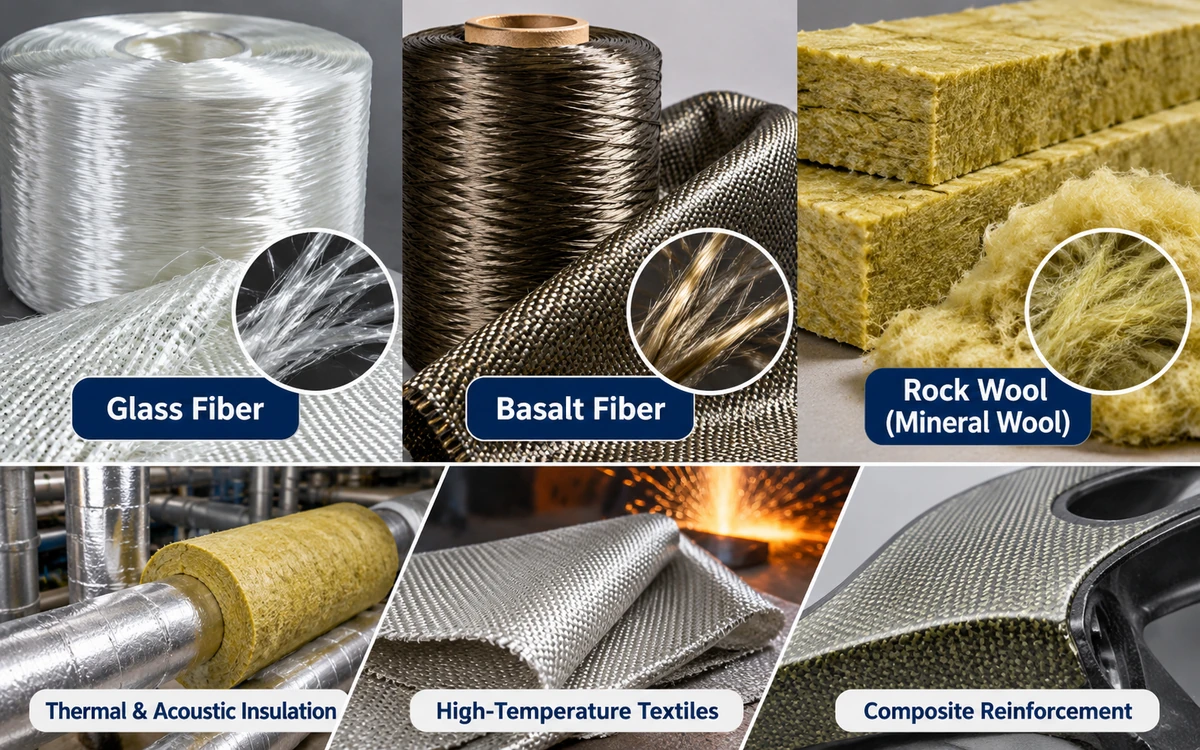
Glass fibre is the most widely used mineral fibre in industry. It is made from silica sand, limestone, soda ash and other minerals that are melted at about 1,400 to 1,500 °C. The molten glass runs through a bushing, a metal plate with hundreds of tiny holes, and the streams are drawn down into very fine filaments, typically 5 to 25 micrometres thick. A coating called sizing is applied straight away to protect the filaments and help them bond with resin later.
The most common type is E-glass, where the E stands for electrical, because of its good electrical insulation. Other types include S-glass for higher strength and C-glass for chemical resistance.
Glass fibre is made into:
- Continuous strands and rovings (bundles of strands)
- Chopped strand for moulding
- Woven fabrics and mats
- Fine fibres for filtration and insulation
Glass fibre is a mainstay of the composites industry. If you want details on its grades and use, read our page on glass fibre and other high-performance fibres.
3. Basalt fibre
Basalt is a dark volcanic rock found almost everywhere. To make basalt fibre, crushed rock is melted at about 1,400 °C and drawn into filaments in a way that is similar to glass. A great strength of the process is that it needs only one raw material, with no additives.
Basalt fibre has good strength, heat resistance and chemical resistance. It is usually gold-brown in colour. It is used in composites, fire-protective fabrics, reinforcing bars for concrete and friction products. It often costs less than carbon fibre and more than E-glass, though prices vary.
4. Mineral wool: rock wool and slag wool
Mineral wool is made by melting rock (rock wool) or furnace slag (slag wool) and spinning or blowing the melt into short, tangled fibres. The result looks like a soft, grey or yellow wool. It traps air well and does not burn, so it is a popular insulation for buildings, pipes and industrial ovens. It is not a textile fibre in the usual sense, because it is not spun into yarn. We include it because it is a common mineral fibre product.
5. Ceramic fibre
Ceramic fibres are made from alumina, silica or similar oxides. They stand extreme heat, often well above 1,000 °C depending on the grade, and are used in furnace linings, kiln blankets and heat shields. Because some ceramic fibres can release small particles, workers wear dust protection when handling them.
6. Metallic fibres
Metal fibres, such as stainless steel, aluminium or copper, are sometimes listed in the inorganic group. They are used for anti-static fabrics, shielding against electromagnetic waves, conductive yarns and decoration. They are spun on their own or blended with cotton or polyester at a low percentage.
Properties of mineral fibers
The table gives typical values for the most common types. Numbers vary with grade and source, so use them as a guide and check the maker’s data sheet for real design work.
| Fibre | Density (g/cm³) | Tensile strength | Max use temperature | Burns? | Main strength |
|---|---|---|---|---|---|
| Asbestos (chrysotile) | About 2.5 | High for a natural fibre | Breaks down at several hundred °C | No | Heat and chemical resistance |
| E-glass | About 2.55 to 2.6 | About 2 to 3.5 GPa as filament | Softens at around 800 °C | No | Strength, low cost, insulation |
| Basalt | About 2.6 to 2.8 | About 3 to 4.8 GPa as filament | Often cited up to around 650 to 800 °C | No | Heat resistance, alkali resistance |
| Ceramic (alumina-silica) | About 2.5 to 3.0 | Lower than glass | Often over 1,000 °C | No | Very high temperature use |
| Stainless steel fibre | About 7.9 | Moderate | High | No | Conductivity, shielding |
A few points stand out.
They do not burn. Because mineral fibres are inorganic, they cannot catch fire in the way cotton, polyester or wool do. They may soften or melt at high temperature, but they do not feed a flame.
They resist rotting. Fungi and insects feed on organic fibres. They do not feed on rock.
They are stiff and brittle. Mineral fibres have very low stretch. Glass, for example, breaks at about 2 to 5 percent elongation. Folding or rubbing can break the filaments.
They are dense. At 2.5 g/cm³ or more, mineral fibres are heavier than most synthetic fibres, such as polyester at 1.38 or polypropylene at 0.91. Still, their high strength can give a good strength-to-weight ratio.
They are poor at taking dye. Colouring is usually done by adding pigment to the melt or by coating, not by dyeing.
For a wider comparison with natural and synthetic fibres, see our guide to the properties of textile fibres.
A worked example: counting filaments in a glass fibre roving
Textile people use tex to describe how heavy a yarn or roving is. One tex means 1 gram per 1,000 metres. A roving that weighs 2,400 grams for every 1,000 metres is a 2,400 tex roving. Let us work out how many filaments are in it.
This is a good problem for a mill technician because roving data sheets list tex and filament diameter, but not the filament count. The calculation uses the volume of a thin cylinder.
Given
- Roving linear density: 2,400 tex
- Filament diameter: 17 micrometres = 17 × 10⁻⁶ m
- Glass density: 2.58 g/cm³ = 2,580 kg/m³
Step 1: Find the cross-section area of one filament.
Area = π ÷ 4 × d²
= 0.7854 × (17 × 10⁻⁶)²
= 0.7854 × 2.89 × 10⁻¹⁰
= 2.27 × 10⁻¹⁰ m²
Step 2: Find the mass of one metre of one filament.
Mass per metre = area × density
= 2.27 × 10⁻¹⁰ × 2,580
= 5.86 × 10⁻⁷ kg per metre
Step 3: Convert to tex.
Tex is grams per 1,000 metres. 5.86 × 10⁻⁷ kg per metre is 5.86 × 10⁻⁴ g per metre, so for 1,000 metres it is 0.586 g. One filament is about 0.586 tex.
Step 4: Divide.
Number of filaments = 2,400 ÷ 0.586 = about 4,096.
So the roving contains roughly 4,100 filaments. The real number is usually near this value because the sizing adds a little weight and the true diameter varies a little. The check is useful anyway. If a data sheet gave 17 micrometre filaments and a count far from 4,100, you would know something did not match.
Now apply the same method to a finer product. A 68 tex glass yarn with 9 micrometre filaments:
- Area = 0.7854 × (9 × 10⁻⁶)² = 0.7854 × 8.1 × 10⁻¹¹ = 6.36 × 10⁻¹¹ m²
- Mass per metre = 6.36 × 10⁻¹¹ × 2,580 = 1.64 × 10⁻⁷ kg, which is 0.164 tex
- Filaments = 68 ÷ 0.164 = about 415
You can see why fine yarns feel soft and drape well. They have hundreds of tiny filaments rather than thousands of thick ones. If you want to review the tex system, our page on yarn count explains each system.
Uses of mineral fibers
Building and insulation
Rock wool and glass wool insulate walls, roofs and pipes. They save energy and slow the spread of fire. Glass fibre mesh reinforces plaster and waterproof membranes. Basalt bars are used in concrete where steel would rust.
Composites
Glass fibre reinforced plastic, often called fibreglass, is used in boat hulls, wind turbine blades, car parts, water tanks, pipes and sports gear. Basalt composites are used in similar ways. See our guide on technical textiles for how fibre reinforcement fits into this field.
Fire and heat protection
Glass fibre and basalt fabrics make welding blankets, fire curtains and heat shields. Ceramic fibre lines furnaces.
Filtration
Fine glass fibre makes air filters, including HEPA filters, and filters for liquid.
Electrical and electronics
Glass fabric is the base of printed circuit boards. Glass fibre also carries light in optical cables, though those use ultra-pure glass made by a different process than reinforcement glass.
Textiles and clothing
Mineral fibres have a small role in clothing. Glass fibre is sometimes used in curtains and fire-resistant fabrics. Metal fibres appear in anti-static work wear and touch-screen gloves. Asbestos clothing, once used by firefighters and foundry workers, is no longer acceptable.
Advantages and limits
Advantages
- Do not burn and resist high heat
- Do not rot or attract insects
- High strength, good stiffness
- Good chemical resistance
- Many are low in cost, especially glass
Limits
- Brittle, with poor flex and abrasion resistance
- Heavy compared with synthetic fibres
- Skin irritation from fine glass fibre dust
- Difficult to dye
- Hard to recycle, particularly when bonded to resin
- Asbestos is a serious health hazard
Handling glass and mineral fibres safely
Fine fibres can irritate skin, eyes and the nose. Simple habits reduce the problem:
- Wear gloves, long sleeves, safety glasses and a dust mask or respirator that fits well.
- Wash exposed skin with cool water and soap. Hot water opens the pores and can make the itch worse.
- Wash work clothes separately.
- Use dust extraction when cutting or grinding.
- Never dry sweep fibre dust. Use a vacuum with a proper filter.
Workplace rules differ by country, so follow your local safety guidance.
Final thoughts
Mineral fibers come from rock, sand and other inorganic raw materials. The natural one, asbestos, is now banned in many countries because of the harm it does to lungs. The man-made ones, glass, basalt, mineral wool and ceramic, do very useful work in buildings, composites, filters and fire protection. They do not burn, they do not rot and they offer high strength for their cost. They are also brittle, dense and hard to dye.
If you work in textiles, you will most likely meet glass fibre first. Learn to read its tex and filament data, as in our worked example, and you will be able to check a data sheet with confidence.
Frequently asked questions
Mineral fibers are fibres made from inorganic raw materials such as rock, sand or minerals. They include natural asbestos and man-made fibres such as glass, basalt, ceramic and mineral wool.
Asbestos is a natural fibre. It is mined as a fibrous mineral and is the only natural fibre in the mineral group of the standard classification.
Breathing asbestos fibres can cause asbestosis, lung cancer and mesothelioma. Health agencies say there is no known safe level of exposure, so many countries have banned it.
Yes. Glass fibre is a man-made mineral fibre. It is spun from molten silica-based glass, and it does not burn or rot.
Glass fibre is made from a mix of sand, limestone and other minerals. Basalt fibre is made by melting one natural volcanic rock. Basalt often has higher heat and alkali resistance, while glass usually costs less.
No. Mineral fibres are inorganic, so they do not burn the way cotton, wool or polyester do. They can soften or melt at high temperatures.
They are hard to dye in the usual way. Colour is normally added as pigment in the melt, or as a coating on the surface.