You are in a fabric shop, the pattern says you need two and a half yards, and the assistant asks, “Cut it for you?” Do you know what a yard of fabric looks like? Knowing how to measure a yard of fabric sounds simple, since a yard is only a length. Fabric makes it harder than it sounds. The cloth has a width as well as a length. It can stretch when you pull it. It might be sold by the metre, the kilogram or the roll. And the number on the pattern may assume a different width from the one you are about to buy.
This guide shows how to measure a yard of fabric by hand, with or without a ruler, how to convert between yards, metres, inches and kilograms, and how to work out how much fabric a project needs. It includes worked examples with real numbers, from a home sewing task to a 500 kg factory roll. If you also want to understand how fabric weight is expressed, our guide to GSM in fabric pairs well with this one.
How long is a yard?
A yard is a unit of length in the imperial and US customary systems.
- 1 yard = 3 feet = 36 inches
- 1 yard = 0.9144 metres = 91.44 centimetres
- 1 metre = 1.0936 yards = 39.37 inches
So a metre is a little longer than a yard, by about 9 cm or 3.5 inches. If a shop sells fabric by the metre and your pattern asks for yards, you need to convert.
Fabric is measured along its length, running parallel to the selvedge. The selvedge is the finished edge of the fabric that does not fray. The width is measured across, from selvedge to selvedge.
Common fabric widths
Fabric comes in standard widths, and the width changes how much length you need.
| Width | Centimetres | Typical use |
|---|---|---|
| 36 in | 91 cm | Some quilting cottons, narrow silk, older fabrics |
| 44 to 45 in | 112 to 115 cm | Quilting cotton, many dress fabrics |
| 54 in | 137 cm | Some upholstery and home fabrics |
| 58 to 60 in | 147 to 152 cm | Many knits, suitings, wide dress fabrics |
| 72 in | 183 cm | Some fleece and craft fabrics |
| 90 to 108 in | 229 to 274 cm | Sheeting and backing fabric |
Check the width on the bolt end or label before you buy. Many patterns list the yardage needed for two common widths, usually 45 inch and 60 inch.
How to measure a yard of fabric by hand
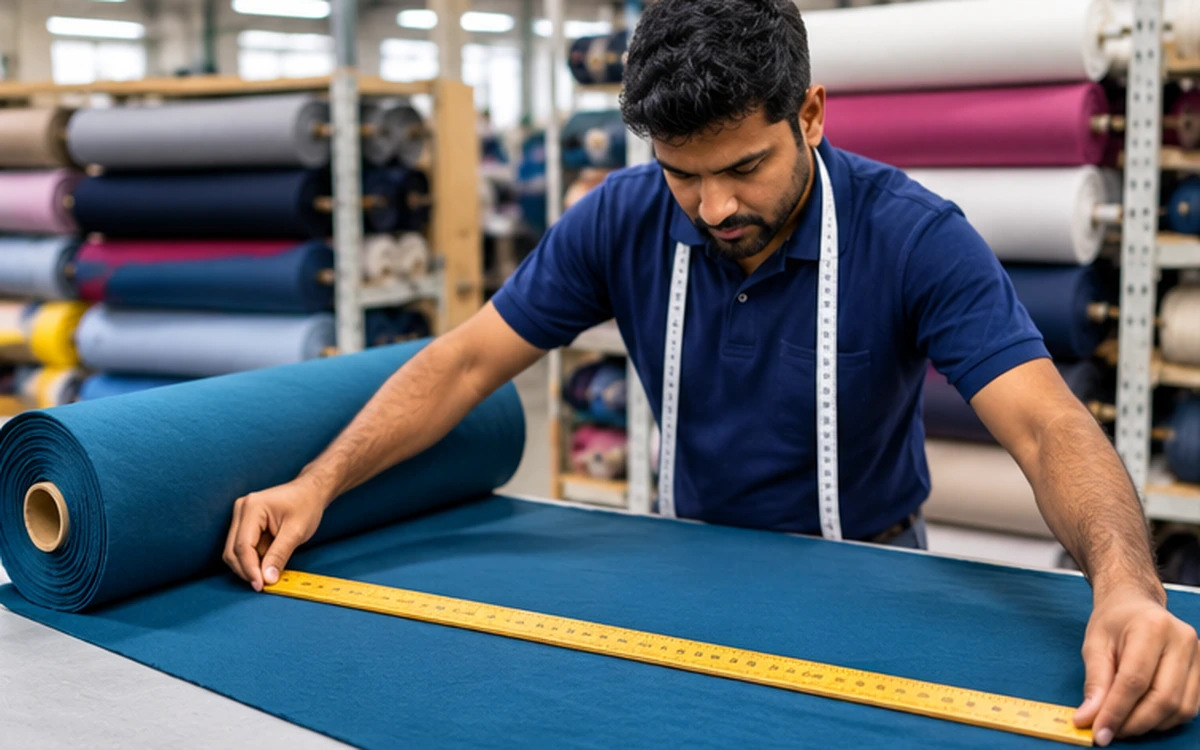
With a yardstick or tape
- Lay the fabric flat. Use a large table or the floor. Smooth out wrinkles but do not stretch the fabric.
- Find the selvedge. Line up one selvedge along the edge of the table or along your yardstick.
- Mark the start. Make a small clip or a chalk mark at the cut edge of the fabric, which will be your zero point.
- Measure 36 inches along the selvedge. Use a yardstick or a tape marked in inches. Mark the 36 inch point with a pin or chalk.
- Mark across. Use a square ruler or fold the fabric to mark a straight line from selvedge to selvedge at the 36 inch point.
- Cut. Cut along the line. If you can, pull a single thread across the width and cut along the gap it leaves. This follows the true grain.
With a metre ruler
If you only have a metre ruler, a yard is 91.4 cm, which is about 8.6 cm shorter than a metre. Measure 91.4 cm and mark it. Or take a full metre and cut off a strip of about 8.5 cm from the end.
With no ruler at all
You can estimate. A yard is about the distance from the tip of your nose to the end of your outstretched fingers, for many adults. It is also close to the length of one large step. This method is only for rough estimates, never for fabric you will pay for.
Using a bolt or measuring table
Shops often have a measuring tape fixed to the cutting table. Fabric is laid flat and the cut is made at the number needed. Some use a measuring machine that counts the fabric as it passes. When you buy, watch the cut and check the fabric lies flat and relaxed.
Common problems when measuring fabric
- Stretching. Knit and stretchy fabrics grow when pulled. Let them lie flat and relaxed, and measure with a light touch.
- Off-grain ends. Many bolts are cut crooked at the end. After you cut, square the end by pulling a thread or folding the selvedges together.
- Folded fabric. Fabric usually sits on the bolt folded in half lengthwise. The width on the label is the open width, from one selvedge to the other. Unfold a corner and check before you buy.
- Shrinkage. Fabric can shrink after washing, so measure and buy with that in mind. We will include this in the examples.
- Pattern repeats. Printed fabrics with big motifs need extra length for matching.
Yards, metres and inches: quick conversions
Here is a handy chart for common amounts.
| Yards | Metres | Inches |
|---|---|---|
| 0.25 (quarter) | 0.23 | 9 |
| 0.5 (half) | 0.46 | 18 |
| 1 | 0.91 | 36 |
| 1.5 | 1.37 | 54 |
| 2 | 1.83 | 72 |
| 2.5 | 2.29 | 90 |
| 3 | 2.74 | 108 |
| 5 | 4.57 | 180 |
| 10 | 9.14 | 360 |
To convert yards to metres, multiply by 0.9144. To convert metres to yards, divide by 0.9144 or multiply by 1.0936.
Example: You need 3.5 yards. In metres that is 3.5 × 0.9144 = 3.20 m. If the shop sells by the metre, ask for 3.2 m, or round up to 3.25 m to be safe.
Example on price: A fabric costs 12 per metre. What is the price per yard? Price per yard = 12 × 0.9144 = 10.97. Since a yard is shorter than a metre, the price per yard is lower than the price per metre.
How much fabric does a project need?
Patterns come with yardage charts. But what if the width is different, or you are working without a pattern? Here are some rules and worked examples.
Changing width
If you buy wider fabric than the pattern assumes, you can usually buy less length. If narrower, you need more. A good first estimate is to keep the total area the same:
New length = old length × old width ÷ new width
Example: A pattern asks for 3 yards of 45 inch fabric. The fabric you like is 60 inches wide.
New length = 3 × 45 ÷ 60 = 135 ÷ 60 = 2.25 yards
Round up to 2.5 yards for a safe margin, because pattern pieces may not fit perfectly into a wider width. It depends on the layout, so check the pattern’s chart if one is given for 60 inch fabric.
Adding allowances
Add extra length for these needs:
- Shrinkage. Natural fibres such as cotton and linen can shrink around 3 to 5 percent in length. Pre-wash and measure again, or add the percentage.
- Matching prints. Add one repeat length for each major seam or panel, or around 10 to 20 percent for strong patterns.
- Nap or one-way fabric. Velvet and corduroy must be cut in one direction. This can add 10 to 15 percent.
- Mistakes. A small safety margin, such as a quarter yard, is wise for first projects.
Example: A dress needs 2.75 yards. The cotton may shrink 4 percent and has a medium-size print.
- Shrinkage allowance = 2.75 × 0.04 = 0.11 yard
- Pattern matching allowance, say 10 percent = 2.75 × 0.10 = 0.275 yard
- Total = 2.75 + 0.11 + 0.275 = 3.135 yards
Buy 3.25 yards. That gives a little spare.
Rough yardage for common items
These are very rough figures, for adult sizes in 45 inch wide fabric. Always check the pattern for your size.
| Item | Rough yardage |
|---|---|
| Simple skirt | 1.5 to 2 yards |
| Short-sleeve shirt | 2 to 2.5 yards |
| Basic dress | 3 to 4 yards |
| Trousers | 2.5 to 3 yards |
| Pillow cover (45 cm square) | 0.5 yard |
| Curtain panel | Depends on height and fullness |
For a full garment example in a factory setting, see our guide to the fabric consumption of a basic T-shirt.
Converting between weight and length
In factories and wholesale trade, fabric is often bought by weight (kilograms) and used by length (metres or yards). To convert, you need the fabric weight in GSM and the width.
The formula is:
Length in metres = weight in grams ÷ (GSM × width in metres)
Reason: GSM is grams per square metre. Width times length gives the area. Area times GSM gives grams.
Worked example: a 500 kg roll
A roll of single jersey weighs 500 kg. The fabric is 180 GSM and 1.8 m wide.
Step 1: Convert the weight to grams.
500 kg = 500,000 g
Step 2: Find the weight of one running metre.
1 metre length × 1.8 m width = 1.8 m². Weight = 180 × 1.8 = 324 g per metre.
Step 3: Find the length.
Length = 500,000 ÷ 324 = 1,543.2 metres
Step 4: Convert to yards.
Yards = 1,543.2 ÷ 0.9144 = 1,687.7 yards
So a 500 kg roll gives about 1,543 metres, or 1,688 yards. If the buyer sells the fabric by the yard, this calculation shows how many yards they can sell from the roll.
Worked example: from length to weight
A shop has 40 yards of woven cotton, 150 GSM, 58 inches wide. What does it weigh?
Step 1: Convert to metric.
- Length = 40 × 0.9144 = 36.58 m
- Width = 58 × 0.0254 = 1.473 m
Step 2: Find the area.
Area = 36.58 × 1.473 = 53.88 m²
Step 3: Find the weight.
Weight = 53.88 × 150 = 8,082 g, about 8.1 kg
Worked example: price per kilogram to price per yard
Fabric costs USD 6.00 per kilogram. It is 180 GSM, 1.8 m wide.
- Weight per metre = 324 g = 0.324 kg
- Price per metre = 6.00 × 0.324 = USD 1.944
- Price per yard = 1.944 × 0.9144 = USD 1.78
This is the cost before waste and trimming. It shows why buyers think in kilograms when comparing mill quotes and in metres or yards when planning marker layouts. For more on weight and construction, see our table of fabric types, names and GSM.
Measuring fabric in a factory
In a garment factory, fabric is measured for several reasons: checking the received length against the packing list, inspecting quality, planning the cutting table and calculating consumption. The usual tools are:
- Fabric inspection machine. It unrolls fabric over a lit table and counts the length with a meter.
- Measuring table. Fabric is laid flat and measured by hand.
- Weighing scale. Used for rolls bought by weight.
When a roll shows less length than the packing list, a shortage claim can be raised. Differences between the labelled and actual width also matter, because a narrower fabric raises the consumption per garment. For the length-weight link, mills often print both the metres and the kilograms on the roll ticket.
Tips for buying fabric
- Always check the width on the bolt.
- Add a small safety margin of 5 to 10 percent for a first project.
- Pre-wash fabrics that shrink before cutting.
- Buy all fabric from the same dye lot for one project.
- Ask the shop to cut along the grain or tear woven fabric where it is suitable.
- Take a note of the fibre content and the care label. See our guide to care labels and wash symbols.
- When buying cotton, read our tips for buying the right cotton fabric.
Final thoughts
Measuring a yard of fabric is easy once you remember three points. A yard is 36 inches or 91.44 centimetres. You measure along the selvedge, with the fabric laid flat and relaxed. And the width matters as much as the length. With those facts and the simple formulas in this guide, you can convert yards to metres, adjust yardage for a different width, add allowances for shrinkage and print matching, and turn a roll weight into a length.
Keep a small tape measure and a calculator in your bag, and you will never be surprised at the cutting table again.
Frequently asked questions
A yard of fabric is 36 inches long, which equals 91.44 centimetres or 0.9144 metres. The length is measured along the selvedge.
No. A metre is about 9 cm longer than a yard. One metre equals 1.0936 yards.
A yard is a length, not a width. The width depends on the fabric. Common widths are 44 to 45 inches and 58 to 60 inches.
Multiply the number of yards by 0.9144. For example, 3 yards is 3 × 0.9144 = 2.74 metres.
As a first estimate, multiply the pattern length by the old width and divide by the new width. For example, 3 yards at 45 inches becomes about 2.25 yards at 60 inches. Round up and check the pattern’s chart.
Divide the weight in grams by the GSM multiplied by the width in metres. For instance, 500 kg of 180 GSM fabric at 1.8 m wide gives about 1,543 metres.
Add around 5 to 10 percent for a simple first project. Add more for fabrics that shrink, have large prints that must match or have a nap that needs to run in one direction.