The custom apparel industry has witnessed a dramatic shift over the past decade. Online platforms promise low prices and vast selection, yet many customers find themselves waiting weeks for orders while struggling with impersonal customer service and inconsistent quality. This gap has created an unexpected opportunity for local print shops that can deliver speed, flexibility, and hands-on expertise that algorithms cannot replicate.
The Hidden Costs of Offshore Printing
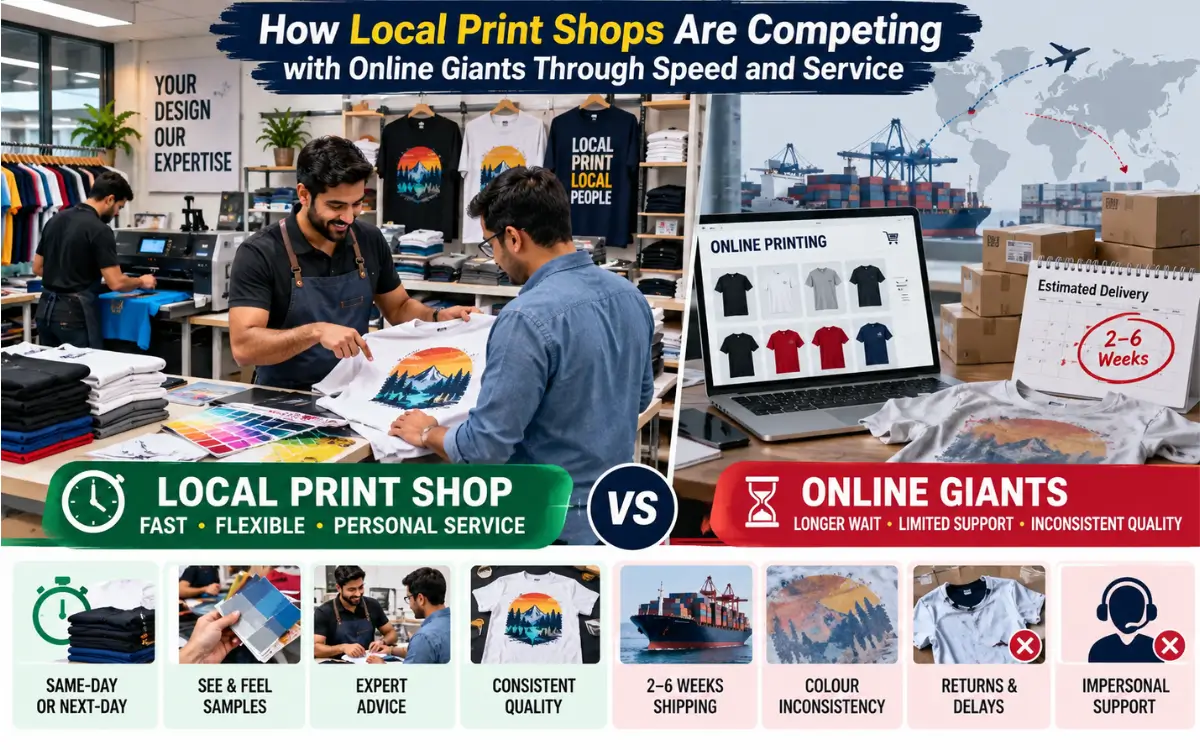
Large online printing operations often outsource production to overseas facilities, which introduces several complications that become apparent only after an order is placed. Shipping times stretch from two to six weeks, making last-minute events or replacement orders nearly impossible. Colour accuracy suffers when designs travel through multiple file conversions and production handoffs, and customers discover that the vibrant logo they uploaded arrives faded or shifted in hue.
Returns and corrections compound the problem. When a batch of team jerseys arrives with misspelled names or incorrect sizes, the process of shipping them back internationally, waiting for replacement production, and receiving the corrected order can consume another month. For time-sensitive projects such as charity runs, corporate events, or school fundraisers, these delays can be catastrophic.
What Local Shops Offer Beyond Convenience
Proximity matters in custom printing, but not merely because of shorter delivery distances. Local operations provide face-to-face design consultations where customers can feel fabric weights, compare actual ink samples, and make adjustments based on physical prototypes rather than screen mockups. This tactile element prevents expensive mistakes and ensures the final product matches expectations.
The ability to handle urgent requests separates neighbourhood print shops from distant competitors. A restaurant opening with unbranded staff uniforms, a campaign volunteer coordinator realising they need shirts for a weekend rally, or a sports league discovering their order was lost by another vendor all represent scenarios where same-day or next-day turnaround becomes essential. Local facilities equipped with direct-to-garment printers or efficient screen printing setups can accommodate these emergencies without the premium surcharges that online rush services demand.
Understanding Modern Printing Methods
The technology available to print shops has evolved considerably, allowing smaller operations to match or exceed the capabilities of large-scale manufacturers. Direct-to-garment printing uses modified inkjet technology to apply water-based inks directly onto fabric, ideal for complex designs with multiple colours or photographic elements. Screen printing remains superior for bulk orders and designs requiring vibrant, opaque colours, particularly on dark garments. Heat transfer methods work well for small batches and specialty materials like performance fabrics. Each technique carries distinct advantages in durability, cost efficiency, and visual effect, and knowledgeable local printers guide customers toward the method that suits their specific application. For a detailed comparison of these approaches and their appropriate uses, different printing methods produce different results depending on fabric type and design complexity.
When Speed Matters Most
Certain industries depend on rapid apparel production as a core component of their operations. Construction contractors bidding on projects need branded shirts for site visits within days of winning contracts. Political campaigns require volunteer shirts between the announcement of an event and its occurrence, often a window of less than 72 hours. Nonprofit organisations coordinating disaster relief efforts need identification apparel for volunteers deployed on short notice.
Businesses throughout Phoenix and similar metropolitan areas have found that working with regional providers who understand local demand patterns delivers practical advantages. One example of this regional approach is custom t-shirt printing Phoenix operations offer, where same-day turnaround options and no minimum order requirements accommodate both emergency requests and ongoing business needs without the complexity of managing inventory or long-term commitments.
Quality Control and the Local Advantage
Inspection becomes straightforward when production occurs nearby. Customers can request to see samples before committing to full runs, examine the actual garments being used rather than relying on generic product descriptions, and verify print quality matches their standards. When issues do arise, a colour that appears different under natural light, a print placement that interferes with seams, or a fabric blend that feels uncomfortable, resolution happens through direct conversation rather than email chains with overseas support teams working in different time zones.
The environmental dimension deserves consideration as well. Shorter supply chains mean reduced transportation emissions, and local shops typically maintain smaller, more flexible inventories rather than warehousing massive quantities of pre-printed stock that may eventually be discarded. Some progressive print facilities have adopted water-based inks and energy-efficient curing processes, investments easier to verify and support when the business operates down the street rather than across an ocean.
DIY Alternatives and Their Limitations
Enterprising individuals sometimes consider home printing as a cost-saving measure. Kits for screen printing at home have become more accessible, and enthusiasts have documented their processes extensively. Home screen printing setups can work for hobbyists producing small quantities, but they require significant time investment, dedicated workspace, proper ventilation, and practice to achieve consistent results.
The equipment costs add up quickly: exposure units, washout stations, mesh screens in various counts, squeegees, inks, emulsions, and curing heat sources. For someone printing a handful of shirts annually, these expenses rarely justify themselves compared to professional services. The learning curve is steep, with common failures including ink bleeding, incomplete curing that washes out, and registration problems when printing multiple colours. Professional shops amortise their equipment costs across thousands of garments and have refined their processes through years of experience.
Building Ongoing Partnerships
Businesses that regularly need custom apparel benefit from establishing relationships with local printers. Repeat customers gain access to stored artwork files, expedited reorder processes, and sometimes preferential pricing or scheduling. A restaurant group adding new locations can replicate existing uniform designs without recreating specifications from scratch. A school refreshing sports team uniforms each year works with a printer who already knows sizing distributions and preferred styles.
These partnerships create mutual understanding that transcends individual transactions. Printers learn their regular customers’ expectations, deadlines, and quirks, while customers gain confidence in consistent quality and reliable delivery. When unusual requests arise, printing on unconventional materials, matching precise corporate colours, or coordinating complex multi-location deliveries, established relationships make problem-solving collaborative rather than adversarial.
The Future of Local Custom Printing
Technology will continue advancing, but the fundamental advantages of local production remain structural rather than temporary. As on-demand manufacturing becomes more sophisticated, the ability to produce small batches economically strengthens the position of neighbourhood shops against mass-production competitors. Digital design tools integrated with local printing facilities allow customers to visualise and approve designs in real time, then receive finished products within hours.
The most successful local print operations have embraced technology without sacrificing personal service. Online design tools, automated quoting systems, and digital proof approvals streamline routine orders while preserving the option for customers who need consultation or have complex requirements. This hybrid approach captures the convenience customers expect from online services while maintaining the responsiveness and quality assurance that physical proximity enables.
For organisations and individuals evaluating printing options, the decision ultimately rests on priorities. Projects with flexible timelines and simple designs may find adequate solutions through large online platforms. Those requiring speed, certainty, or nuanced customisation will continue discovering that local expertise and rapid turnaround justify any marginal cost difference, particularly when factoring in the hidden expenses of delays, returns, and quality issues that distant providers can introduce.