
The question a factory owner actually needs answered isn’t “which cutting method is better.” It’s “at what volume does automatic cutting start paying for itself faster than the capital sits idle.” Straight-knife manual cutting and automated CNC cutting systems both have a legitimate place in garment manufacturing, and the right answer depends far more on daily meterage and style variety than on which system is technically more capable.
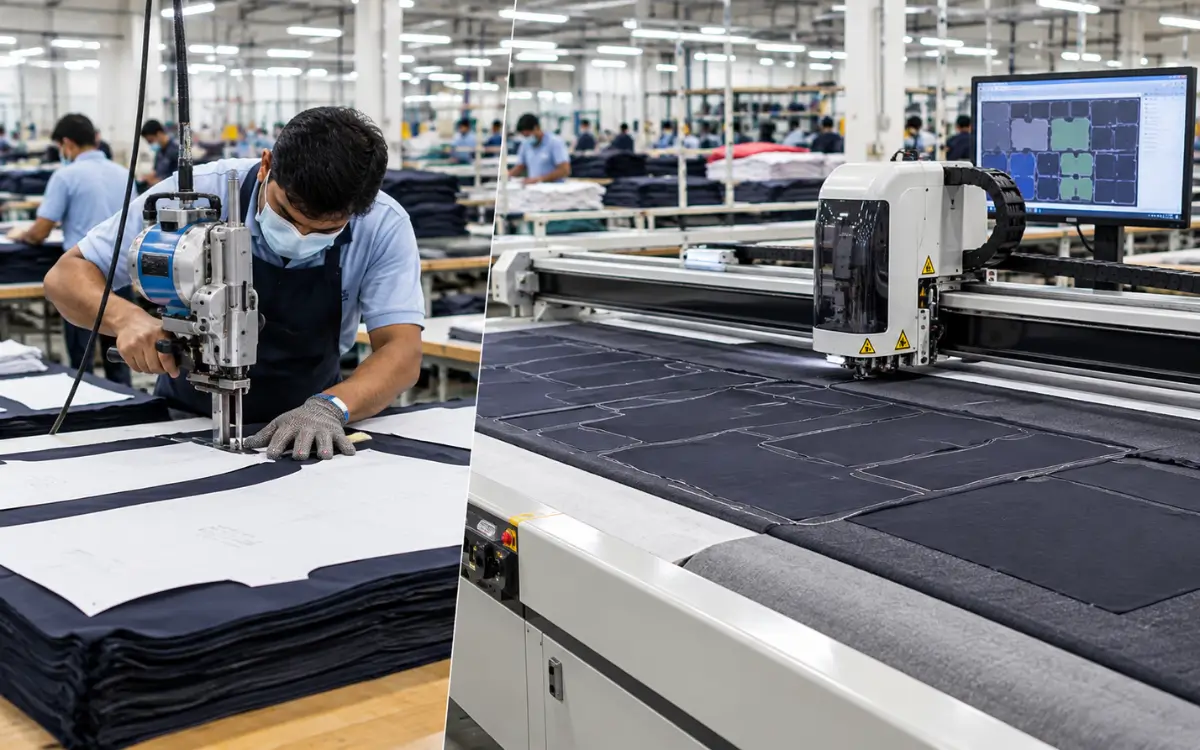
How the Two Systems Actually Differ
For a step-by-step look at how a cutting section actually sequences this work, see this process sequence of fabric cutting. Manual straight-knife cutting relies on an operator guiding a vertical or horizontal blade along a marker laid over stacked fabric plies. It’s flexible, relatively cheap to acquire and maintain, and doesn’t require specialized digital marker files to operate, which makes it well suited to factories running high style variety with frequent pattern changes.
Automatic cutting systems, most commonly CNC-driven flatbed or conveyorized cutters, read a digital marker file and cut multiple plies with a reciprocating or rotary blade, sometimes paired with automatic spreading equipment upstream. The system’s accuracy doesn’t degrade with operator fatigue the way manual cutting can late in a long shift, and it holds tighter tolerance on cut edges, particularly on curved pattern pieces where manual cutting is most prone to drift.
Fabric Utilization: Where the Real Savings Sit
Fabric is typically the largest single cost in a garment’s bill of materials, which makes fabric utilization the largest financial difference between these two cutting methods, more so than labor savings in many cases. Automatic cutting systems paired with computerized marker-making software consistently achieve tighter marker efficiency than manual marker-making and manual cutting combined, since the software can test far more marker layout permutations than a person manually arranging pattern pieces on paper.
The utilization gap between automatic and manual cutting commonly runs a few percentage points, and while that sounds modest, it compounds directly against fabric spend. A factory cutting a large volume of fabric annually sees that percentage-point gap translate into a meaningful absolute figure, since it applies to every meter of fabric purchased, not just a portion of it.
Cost Per Ply and Labor Comparison
Manual cutting requires skilled cutters whose output scales roughly linearly with headcount, and cutting speed depends heavily on operator skill and fabric type. Automatic cutting systems have a higher fixed cost but a lower marginal labor cost per ply cut, since one operator can typically oversee a cutting system processing considerably more fabric per hour than a comparable number of manual cutters working the same volume.
This is the classic fixed-cost-versus-variable-cost trade-off. At low daily meterage, manual cutting’s lower fixed cost wins because there isn’t enough volume to spread an automatic system’s higher upfront cost across. At high daily meterage, the automatic system’s lower marginal cost per ply eventually overtakes manual cutting’s cost structure, and the crossover point is where automation starts making financial sense.
Where the Volume Threshold Typically Sits
The exact crossover point depends on labor cost in a given market, fabric cost, and the specific automatic system’s throughput and price, so there’s no single universal number that applies everywhere. That said, the pattern holds consistently across markets: factories cutting low daily meterage with high style variety generally find manual cutting’s flexibility and lower capital outlay hard to beat, while factories running high daily meterage on a smaller number of styles, where marker files get reused across large cut quantities, see automatic systems pay back their capital cost within a reasonable number of operating years through the combination of fabric utilization gains and reduced labor cost per unit cut.
Style variety matters here as much as raw volume. An automatic system’s marker-reading advantage depends on markers being created and reused efficiently, and a factory that changes styles constantly gets less benefit from automation’s speed advantage than one running long, consistent cut orders.
Payback Period: What to Actually Calculate
A proper payback calculation for automatic cutting equipment needs to account for the capital cost difference between the two systems, the ongoing labor cost difference at your actual planned volume, and the fabric savings from improved utilization at your actual fabric cost per meter. Add the fabric savings and labor savings together as an annual figure, then divide the capital cost difference by that annual savings figure to arrive at a payback period in years.
Factories often calculate payback using labor savings alone and get a payback period that looks unattractive, only to find the real payback is considerably faster once fabric utilization savings are added into the calculation. Since fabric is usually the larger cost category, leaving it out of the payback model understates automation’s financial case more often than it overstates it.
Marker Software Independent of Cutting Method
It’s worth separating two decisions that sometimes get bundled together: the cutting method itself, and the marker-making software used to plan fabric layout before cutting. Computerized marker-making software, which optimizes pattern piece layout algorithmically rather than relying on a marker-maker’s manual arrangement, can be paired with either manual or automatic cutting, and adopting better marker software is a lower-capital step that can capture some fabric utilization improvement even for a factory not yet ready to invest in full cutting automation. This is worth considering as an intermediate step for factories where the automatic cutting payback calculation doesn’t yet clear the bar covered above, since improved marker efficiency alone, without touching the cutting method, can meaningfully narrow the utilization gap between manual and automatic cutting described earlier in this article, changing the economics of the eventual full automation decision by raising the manual baseline it’s being compared against.
Beyond the Numbers: Quality and Consistency
Cost isn’t the only factor worth weighing. Automatic cutting systems produce more consistent cut edges across an entire cut lot, which matters for downstream sewing accuracy, particularly on pattern pieces with tight tolerance requirements or complex curves where manual cutting drift is most likely to occur. For factories producing technical or precision-fit garments, this consistency argument sometimes justifies automation even at volumes where the pure cost payback calculation is marginal.
A Worked Payback Example
Concrete numbers make this easier to apply than formulas alone, so here’s a simplified worked example using illustrative figures. Treat every number below as a placeholder to replace with your own mill’s actual costs, not a benchmark to copy.
Assume a factory cutting 3,000 meters of fabric a day, running 300 working days a year, for total annual fabric consumption of 900,000 meters. Fabric costs $4.00 per meter. Under manual cutting, average fabric utilization runs 82 percent. A specific automatic cutting system under consideration is quoted at achieving 87 percent utilization on the same marker library, a 5 percentage point improvement.
Fabric savings: A 5 percentage point utilization gain on 900,000 meters at $4.00 per meter works out to roughly 900,000 × 0.05 × $4.00 = $180,000 in annual fabric savings, before accounting for labor.
Labor savings: Say manual cutting currently requires 6 cutters at a fully loaded annual cost of $3,600 each ($21,600 total), while the automatic system needs 2 operators overseeing it at the same loaded cost ($7,200 total), for a labor saving of $14,400 a year.
Combined annual saving: $180,000 + $14,400 = $194,400 a year.
Capital cost difference: Say the automatic cutting system costs $220,000 installed, against $25,000 for an equivalent-capacity manual cutting setup, a capital difference of $195,000.
Payback period: $195,000 ÷ $194,400 ≈ 1 year.
Notice how much of that payback is driven by fabric utilization, not labor. A factory running the same calculation using only the labor saving ($14,400) against the same $195,000 capital difference would get a payback period of over 13 years, which looks unattractive and might lead to skipping automation entirely. Including fabric utilization savings, which the earlier section of this article flagged as usually the larger factor, changes the conclusion completely. This is exactly why leaving fabric savings out of the calculation, a common shortcut, understates automation’s case far more often than it overstates it.
A Practical Way to Decide
Rather than treating this as a binary choice, calculate your actual daily meterage, current fabric utilization rate under manual cutting, current cutting labor cost, and get a real quotation for an automatic system sized to your volume. Run the payback calculation using your own numbers rather than industry averages, since labor cost, fabric cost, and specific machine pricing all vary enough by market and supplier that a generic answer risks leading to the wrong decision for your specific situation.
For factories not yet at the volume where full automation clearly pays back, semi-automatic options, such as computerized marker-making paired with manual cutting, capture some of the fabric utilization benefit without the full capital outlay of a complete automated cutting system, and can serve as a reasonable middle step as volume grows toward the point where full automation becomes the clearer financial choice.
Frequently Asked Questions
At what daily fabric volume does automatic cutting start paying off?
There’s no single universal threshold since it depends on labor cost, fabric cost, and the specific machine’s price, but the worked example in this article shows how to calculate your own crossover point using your actual numbers.
Is fabric utilization or labor savings the bigger factor in automation payback?
Fabric utilization is usually the larger factor, often several times bigger than labor savings alone, since fabric is typically a garment’s largest cost component. Leaving it out of a payback calculation is a common mistake that understates automation’s case.
Can I get some of automatic cutting’s benefit without buying an automatic cutting machine?
Yes. Computerized marker-making software can improve fabric utilization on its own, paired with manual cutting, capturing part of the benefit at a much lower capital cost than full automation.
Does automatic cutting improve quality, not just cost?
Yes. Automatic systems generally hold tighter tolerance on cut edges than manual cutting, particularly on curved pattern pieces, which matters for precision-fit garments beyond the pure cost argument.