
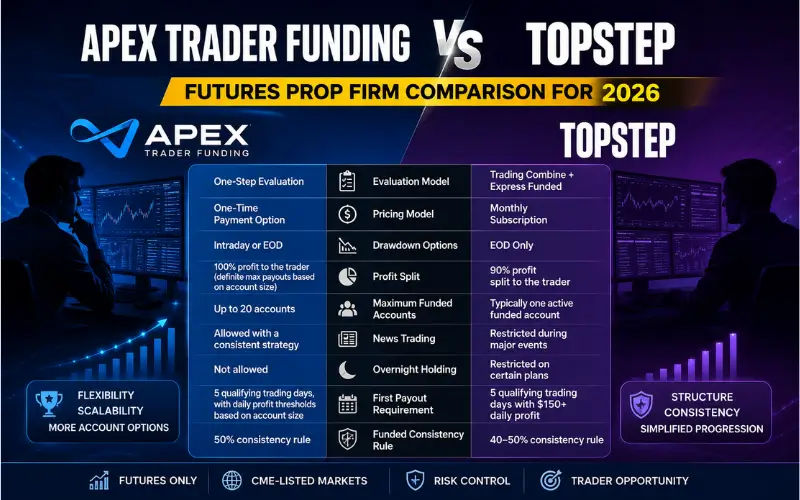
Apex Trader Funding and Topstep are both futures-only prop firms in 2026, but they serve different priorities. Apex focuses on flexibility, account scaling (up to 20 accounts), and one-time evaluation payments. Topstep focuses on structured progression, standardized EOD drawdown, and faster payout qualification through its Express Funded pathway. Both use CME-listed E-mini and Micro contracts.
What Is the Main Difference Between Apex Trader Funding and Topstep?
The biggest difference between Apex Trader Funding and Topstep is how they approach trader growth. Apex prioritizes flexibility through multiple account usage, evaluation options, and payout incentives. Topstep prioritizes structure through its Express Funded model, standardized risk controls, and simplified progression rules.
Both firms operate exclusively in futures markets, giving access to products such as E-mini and Micro contracts on major CME exchanges. Since market access is largely the same, the comparison comes down to rules, scaling opportunities, payout requirements, and trading restrictions.
The easiest way to compare both firms is to review how their 2026 rules differ across evaluations, drawdowns, payouts, scaling opportunities, and trading restrictions.
What Changed at Apex and Topstep in 2026?
The 2026 updates introduced meaningful changes that affect how traders qualify, scale, and withdraw profits.
2026 Comparison Snapshot
| Feature | Apex Trader Funding | Topstep |
| Evaluation Model | One-Step Evaluation | Trading Combine + Express Funded |
| Pricing Model | One-Time Payment Option | Monthly Subscription |
| Drawdown Options | Intraday or EOD | EOD Only |
| Profit Split | 100% profit to the trader, subject to maximum payouts based on account size | 90% profit split to the trader |
| Maximum Funded Accounts | Up to 20 accounts | Typically one active funded account |
| News Trading | Allowed with a consistent strategy | Restricted during major events |
| Overnight Holding | Not allowed | Restricted on certain plans |
| First Payout Requirement | 5 qualifying trading days, with daily profit thresholds based on account size | 5 qualifying trading days with $150+ daily profit |
| Funded Consistency Rule | 50% consistency rule | 40–50% consistency rule |
Apex’s largest update was the introduction of one-time payment evaluations and the expansion of End-of-Day drawdown options. The firm also added a new dashboard designed to provide real-time rule warnings, helping traders identify issues before payout requests are made.
Topstep’s biggest change was the rollout of additional Express Funded pathways. These pathways create a faster transition from evaluation to payout eligibility while maintaining the firm’s structured approach to risk management.
While both firms updated their systems, the overall philosophy remains unchanged. Apex continues to emphasize flexibility and scaling. Topstep continues to emphasize consistency and progression.
Drawdown Rules: The Most Important Difference in 2026
Drawdown rules define the risk boundary within which a trader operates and for active futures traders, this is often the single most important rule set to evaluate before choosing a firm. For active futures traders, this is often the single most important rule set to evaluate.
Apex Drawdown Structure
Apex allows traders to choose between two drawdown models when purchasing an account:
- Intraday Trailing Drawdown
- End-of-Day (EOD) Trailing Drawdown
The introduction of EOD (End-of-Day) drawdown was one of Apex’s most important improvements because it changes how account risk is calculated. A drawdown is the maximum amount an account can decline before it reaches its risk limit. An intraday drawdown adjusts throughout the trading session as account equity changes, while an End-of-Day (EOD) drawdown is based on the account balance at the close of the trading day. With an EOD account, intraday profit spikes do not immediately tighten the drawdown floor. The drawdown level only adjusts after the trading day closes, giving positions more room to fluctuate during volatile sessions.
For traders who hold positions through pullbacks or allow trades additional room to develop, EOD accounts are generally easier to manage than intraday trailing systems.
Topstep Drawdown Structure
Topstep uses an End-of-Day drawdown framework across its funded ecosystem. Unlike Apex, traders do not choose between multiple drawdown models. Every account follows the same structure, creating a standardized experience.
The drawdown level is calculated using end-of-day balances rather than intraday fluctuations. Temporary market swings, therefore, have less influence on account limits as long as the account recovers before the session closes. This creates a simpler and more standardized experience because every trader operates under the same structure.
Account Scaling: Apex’s 20-Account Model vs Topstep’s Growth Path
Scaling potential is one of the largest differences between these firms. Apex allows traders to manage up to 20 funded accounts simultaneously. Combined with trade copier technology, this creates one of the largest scaling opportunities available in the futures prop industry.
Instead of relying on a single funded account, a trader can execute the same strategy across multiple accounts at the same time. This creates substantially greater profit potential when a strategy is executed consistently.
Key Apex scaling advantages include:
- Up to 20 funded accounts
- Trade copier compatibility
- Larger overall capital exposure
Topstep follows a different philosophy. The firm’s growth model focuses on gradual progression. Rather than expanding through multiple funded accounts, growth occurs through performance milestones and increasing account responsibility.
This structure can be appealing for traders who prefer to focus on a single account and a clearly defined progression path.
If your primary goal is maximizing scaling potential, Apex offers a significant advantage in 2026.
Payout Rules and Profit Splits
Profit splits often receive the most attention, but payout qualification rules frequently have a greater impact on actual withdrawals.
Apex Payout Structure
Apex offers one of the most attractive payout structures in futures prop trading where 100% profits are paid out to the trader with definite maximum payouts based on account size. However, payout qualification involves additional requirements.
Before receiving payouts, traders must satisfy:
- Five qualifying trading days with set daily profit
- Required account buffer
- Consistency requirements
The most discussed requirement is Apex’s 50% consistency rule. This rule means that a single trading day cannot represent more than 50% of the total profit used for payout qualification.
For example, if a trader records a $1,000 winning day, total qualifying profits must reach above $2,000 for that day to represent no more than 50% of the overall profit. This structure rewards consistent performance; qualifying profits need to be distributed across sessions rather than concentrated in one or two large trading days.
Topstep Payout Structure
Topstep uses a more direct qualification model. To request an initial payout, traders generally need:
- Five qualifying trading days
- At least $150 profit per qualifying day
Topstep also applies consistency requirements, generally ranging between 40% and 50% depending on the account pathway. Like Apex, the objective is to encourage steady performance rather than relying on a single large trading day.
News Trading and Overnight Holding Rules
Trading restrictions can have a major impact on strategy selection. A strategy built around economic releases cannot function properly if trading restrictions prevent participation during those events.
Apex Trading Flexibility
Apex allows trading during major scheduled economic announcements when executed within its rule framework. However, overnight holding is not permitted, so positions must be managed within the firm’s trading-session requirements.
This flexibility allows traders to build strategies around events such as:
- Non-Farm Payrolls (NFP)
- Consumer Price Index (CPI)
- Federal Open Market Committee (FOMC) announcements
For traders who specialize in volatility or overnight market movements, these permissions create more strategic freedom.
Topstep Trading Restrictions
Topstep applies restrictions around certain high-impact economic events and may restrict overnight holding depending on the account structure. These rules help standardize risk management but can limit strategies that depend on scheduled volatility or extended holding periods.
Evaluation Costs and Platform Compatibility
Evaluation costs are an important part of choosing a futures prop firm, but platform compatibility can also influence the overall trading experience. While pricing affects the path to funding, the platforms supported by each firm determine how traders access markets, manage positions, and execute their strategies.
Apex Cost Structure
Apex’s new one-time payment evaluations eliminate the need for recurring subscription fees on eligible accounts. The firm also regularly offers promotional discounts, reducing the initial cost of entry. Additional activation fees apply after passing the evaluation. This structure often benefits traders who expect to complete the evaluation quickly.
Apex evaluations can be accessed through platforms including NinjaTrader and Tradovate, with market data connectivity provided through Rithmic. Traders already familiar with these futures trading environments may find the transition straightforward.
Topstep Cost Structure
Topstep continues to use a subscription-based model. The recurring fee structure allows traders to remain in the evaluation phase without purchasing a new account immediately after a longer evaluation period. This can be beneficial for traders who prefer a slower pace or who are still refining their approach.
Topstep combines its evaluation process with TopstepX, the firm’s proprietary trading platform. Traders who prefer a browser-based experience may appreciate having a dedicated platform integrated directly into the firm’s ecosystem.
What Should You Know Before Paying for a Prop Firm Evaluation?
Before purchasing an evaluation, compare the full path to funding rather than the starting price. Evaluation rules, drawdown structure, payout requirements, account limits, and platform access all influence the trading experience. The best value comes from choosing a model that matches your strategy and risk-management approach.
Before choosing a prop firm, review:
- Evaluation requirements
- Drawdown methodology
- Payout qualification rules
- Trading restrictions
- Scaling opportunities
- Platform compatibility
Final Verdict
Apex Trader Funding and Topstep remain two of the strongest futures prop firm options in 2026, but they appeal to different trading priorities.
Apex stands out for traders who value flexibility. The ability to manage up to 20 funded accounts, choose between drawdown structures, and participate in major market-moving events creates significant scaling potential. The firm’s one-time evaluation model may also appeal to traders looking to minimize recurring costs.
Topstep stands out for traders who prefer a more standardized environment. Its structured progression model, consistent drawdown framework, and defined payout pathway create a straightforward experience that can be easier to navigate.
If account scaling and flexibility are your primary goals, Apex has the advantage. If rule consistency and a guided progression path are more important, Topstep remains a compelling choice.
Risk Disclosure: Futures trading involves substantial risk of loss and is not suitable for all traders. Past performance is not indicative of future results. Only risk capital should be used.