
Formatting is the first thing that every examiner notice and assesses your academic research writing capabilities. The presentation, references, and organisation of the whole research process determine the credibility of your study. Many students invest months in research and writing, but they do not pay attention to the formatting process, which results in delays, confusion, and inappropriate deductions that weaken their arguments. The right formatting style helps make a presentation more readable and shows attention to detail and professionalism.
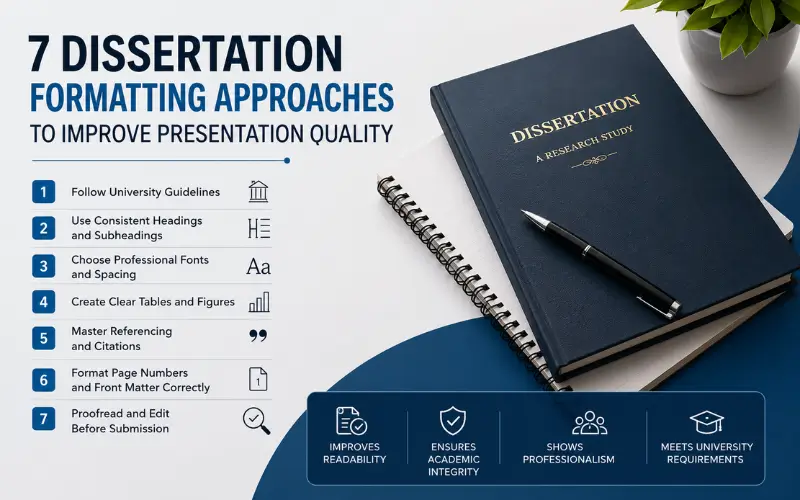
This guide highlights the best formatting strategies for dissertations, which can enhance the presentation of work, making it easier for students to turn in a high-quality academic paper.
Key Takeaways
- Formatting is essential to maintain professionalism and readability
- The dissertation should be consistent throughout.
- Correct referencing enhances academic integrity.
- Table, headings, and page layout enhance and improve dissertation presentation.
- Professional editing guidance ensures error-free formatting quality.
Why Dissertation Formatting Matters
Formatting is not just about different fonts and margins. It is about how you structure your work for readers to easily navigate. Good formatting helps in:
- Improve readability through coherence.
- Highlight key arguments in a standardised manner.
- Show academic professionalism.
- Ensure compliance with university requirements.
- Reduce unpredictable flow.
Imagine packaging your research as you think of it. Great content can be delivered in a subpar manner and still not do the job.
7 Formatting Approaches That Improve Dissertation Presentation
1. Follow University Guidelines
Department of Computer Engineering, School of Electrical Engineering, University of Belgrade, mentions the best ways to improve the dissertation presentation. But as we know, each institution has its own formatting specifications. These may include:
- Margin size.
- Font style and size.
- Line spacing.
- Referencing style.
- Chapter layout
Failure to follow these guidelines may result in rewriting or a reduction in a student’s grade. The official guidance is offered in the Dissertation Handbook of several universities, or you can start with standard APA guidelines.
Pro Tip: Before you start the writing process, download your university’s dissertation handbook.
2. Use Consistent Headings and Subheadings
Headings make your paper more organized and make it easier for readers to understand the structure of your dissertation research. Maintain consistency with:
- Chapter titles.
- Heading levels.
- Font sizes.
- Numbering systems.
For example:
- Chapter 1: Introduction
- 1.1 Background
- 1.2 Research Objectives
- 1.3 Significance of the Study
Pro Tip: Use styles to automate Word formatting and create a table of contents (ToC).
3. Choose Professional Fonts and Spacing
Formatting should be easy to read and understandable. It shows how you are presenting:
| Element | Recommended Format |
| Font | Times New Roman or Arial |
| Font Size | 12 pt |
| Line Spacing | 1.5 or Double |
| Alignment | Justified |
| Margins | 1 inch or university requirements |
Do not use fonts that are decorative or have inconsistent spacing. Before start writing, confirm the above-mentioned specifications with your institute’s respective dissertation handbook.
Pro Tip: Use the same font throughout the entire dissertation.
4. Create Clear Tables and Figures
Tables, charts, and graphs help to make complex information easier to understand. Ensure:
- Every table is numbered.
- Titles must be descriptive.
- Figures are clearly labelled.
- Sources are acknowledged where necessary.
Visual elements should be used in conjunction with your discussion but not to the detriment of your discussion.
Pro Tip: When referring to tables or figures in the text, explain their meaning.
5. Master Referencing and Citations
One of the most frequently occurring dissertation errors is inaccurate citations. Common referencing styles are:
- APA. (Author(s), year)
- Harvard. (Author(s), year)
- MLA. (Author(s), page number)
- Chicago. (Footnotes)
Proper referencing:
- Prevents plagiarism.
- Strengthens credibility.
- Supports academic arguments.
One of the most common reasons students use dissertation editing services is to check if their citations are correct and consistent throughout the dissertation.
Pro Tip: Citation management program like Mendeley or Zotero to make referencing easy.
6. Format Page Numbers and Front Matter Correctly
Many students fail to mention the preliminary pages. Your dissertation will have the following structure:
- Title page.
- Abstract.
- Acknowledgements.
- Table of contents.
- List of figures and tables.
- Main chapters.
- References.
- Appendices.
All pages need to be numbered appropriately. t The numbering style should be consistent throughout the paper and according to the institute guidelines.
Pro Tip: You should use section breaks to show the gap between the preliminary pages and the main content.
7. Proofread and Edit Before Submission
Formatting problems can only be seen in the final review phase. As a proofreader, you need to check:
- Font consistency.
- Spacing irregularities.
- Alignment problems.
- Citation formatting.
- Table numbering.
- Page breaks.
Students often missed errors and presentation quality. Hiring a reliable dissertation proofreading service helps them to overcome these concerns.
Pro Tip: Make a hard copy or save your dissertation in a PDF to more easily identify formatting issues.
Dissertation Formatting Checklist
| Component | Purpose | Benefit |
| Headings | Improve organisation | Better readability |
| References | Ensure academic integrity | Avoid plagiarism |
| Tables and Figures | Present data clearly | Stronger understanding |
| Margins and Spacing | Enhance appearance | Professional layout |
| Page Numbering | Improve navigation | Consistency |
| Proofreading | Eliminate errors | Polished final document |
Common Formatting Mistakes Students Should Avoid
You can lose your marks even if your arguments are strong due to poor formatting and presentation errors. Many students make these common mistakes that may result in a mark deduction or even paper rejection. These common formatting mistakes include the following:
- Inconsistent Fonts: Using inconsistent font styles in one dissertation is not a professional approach.
- Incorrect Referencing: Readers are distracted, and credibility is lost when you use a variety of citations in the same document.
- Poor Table Placement: Explanatory tables must not be given unless they are necessary.
- Uneven Spacing: It is hard to read when there is spacing irregularity.
- Ignoring University Requirements: Each institution has its own expectations on formatting and layout. Ignoring these requirements can fail.
Traditional Formatting vs Professional Formatting
| Aspect | Traditional Approach | Professional Approach |
| Fonts | Inconsistent styles | Uniform appearance |
| References | Manual formatting | Citation management tools |
| Headings | Random structure | Hierarchical organisation |
| Tables | Basic layouts | Clearly labelled visuals |
| Editing | Minimal proofreading | Comprehensive review |
| Presentation | Average quality | Professional finish |
Why Students Seek Professional Formatting Support
Those students who do not complete the dissertation writing can get the assistance of professionals to refine their documentation process. This support can be valuable in the following checks to meet their specific university requirements:
- Formatting corrections.
- Citation checks.
- Grammar and language improvements.
- Structural consistency.
- Proofreading and quality assurance.
Conclusion
Formatting is the first key to deciding whether to continue reading this journey or not. All seven approaches that are previously mentioned not only help you to understand the whole editing process from start to finish, but also improve the credibility of your dissertation study.
Frequently Asked Questions
Why is dissertation formatting important?
Dissertation formatting is important to make it more readable, look more professional, and to meet your specific university requirements.
Which font is commonly used for dissertations?
Times New Roman or Arial (12-point size) is the standard font size that most universities recommend, but it may vary across the region.
How can I ensure consistent referencing?
The use of professional dissertation editing tools, and proper reference management systems, and guidance can help ensure consistent and credible referencing.
Should tables and figures be numbered?
Yes. Each table and figure must be numbered, and each has a descriptive title.
Can professional support improve a dissertation presentation?
Yes. Professional dissertation support is designed to assist students in fine-tuning their academic papers. It also ensures these papers are well-structured and error-free.