Missing teeth do far more damage than most people realize. The American College of Prosthodontists reports over 120 million Americans are missing at least one tooth — and nearly 36 million have none left at all. Gaps don’t just change how your smile looks. They disrupt eating, muddy your speech, and quietly erode your oral health from the inside out. Knowing the warning signs early? That’s what lets you actually do something about it.
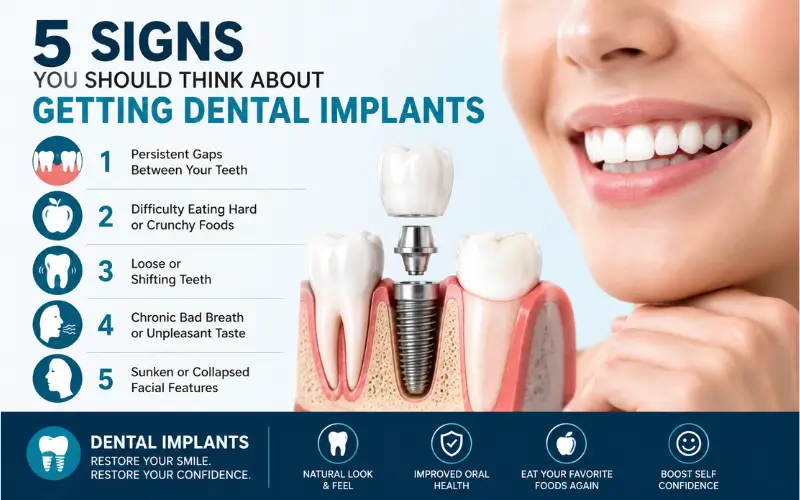
1. Persistent Gaps Between Your Teeth
Spaces that weren’t there before deserve attention. They often point to jawbone loss — and that loss moves fast, roughly 25 percent in the first year after a tooth goes missing. Sometimes gaps creep in gradually. Other times they appear almost overnight after an extraction or injury. Either way, those spaces become traps. Food particles, bacteria, plaque — all of it accumulates there, pushing your gum disease risk considerably higher. Constantly reaching for floss mid-meal? Your mouth is telling you something. Don’t ignore it.
2. Difficulty Eating Hard or Crunchy Foods
Wincing through an apple? Steering clear of steak, nuts, raw carrots? That’s compensation — your jaw routing around missing or weakened teeth instead of working through them. And it matters more than it sounds. Raw vegetables, lean proteins — the crunchy stuff — happen to be the most nutrient-packed things on the plate. Studies find that people with several missing teeth end up eating less produce overall. Their health shows it, too. Here’s the other problem: most people unconsciously start favoring one side of their mouth. One side carries all the load. Pressure piles up unevenly, and an entirely new category of dental trouble follows. Patients who’ve looked into providers who offer dental implants in Sacramento often say restored chewing function reopened their diet in ways they genuinely hadn’t anticipated. If your food choices keep narrowing, your bite needs a serious look.
3. Loose or Shifting Teeth
Teeth that wobble — or seem to be slowly drifting — aren’t just uncomfortable. They’re a red flag. Bone loss, advancing gum disease — when the structures anchoring your teeth start to fail, everything shifts. The teeth lose their grip. They migrate. That throws your bite completely out of alignment, and a misaligned bite can snowball into temporomandibular joint disorder. Painful. Hard to fix. Worth avoiding at all costs. Even tiny movement — the kind only your tongue catches — tell a dentist about it. Seriously. Early intervention almost always means less damage to deal with later.
4. Chronic Bad Breath or Unpleasant Taste
Brushing twice daily, flossing, rinsing — and the bad breath still won’t quit. That’s not a hygiene failure. That’s likely an infection or decay tucked somewhere difficult to clean. Empty sockets? They’re bacterial traps. Food debris collects, sits, and produces odor basically nonstop. Gum disease — which tends to trail tooth loss like a shadow — churns out sulfur compounds that smell distinctly foul, nothing like ordinary morning breath. And some people get hit with a metallic or sour taste that hangs around all day. Doesn’t matter what they eat or drink; it just stays. When brushing and flossing stop making any real difference, the problem runs deeper than surface plaque. Way deeper.
5. Sunken or Collapsed Facial Features
Tooth loss doesn’t just affect your mouth. It reshapes your face. As the jawbone resorbs — which it does steadily after teeth are lost — cheeks can hollow out, the chin grows more prominent, and lines around the mouth deepen faster than they otherwise would. It creeps up gradually. You might not catch it in the mirror day to day. But others notice. Friends comment that you look tired, or older, or somehow just different. And it’s not purely cosmetic, either; reduced vertical support in the jaw affects how your remaining teeth sit, how you speak, even how you swallow. Many people are genuinely caught off guard by how dramatically their face shifts after significant tooth loss. Restoration, in that context, isn’t vanity — it’s healthcare.
Conclusion
Catching these signs early gives you options. Real ones. Whether you’re dealing with one missing tooth or several, modern implants offer a permanent, natural-looking solution that brings full function back — not just the appearance of it. If any of these warning signs sound familiar, a conversation with a dental professional can clarify what’s actually going on and what’s worth doing about it. Acting sooner protects your remaining teeth, stops additional complications from gaining ground, and keeps your smile functional for the long run.