
Welcome to our guide on improving your clinical documentation. Providing high-quality care starts with a solid foundation, yet even experienced professionals sometimes stumble when drafting their daily records. Recognizing these 5 Common Nursing Plans Mistakes is the first step toward enhancing patient safety and your own professional growth.
Writing accurate care strategies can feel overwhelming during a busy shift. If you find yourself struggling with complex assignments or documentation standards, remember that seeking nursing homework help is a smart way to refine your skills. You do not have to navigate these challenges alone.
In this article, we will provide a clear roadmap to help you avoid frequent pitfalls. It is worth mastering these techniques to feel more confident in your daily practice and ensure your documentation truly reflects the excellent care you provide. The article addresses the following objectives:
- Understand the impact of documentation on patient safety.
- Identify frequent errors that hinder clinical efficiency.
- Learn practical strategies to improve your writing accuracy.
- Discover how professional support can boost your academic and clinical confidence.
- Gain a clear roadmap for creating effective care strategies.
The Importance of Accurate Nursing Care Plans
Precise nursing care plans act as the heartbeat of effective healthcare delivery across the United States. These documents are far more than just paperwork; they serve as the essential roadmap that guides your daily interactions with patients. By maintaining high standards in your documentation, you ensure that every clinical action is purposeful and directly aligned with the patient’s current health status.
A well-structured plan functions as a vital communication tool between nurses and the broader medical team. When everyone is on the same page, the risk of errors drops significantly, and patient safety improves. Clear communication through these records allows physicians, therapists, and specialists to understand the patient’s progress without needing constant verbal updates.
Beyond daily coordination, these documents serve as a critical legal record of the care provided. In the event of a review or audit, your nursing care plans provide the necessary evidence that you followed standard protocols and addressed specific patient needs. This level of detail protects both the nurse and the healthcare facility while ensuring accountability.
Ultimately, consistent and accurate documentation is the hallmark of a professional nurse. When you invest time in creating high-quality nursing care plans, you are directly contributing to better patient outcomes. This commitment to excellence helps bridge the gap between clinical theory and real-world bedside practice, ensuring that every patient receives the personalized attention they deserve.
Understanding the 5 Common Nursing Plans Mistakes
Understanding the 5 Common Nursing Plans Mistakes is the first step toward improving your clinical documentation skills. Even the most dedicated healthcare professionals can encounter hurdles when balancing heavy patient loads with the need for precise record-keeping.
These errors often stem from high-pressure environments where time is limited and standardized training may be lacking. When you recognize these patterns, you can proactively adjust your workflow to ensure better patient outcomes and more accurate documentation.
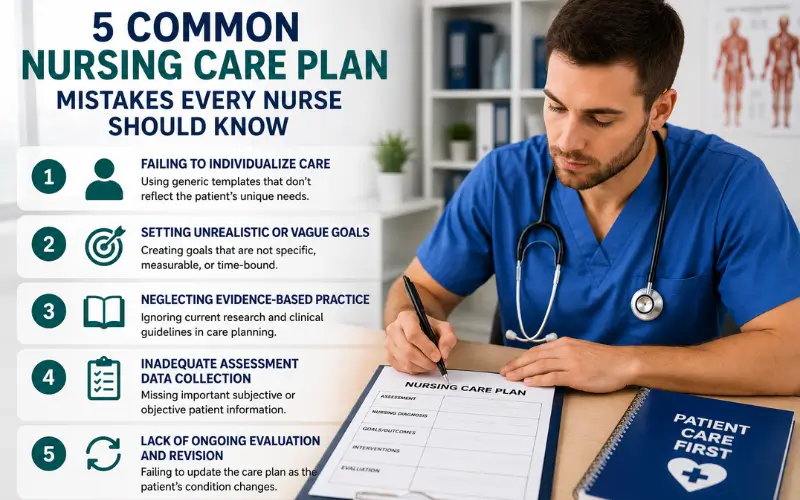
By identifying the 5 Common Nursing Plans Mistakes, you gain the power to transform your daily practice. Consistency and attention to detail are your best tools for avoiding these frequent pitfalls:
- Failing to individualize care: Relying too heavily on generic templates.
- Setting vague goals: Creating objectives that lack measurable criteria.
- Ignoring evidence: Neglecting the latest clinical research and guidelines.
- Poor data collection: Missing critical subjective or objective patient information.
- Lack of revision: Failing to update the plan as the patient’s condition changes.
Each of these areas represents a significant opportunity for growth. As you refine your approach, you will find that your care plans become more effective, efficient, and supportive of the recovery process for every patient under your care.
Mistake One: Failing to Individualize Patient Care
The most common pitfall in clinical documentation is the tendency to treat patients as a diagnosis rather than a person. When nurses rely on standardized, pre-filled forms, they often miss the unique nuances that define a patient’s recovery journey. True excellence in nursing requires moving beyond the checklist.
Why Generic Templates Lead to Poor Outcomes
Generic templates are designed for efficiency, but they frequently sacrifice quality for speed. When a care plan does not reflect the specific cultural, physical, or emotional needs of an individual, it becomes a static document rather than a roadmap for healing. This disconnect often leads to suboptimal patient outcomes because the interventions simply do not align with the patient’s reality.
The art of medicine consists of amusing the patient while nature cures the disease.
Furthermore, patients can often sense when their care is not personalized. This lack of attention can decrease trust and lower overall satisfaction with the healthcare experience. Relying on “one-size-fits-all” approaches is a significant barrier to achieving the high standards of patient-centered care that modern facilities strive to maintain.
Strategies for Tailoring Interventions to Specific Needs
To avoid these pitfalls, nurses must actively customize their documentation to reflect the patient’s current status. Start by incorporating specific assessment findings into your nursing interventions rather than using vague, generalized statements. For example, instead of writing “encourage mobility,” specify the exact distance or frequency based on the patient’s current strength and pain levels.
Always involve the patient in the planning process to ensure the goals are meaningful to them. By asking open-ended questions, you gain valuable insights that help you refine your approach. This collaborative effort ensures that your patient-centered care is both relevant and effective, ultimately leading to better patient outcomes and a more rewarding clinical practice.
Mistake Two: Setting Unrealistic or Vague Goals
Vague objectives are a common pitfall that can hinder the progress of patient-centered care. When goals lack clarity, it becomes difficult for the healthcare team to track success or adjust interventions appropriately. Nurses often feel frustrated when they cannot see tangible improvements, which is frequently a result of poorly defined targets.
To avoid these issues, clinicians must shift away from general statements like “patient will improve” toward more concrete outcomes. Precision in your documentation ensures that every team member understands the intended path to recovery.
The Role of SMART Criteria in Goal Setting
The SMART goals framework serves as the gold standard for creating effective nursing plans. By ensuring that every objective is Specific, Measurable, Achievable, Relevant, and Time-bound, you eliminate the guesswork that often leads to clinical errors.
A goal without a plan is just a wish. Defining clear, actionable steps helps us transform our intentions into measurable patient outcomes.
Using this structure allows you to break down complex recovery processes into manageable milestones. When you apply SMART goals, you provide a clear roadmap that keeps both the nurse and the patient focused on the same finish line.
How to Measure Patient Progress Effectively
Measuring progress requires consistent benchmarks that leave no room for ambiguity. You should rely on objective data points, such as vital signs, mobility scores, or pain scales, to verify if the patient is meeting their targets. This approach fosters patient-centered care by keeping the focus on actual clinical improvement rather than subjective feelings.
| Goal Type | Vague Example | SMART Example |
| Mobility | Patient will walk more. | Patient will walk 50 feet with assistance 3 times daily. |
| Hydration | Patient will drink fluids. | Patient will consume 1500ml of water within 24 hours. |
| Pain Management | Patient will feel better. | Patient will report a pain score of 3/10 or less within 2 hours. |
By regularly reviewing these metrics, you can identify when a plan needs adjustment. If a patient is not meeting a specific benchmark, you can pivot your strategy quickly. This dynamic process ensures that your care remains effective and responsive to the patient’s changing needs.
Mistake Three: Neglecting Evidence-Based Practice
Your nursing care plan should be a living document rooted in the most current scientific research. When nurses rely solely on outdated habits or personal intuition, they risk providing care that is no longer considered the gold standard. Evidence-based practice is the foundation of safe, effective, and high-quality patient outcomes.
Integrating Current Research into Daily Planning
To avoid the trap of stagnant care, you must actively incorporate new findings into your daily routine. Start by aligning your interventions with SMART goals that are supported by recent clinical studies. This approach ensures that every action you take is backed by data rather than just tradition.
When you ground your care plans in science, you can confidently justify your clinical choices to the interdisciplinary team. This practice not only improves patient safety but also builds your professional credibility. Consistency in applying research is what separates a good nurse from a great one.
Resources for Finding Reliable Clinical Guidelines
Finding the right information does not have to be a daunting task. Several reputable platforms provide easy access to the latest evidence-based practice guidelines that you can apply immediately at the bedside.
- The Cochrane Library: Excellent for high-quality systematic reviews.
- PubMed: A vast database for peer-reviewed medical literature.
- Joanna Briggs Institute (JBI): A leader in evidence-based healthcare resources.
- Agency for Healthcare Research and Quality (AHRQ): Provides clinical practice guidelines for various conditions.
By utilizing these tools, you can refine your SMART goals and ensure your interventions remain relevant. Regularly checking these resources helps you stay ahead of medical advancements and provides the best possible care for your patients.
Mistake Four: Inadequate Assessment Data Collection
A successful nursing care plan begins long before you write the first goal; it starts with how you gather information. When you rush through the intake process, you risk missing the subtle cues that define a patient’s true condition. Performing a high-quality clinical assessment is the most effective way to ensure your care plan remains relevant and safe.
The Link Between Thorough Assessment and Accurate Diagnosis
Your nursing diagnosis acts as the roadmap for all future interventions. If the initial data is flawed, the entire plan will likely lead to ineffective outcomes. A thorough clinical assessment provides the evidence needed to support your clinical judgment.
When you take the time to observe and listen, you build a stronger foundation for your work. This process allows you to identify the root cause of a patient’s distress rather than just treating the symptoms. Accuracy in diagnosis depends entirely on the depth of the information you collect during your first interaction.
Common Gaps in Subjective and Objective Data
Nurses often struggle to balance subjective reports with objective findings. Subjective data includes what the patient tells you, such as their pain level or emotional state. Objective data involves what you measure, like vital signs or lab results.
A common mistake is relying too heavily on one type of data while ignoring the other. For example, you might focus only on blood pressure readings while failing to ask the patient about their daily stress levels. To avoid this, always verify subjective complaints with objective clinical assessment tools whenever possible.
You can improve your data collection by using a structured interview format. Always double-check your findings to ensure no critical information is missing from the chart. By closing these gaps, you ensure that your clinical assessment remains a reliable guide for your patient’s recovery journey.
Mistake Five: Lack of Ongoing Evaluation and Revision
A patient’s health status changes rapidly, making the static care plan a relic of the past. Many nurses fall into the trap of writing a plan at the start of a shift and never looking at it again. This approach ignores the reality that clinical assessment is a continuous process, not a single event.
Why Care Plans Must Be Dynamic Documents
A care plan should function as a living map that guides your daily practice. When you treat these documents as static, you risk missing critical shifts in a patient’s recovery. Effective care plan evaluation requires you to constantly compare current patient data against the goals you initially set.
If the patient is not meeting their milestones, the plan must change to reflect new needs. Sticking to an outdated plan can lead to wasted time and, more importantly, suboptimal patient outcomes. You must view every interaction as an opportunity to refine your approach.
Recognizing When to Update Interventions
Knowing when to pivot is a hallmark of a skilled nurse. You should look for specific triggers, such as a sudden change in vital signs or a lack of progress toward a goal. These signs indicate that your current nursing interventions are no longer sufficient for the patient’s needs.
Regularly reviewing your documentation helps you identify these gaps early. If a patient reports new pain or shows signs of improvement, update the plan immediately to keep the care team aligned. Staying proactive ensures that your work remains relevant throughout the entire stay.
| Indicator | Static Approach | Dynamic Approach |
| Patient Progress | Ignored until discharge | Monitored every shift |
| Interventions | Fixed and rigid | Adjusted based on data |
| Documentation | Completed once | Updated in real-time |
| Goal Setting | Generic and broad | Specific and evolving |
How to Seek Nursing Homework Help for Writing Support
Balancing rigorous coursework and clinical duties often leads nursing students to seek external essay writing assistance. While the goal is to master clinical skills, the academic burden of documentation can sometimes feel overwhelming. Finding the right writing support can bridge the gap between understanding complex medical concepts and articulating them clearly in your assignments.
Identifying When You Need Professional Assistance
Recognizing the signs of academic burnout is the first step toward seeking help. If you find yourself struggling to translate clinical observations into formal care plans, it may be time to look for nursing homework help. This is especially true when you are juggling multiple deadlines and high-stakes clinical rotations.
Professional assistance is not just about finishing a paper; it is about improving your own writing process. If you consistently receive feedback regarding your structure or clinical reasoning, a tutor can provide the guidance needed to sharpen your skills. Seeking help early prevents small gaps in knowledge from becoming major academic hurdles.
Ethical Considerations When Using Writing Services
Maintaining academic integrity is non-negotiable for any student in the healthcare field. When you utilize writing support, it should always be for the purpose of learning and refining your work, rather than outsourcing your responsibilities. Ethical platforms focus on tutoring, editing, and providing feedback that helps you grow as a writer.
Always ensure that the assistance you receive aligns with your university’s code of conduct. Using a service to generate original ideas or to help you understand complex research is acceptable. However, submitting work that is not your own is a violation of professional ethics that could jeopardize your future career.
Selecting Reputable Academic Support Platforms
Not all services are created equal, and nursing students must be diligent when choosing a partner for their academic journey. Look for platforms that employ verified professionals with backgrounds in nursing or medical education. A reputable service will prioritize your privacy and offer transparent communication regarding their methods.
Before committing to a service, consider these essential criteria:
- Verified Expertise: Ensure the tutors have clinical or academic experience in nursing.
- Clear Policies: Review their terms to ensure they support academic integrity.
- Positive Feedback: Look for testimonials from other students who have used the service for nursing homework help.
Best Practices for Streamlining Your Documentation
Efficient nursing documentation is a vital skill that every modern nurse must cultivate to thrive in today’s fast-paced healthcare environment. By refining how you record patient data, you can significantly reduce the time spent on paperwork. This shift allows you to dedicate more energy to direct patient interaction and clinical decision-making.
Utilizing Electronic Health Records Efficiently
Modern Electronic Health Records (EHR) systems offer powerful tools designed to save you time. Many nurses overlook built-in features that can automate repetitive data entry tasks. Mastering these shortcuts is essential for maintaining accuracy without feeling overwhelmed by the interface.
- Use standardized templates for common patient assessments to ensure consistency.
- Leverage “copy and paste” features cautiously, always verifying that the information remains relevant to the current patient status.
- Utilize voice-to-text software if your facility supports it to speed up narrative notes.
“The goal of documentation is to tell the patient’s story clearly and concisely, ensuring that every member of the care team understands the plan of action.”
Balancing Clinical Time with Administrative Tasks
Finding the right balance between bedside care and administrative duties is a common struggle. You might consider writing support tools or peer-review sessions to improve your speed and clarity. When you approach your documentation with a structured plan, you minimize the risk of errors and burnout.
Try to batch your administrative tasks rather than multitasking throughout the shift. You can set aside specific blocks of time for charting, thereby helping maintain focus and complete your records more effectively. This disciplined approach is particularly helpful during care plan evaluation, as it ensures you have the mental clarity to assess patient progress accurately.
Remember that your documentation serves as a legal record and a communication tool. Prioritizing quality over quantity will always yield better outcomes for your patients. Stay organized, use your resources wisely, and keep your focus on the primary goal: providing excellent care.
Developing Critical Thinking Skills for Better Planning
Elevating your clinical practice starts with sharpening your ability to think critically at the bedside. When you move beyond rote memorization, you begin to see the patient as a complex individual rather than a set of symptoms. This shift is essential for creating high-quality nursing documentation that truly reflects the patient’s status.
Connecting Pathophysiology to Nursing Interventions
Effective care planning requires a deep understanding of how disease processes impact human physiology. By analyzing the underlying pathology, you can select interventions that address the root cause of a problem rather than just the surface symptoms. This logical connection ensures that your evidence-based practice remains relevant and highly targeted.
When you understand the “why” behind a diagnosis, your interventions become more precise. For example, knowing the pathophysiology of heart failure allows you to prioritize fluid management and oxygenation strategies effectively. This cognitive process transforms standard tasks into meaningful clinical actions.
Reflective Practice as a Tool for Growth
Reflective practice is a powerful habit that turns every shift into a learning opportunity. By taking time to review your decisions, you can identify what worked well and where you might improve your approach. This cycle of self-assessment is vital for long-term professional development and better critical thinking.
Consider keeping a brief journal or engaging in peer discussions to process complex cases. This habit helps you refine your evidence-based practice and ensures your future plans are even more robust. Embracing this mindset allows you to grow alongside your patients, leading to safer and more effective care outcomes.
| Planning Aspect | Basic Approach | Advanced Critical Thinking |
| Data Analysis | Surface observation | Pathophysiological reasoning |
| Intervention Selection | Generic templates | Tailored, evidence-based actions |
| Documentation | Checklist completion | Comprehensive clinical narrative |
| Growth Strategy | Passive experience | Active reflective practice |
Overcoming Common Barriers to Effective Care Planning
Creating effective nursing care plans often feels like an uphill battle when you are facing a packed shift. While the goal is always to provide the best patient outcomes, real-world obstacles frequently stand in the way. By identifying these barriers early, you can develop strategies to maintain high standards of care without burning out.
Managing Time Constraints in Busy Clinical Settings
Time is arguably the most precious resource in any hospital unit. When you are juggling multiple patients, finding the space to document detailed plans can seem impossible. Prioritization is your best tool here; focus on the most urgent patient needs first to ensure safety remains the top priority.
You can also streamline your workflow by using templates that allow for quick, accurate updates. Remember that critical thinking allows you to identify which interventions are truly essential versus those that can wait. Efficiency does not mean cutting corners; it means working smarter to ensure your documentation reflects the high quality of care you provide.
Individual commitment to a group effort—that is what makes a team work, a company work, a society work, a civilization work.
Collaborating with the Interdisciplinary Team
No nurse works in a vacuum, and your care plans should reflect the input of the entire medical team. Interdisciplinary collaboration is vital for creating a holistic approach that addresses every aspect of a patient’s health. When you communicate effectively with physicians, therapists, and social workers, you gain a clearer picture of the patient’s recovery path.
This team-based approach reduces the burden on any single provider and ensures that everyone is working toward the same goals. Utilizing critical thinking during team huddles helps you advocate for your patient’s specific needs. By fostering open communication, you turn potential barriers into opportunities for better patient outcomes.
| Barrier | Impact on Care | Effective Solution |
| Severe Time Pressure | Incomplete documentation | Use standardized templates |
| Communication Silos | Fragmented patient care | Active interdisciplinary collaboration |
| High Patient Acuity | Delayed care planning | Prioritize based on clinical risk |
Conclusion
Mastering the art of care planning transforms your daily routine into a powerful tool for healing. By avoiding common pitfalls, you ensure that every action serves a clear purpose for those under your watch.
Dedicated nursing students often find that small adjustments in documentation lead to significant gains in clinical confidence. Focus on precision and evidence to build a strong foundation for your career.
Strong patient outcomes rely on your ability to think critically and adapt to changing needs. Keep your plans dynamic to reflect the real-time status of the individuals you serve.
Success in modern healthcare requires active interdisciplinary collaboration. Reach out to your team members to share insights and create a unified approach to treatment.
Commit to lifelong learning as you navigate the complexities of the medical field. Your growth directly impacts the quality of care provided in hospitals and clinics across the country.
Start applying these strategies during your next shift to see the difference in your workflow. Your dedication to excellence shapes the future of the nursing profession.
Frequently Asked Questions
How can I ensure my care plan isn’t just another generic template?
To avoid the pitfall of “cookie-cutter” care, focus on individualized patient care by incorporating specific patient preferences, cultural needs, and unique health histories. Instead of relying solely on pre-populated fields in systems like Epic or Cerner, use your assessment data to tailor interventions that reflect the distinct pathophysiology and personal goals of the individual in your care.
Why are SMART criteria so important for nursing outcomes?
Setting SMART goals—Specific, Measurable, Achievable, Relevant, and Time-bound—eliminates ambiguity in the clinical setting. This framework allows you to objectively measure patient progress and provides the entire interdisciplinary team with a clear benchmark for success, ensuring that interventions are purposeful and results-oriented.
How do I stay updated with Evidence-Based Practice (EBP) in a busy clinical environment?
Integrating Evidence-Based Practice doesn’t have to be overwhelming. Utilize reputable resources such as the Cochrane Library, PubMed, or clinical guidelines from the American Nurses Association (ANA). Grounding your care plans in the latest research ensures your interventions are safe, effective, and ethically sound.
What is the most common mistake made during assessment data collection?
The most frequent error is failing to bridge the gap between subjective and objective data. An incomplete assessment can lead to an inaccurate nursing diagnosis. To avoid this, perform a comprehensive head-to-toe evaluation and actively listen to the patient’s concerns to ensure your clinical documentation captures the full picture of their health status.
Why must a nursing care plan be treated as a dynamic document?
A patient’s condition is rarely static, so their care plan shouldn’t be either. Ongoing evaluation and revision prioritization ensures that the interventions remain relevant to the patient’s current status. Recognizing clinical triggers that signal a need for change is a hallmark of strong critical thinking skills.
When is it appropriate to seek nursing homework help for writing support?
Seeking nursing HW help is a great strategy when you need to improve your academic writing or better understand the structure of complex care plans. Utilizing academic support platforms for guidance on clinical documentation can help students and professionals alike maintain academic integrity while mastering the nuances of professional healthcare communication.
How can I use Electronic Health Records (EHR) more efficiently without sacrificing care?
To streamline your workflow, master the shortcuts and “smart phrases” within your Electronic Health Records (EHR) system. Efficient documentation allows you to balance administrative tasks with direct patient interaction, ensuring that your legal record is thorough without causing burnout or taking away from bedside care.
How does understanding pathophysiology improve my care planning?
Deeply connecting pathophysiology to your nursing interventions allows you to anticipate potential complications before they arise. This proactive approach, fueled by reflective practice, transforms a standard checklist into a sophisticated tool for high-quality healthcare delivery and improved patient safety.