Gymnastics places unusual demands on clothing. A gymnast needs full-body mobility, precise fit, secure coverage, grip awareness, and comfort through fast transitions. The garment must move through jumps, rolls, splits, handstands, twists, landings, and strength holds without shifting or restricting technique.
Good gymnastics apparel is not only about appearance. It supports performance by reducing distractions, protecting movement range, and helping athletes feel secure during training and competition.
For designers, coaches, and clubs, the best sportswear decisions start with how gymnasts actually move.
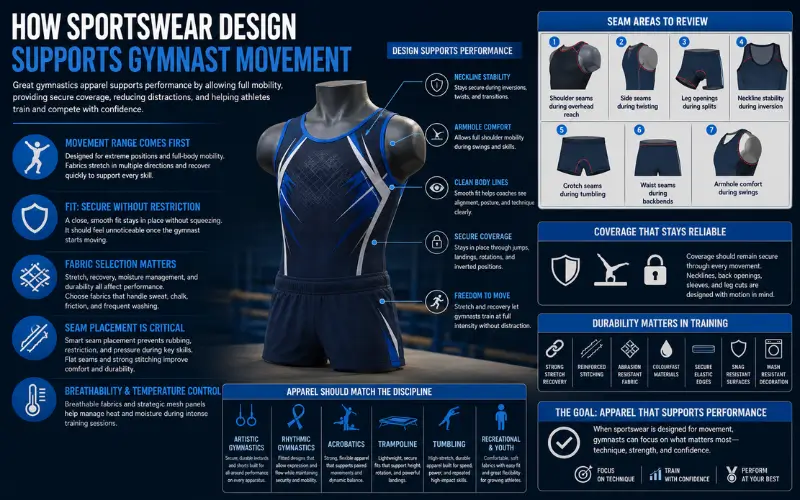
Movement Range Comes First
Gymnasts move through extreme positions. Shoulders open overhead. Hips rotate deeply. Legs split, tuck, pike, and extend. The spine bends, arches, and twists.
A garment that works for normal exercise may fail in gymnastics because it was not designed for these ranges.
Sportswear must allow extension without pulling at the shoulders, hips, neckline, or leg openings. Fabric should stretch in multiple directions and recover quickly after movement.
Poor recovery leads to sagging, shifting, and loose areas that can distract the athlete.
Fit Must Be Secure Without Compression Problems
Gymnastics clothing should stay close to the body. Loose fabric can catch, twist, or hide body lines that coaches and judges need to see.
However, tight does not always mean better. Excess compression can restrict breathing, shoulder movement, hip mobility, and circulation.
The ideal fit is firm, smooth, and stable.
For clubs, teams, and performance groups, custom gymnastics apparel can help align sizing, design, and movement requirements while keeping team identity consistent across training, competitions, and events.
A well-fitted piece should feel almost unnoticeable once the gymnast starts moving.
Fabric Selection Affects Performance
Gymnastics apparel needs fabric that stretches, recovers, resists pilling, and manages moisture. Common options include polyester-spandex, nylon-spandex, velvet blends, and technical compression fabrics.
Each fabric behaves differently.
Nylon blends often feel smooth and strong. Polyester blends can manage moisture and print well. Velvet can create a classic competition look but may feel warmer. Mesh inserts can improve breathability but must be placed where they will not weaken structure.
The fabric must also handle repeated washing. Training garments face sweat, chalk, friction, and frequent laundering.
Seam Placement Can Help or Hurt
Seams affect comfort and mobility. Poorly placed seams can rub under the arms, dig into shoulders, restrict splits, or create pressure during floor work.
Flat seams or covered seams reduce irritation. Strong stitching is essential because gymnastics movements put tension on multiple parts of the garment at once.
Seam Areas to Review
Designers and buyers should check:
- Shoulder seams during overhead reach
- Side seams during twisting
- Leg openings during splits
- Neckline stability during inversion
- Crotch seams during tumbling
- Waist seams during backbends
- Armhole comfort during swings
A garment should be tested in real movement, not only on a hanger.
Coverage Needs to Stay Consistent
Gymnasts should not have to adjust clothing during routines. Coverage must remain secure through inverted positions, landings, jumps, and rotations.
Necklines, back openings, sleeve length, and leg cuts should be designed with movement in mind.
Competition designs often use more visual detail, but coverage still matters. Rhinestones, mesh, cutouts, and open backs should not compromise fit or security.
Training apparel may be simpler, but it still needs reliable coverage for drills, spotting, and conditioning.
Design Should Support Body Line Visibility
In gymnastics, coaches need to see alignment. Shoulder position, hip extension, knee straightness, toe point, and posture are easier to correct when clothing follows the body cleanly.
Busy designs can sometimes distract from body line. Strategic colour blocking can help highlight shape, but excessive patterning may make movement harder to read.
For training, simple designs often work best. For competition, design can be more expressive while still preserving clean visual lines.
Durability Matters in Training
Training apparel must withstand more wear than competition pieces. Gymnasts may train several times a week, repeating skills on mats, bars, beams, and floors.
Fabric can wear at the hips, seat, thighs, shoulders, and underarms. Chalk can dry out fibres. Velcro, rough surfaces, and equipment contact can cause snagging.
Durability Features to Look For
Good training pieces often include:
- Strong stretch recovery
- Reinforced stitching
- Abrasion-resistant fabric
- Colourfast materials
- Secure elastic edges
- Snag-resistant surfaces
- Wash-resistant decoration
Competition garments may prioritize presentation. Training garments must prioritize repeated use.
Breathability and Temperature Control
Gymnastics sessions can move from low-intensity stretching to high-output tumbling quickly. Apparel must support temperature changes.
Breathable fabrics help reduce overheating. Mesh panels can help when placed in low-stress zones such as upper back or sleeve areas.
Moisture management also matters. Heavy, wet fabric can feel uncomfortable and affect confidence.
A gymnast who feels too hot, restricted, or distracted may adjust effort without noticing.
Apparel Should Match the Discipline
Different gymnastics disciplines have different apparel needs. Artistic gymnastics, rhythmic gymnastics, acrobatics, trampoline, tumbling, and recreational classes all involve different movement patterns.
Artistic gymnastics needs secure leotards that work across apparatus. Rhythmic designs may allow more expression and flow while still staying fitted. Tumbling requires strong recovery and high-impact movement support.
Younger gymnasts may need softer fabrics and easier dressing. Advanced athletes may need more technical fit and higher durability.
Final Thoughts
Sportswear design supports gymnast movement by combining stretch, recovery, secure fit, smart seams, reliable coverage, and durable fabrics.
The best gymnastics apparel does not interrupt performance. It allows athletes to move fully, focus clearly, and train with confidence.
For clubs and designers, movement testing should come before visual styling. A garment can look impressive, but it must first support the gymnast through every jump, hold, turn, and landing.