Fabric tensile strength refers to the maximum force a fabric can withstand before breaking when stretched. It is one of the most critical mechanical properties used to evaluate the durability and performance of textiles.
In simple terms, it tells you how strong a fabric is when pulled.
It’s important to note that tensile strength is different from tear strength. While tensile strength measures resistance to pulling force, tear strength measures resistance to the propagation of an existing tear.
What is a Fabric Tensile Strength Test?
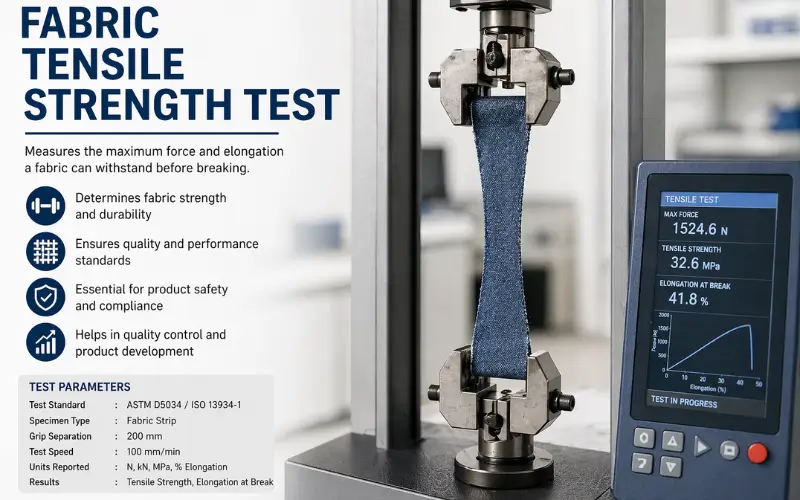
A fabric tensile strength test is a laboratory procedure used to determine how much force a textile can handle before it breaks. This test is widely used in textile manufacturing to ensure product quality and reliability. A machine used to test the fabric tensile strength is known as tensile tester.
It plays a key role in:
- Quality control processes
- Product development
- Material comparison
Industries such as apparel, automotive textiles, medical fabrics, and industrial materials rely heavily on tensile testing.
Why is Tensile Strength Testing Important?
Testing fabric tensile strength is essential for several reasons:
- Ensures durability: Helps confirm that the fabric can withstand real-world usage
- Maintains quality standards: Prevents defective products from reaching customers
- Supports compliance: Meets industry standards like ASTM and ISO
- Reduces returns and complaints: Stronger fabrics mean better customer satisfaction
Without proper testing, fabrics may fail prematurely, leading to financial losses and brand damage.
Types of Fabric Tensile Strength Tests
1. Strip Test Method
The strip test is one of the most common methods. A rectangular strip of fabric is clamped and pulled until it breaks.
Key features:
- Measures full-width fabric strength
- Provides consistent and reliable results
- Commonly used in laboratories
2. Grab Test Method
In the grab test, only the center portion of the fabric is gripped while the edges remain free.
Key features:
- Simulates real-life stress conditions
- Often used for woven fabrics
- Faster and simpler than strip testing
3. Wide Width Test Method
This method tests a wider section of fabric, making it suitable for technical textiles.
Best for:
- Geotextiles
- Industrial fabrics
- Reinforced materials
Fabric Tensile Strength Test Procedure (Step-by-Step)
- Sample Preparation
Fabric samples are cut into standard sizes based on testing guidelines. - Conditioning
Samples are conditioned under controlled temperature and humidity. - Machine Setup
The sample is placed in a Universal Testing Machine (UTM). - Applying Force
The machine pulls the fabric at a constant rate. - Breaking Point Measurement
The force required to break the fabric is recorded. - Result Analysis
Data is analyzed to determine tensile strength and elongation.
Testing Standards for Fabric Tensile Strength
Standardized testing ensures accuracy and consistency.
Common standards include:
- ASTM D5034 – Grab Test
- ASTM D5035 – Strip Test
- ISO 13934-1 – Strip Method
- ISO 13934-2 – Grab Method
Following these standards ensures reliable and comparable results worldwide.
Equipment Used in Tensile Strength Testing
The primary equipment used is a Universal Testing Machine (UTM).
Key components:
- Grips/clamps to hold fabric
- Load cell to measure force
- Control system for speed and tension
- Software for data recording
Modern UTMs provide precise digital results and graphical analysis.
Factors Affecting Fabric Tensile Strength
Several variables influence tensile strength:
- Fiber type: Polyester is stronger than cotton
- Yarn quality: Higher twist improves strength
- Fabric structure: Woven fabrics are generally stronger than knitted
- Finishing treatments: Coatings can enhance or weaken strength
- Environmental conditions: Moisture and temperature affect results
How to Calculate Fabric Tensile Strength
Tensile Strength= Force/Area
Where:
- Force = Load at breaking point
- Area = Cross-sectional area of the fabric
Units commonly used:
- Newton (N)
- Kilogram-force (kgf)
- Megapascal (MPa)
Interpretation of Test Results
Understanding the results is crucial:
- Higher tensile strength = stronger fabric
- Warp direction is usually stronger than weft
- Values vary depending on fabric type and use
For example:
- Heavy-duty fabrics → High tensile strength
- Lightweight fabrics → Lower tensile strength
Fabric Tensile Strength vs GSM (Fabric Weight)
Many assume heavier fabrics are always stronger—but that’s not always true.
- High GSM (grams per square meter):
Generally stronger but depends on fiber type - Low GSM fabrics:
Can still be strong if made with high-performance fibers
👉 Strength depends more on:
- Fiber quality
- Yarn structure
- Fabric construction
Real-World Example of Tensile Strength in Fabrics
Let’s compare common fabrics:
| Fabric Type | Tensile Strength | Typical Use |
|---|---|---|
| Cotton | Medium | Casual wear |
| Polyester | High | Sportswear |
| Nylon | Very High | Industrial, outdoor gear |
| Silk | Moderate | Luxury apparel |
Quality Control Checklist for Tensile Testing
To ensure reliable results, follow this checklist:
- ✅ Use standardized test methods (ASTM/ISO)
- ✅ Calibrate testing machine regularly
- ✅ Prepare samples accurately
- ✅ Maintain controlled testing environment
- ✅ Record and analyze data properly
Applications of Fabric Tensile Strength Testing
Tensile testing is used across multiple industries:
- Apparel manufacturing: Ensures garment durability
- Technical textiles: Used in construction and engineering
- Home textiles: Upholstery and curtains
- Protective gear: Safety clothing and uniforms
Common Mistakes in Tensile Strength Testing
Avoid these errors:
- Improper sample cutting
- Incorrect machine calibration
- Ignoring humidity and temperature conditions
- Misinterpreting test data
These mistakes can lead to inaccurate results and poor decisions.
Tips to Improve Fabric Strength
- Use high-quality fibers
- Increase yarn twist
- Choose appropriate fabric construction
- Apply strengthening finishes
- Conduct regular quality testing
Conclusion
Fabric tensile strength testing is a critical part of textile quality control. It ensures that fabrics meet durability standards and perform well under stress.
By understanding testing methods, standards, and influencing factors, manufacturers can produce high-quality, reliable textiles.
FAQs
What is tensile strength in fabric?
It is the maximum force a fabric can withstand before breaking.
How is fabric tensile strength measured?
Using a Universal Testing Machine that applies force until the fabric breaks.
What is the difference between grab and strip test?
Grab test measures localized strength, while strip test measures overall fabric strength.
Which fabric has the highest tensile strength?
Synthetic fibers like polyester and nylon generally have higher tensile strength than natural fibers.