Warehouses rarely stay in one operating mode for long. One week you are building outbound pallets nonstop, the next you are processing returns, consolidating lanes, or staging materials for a short production run. When volume shifts, empty containers can become the mess that slows everything down. Stack and nest containers solve that problem by giving you stable stacking when loaded and tight nesting when empty.
How Stack and Nest Containers Work
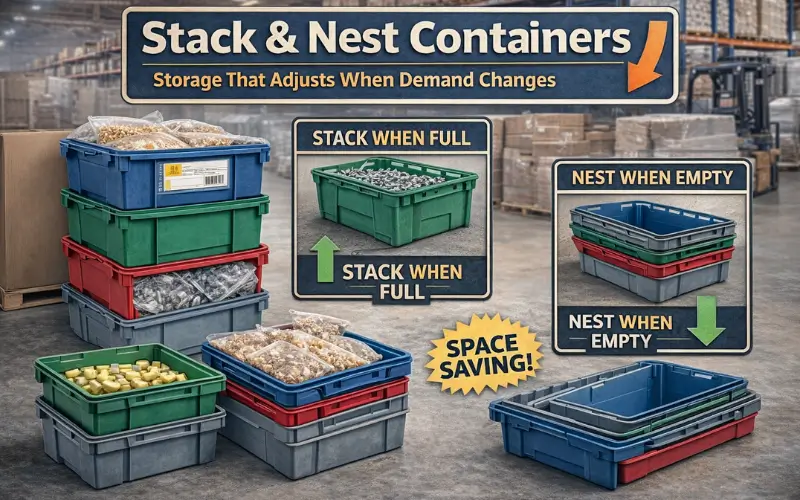
A stack and nest container is built to do two opposite jobs. When it is full, it stacks securely on top of the same footprint, so you can store or stage product vertically. When it is empty, you rotate it (or flip it, depending on the design) so the container nests inside another. That nesting reduces the cube of empty containers, which matters on the floor and on return freight.
Most industrial versions are molded plastic with reinforced rims and corners, since those contact points take the hits from daily handling.
Stacking vs Nesting vs Straight Wall Totes
These terms are related, but they’re not the same.
- Stacking Containers: Optimized to stack when full. Some nest, many do not.
- Nesting Containers: Optimized to nest when empty. They save space, but may not be ideal for heavier stacked loads.
- Straight Wall Totes: Used when you need consistent internal volume and easier automation compatibility. They are common on conveyors, but they do not always nest efficiently.
When you shop stack and nest containers, you’ll see that most sit between these options. In picking and assembly areas, teams sometimes compare them to stacking totes because access and stack stability can matter more than nesting.
Ideal Use Cases for Stack and Nest Containers
They are a strong fit when you move the same packaging back and forth.
- Return logistics and closed-loop distribution
- Manufacturing WIP between workstations
- Kitting and light assembly staging
- Seasonal volume swings
If your dock and aisles get clogged with empties at peak times, this is usually the fix.
Space Savings in Storage and Transport
Space savings shows up in three places.
Floor Space and Staging
Nested empties take a fraction of the footprint, freeing space near receiving, shipping, and replenishment zones.
Return Freight Cube
Empty containers are mostly air. Nesting lets you return more containers per trailer, reducing the cost per cycle.
Easier Standard Work
Predictable stacking and nesting makes it simpler to set rules for where empties go and how they get staged for pickup.
Another benefit is container control. When you standardize on one or two footprints, it is easier to count empties, spot damage, and reduce shrink. Many teams add simple labeling and a return checklist so containers do not disappear into corners or scrap piles during audits.
Durability and Handling Checks
For large warehouses, small design details determine whether containers last.
- Reinforced rims and corners for stacking impact
- Strong base design to resist cracking
- Handholds that reduce drops
- Nesting stops so containers do not wedge together
If you are buying used, check for warped rims, corner fractures, and stress whitening. Those often signal a container that has been overloaded or repeatedly dropped.
Choosing the Right Size and Configuration
Start with the workflow, then pick dimensions.
- Load size and weight, including worst-case spikes
- Handling method: hand-carry, carts, forklifts, or mixed
- Need for lids and label visibility
- Stack height limits for safety and racking clearance
Standardizing a few sizes across zones usually reduces friction and keeps returns smoother.
Conclusion
If you want stack and nest containers that match real warehouse handling, Container Exchanger can help you source the right footprints and quantities, including used options when it makes sense. They can also help you compare container types side by side, confirm load ratings, and reduce surprises when pallets hit the dock. If your operation needs flexible storage now, this is an easy upgrade to prioritize.