Have you ever wondered what really gives your bra its shape, support, and comfort?
Most of us wear bras almost every day, yet few can name more than a couple of their parts. But once you understand what each piece does — from the under band that does most of the heavy lifting to the delicate straps that fine-tune your fit — it’s like unlocking a secret blueprint to comfort and confidence.
Bras aren’t just everyday garments; they’re feats of clever engineering, combining tension, elasticity, and design to complement the body’s natural shape. Whether you’re a woman trying to find your perfect fit, a lingerie professional studying structure, a fashion student exploring intimate apparel design, or a sewing enthusiast eager to craft your own, knowing the different parts of a bra gives you the foundation for success.
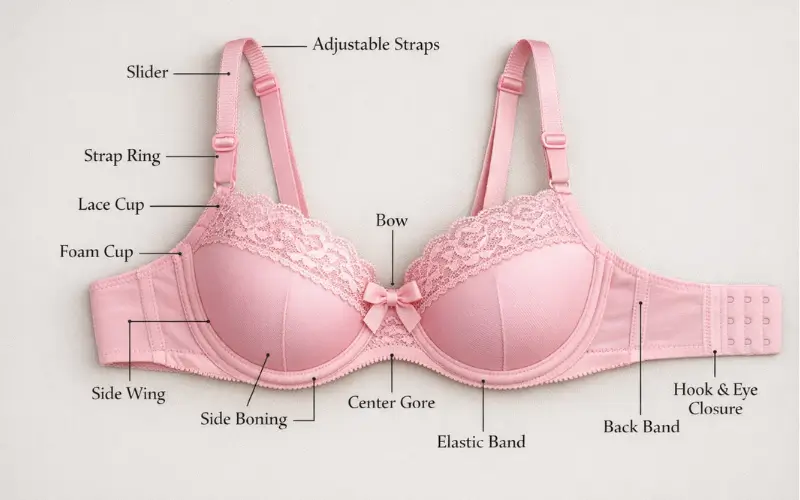
In this guide, we’ll break down every component — from the cups and center gore to the smallest rings and sliders — explaining what they do, why they matter, and how they affect your fit and comfort. By the end, you’ll never look at your bra the same way again.
What Is a Bra?
A bra, short for brassiere, is far more than just an undergarment — it’s a carefully engineered piece of clothing designed to support, shape and complement the natural form of the breasts. While most people think of it as something worn for modesty or style a well-made bra’s primary purpose is support and comfort.
The Purpose Behind the Design
Every element in a bra — the band, straps, cups, underwire and even the tiny bits of elastic and stitching — works together to distribute weight evenly and maintain posture. When fitted correctly, a bra should feel almost weightless, providing lift and containment without digging, slipping or constraining movement.
In essence, a bra’s job is threefold:
- Support: Holding the breasts securely while reducing strain on the shoulders and back.
- Shape: Enhancing or maintaining a desired silhouette under clothing.
- Comfort: Allowing free movement while keeping everything in place.
A Quick Look at How Bras Evolved
The modern bra as we know it is just over a century old, yet its evolution tells a fascinating story of changing fashion, technology and women’s lifestyles.
- Early Beginnings: In ancient civilizations, women used bands of fabric or linen wraps for modesty and support.
- Corset Era: By the 16th–19th centuries, corsets dominated, shaping the torso but offering little comfort or practicality.
- The Birth of the Bra: In the early 1900s, innovators began breaking corsets into separate upper and lower garments. By 1914, Mary Phelps Jacob patented the first modern bra — made of handkerchiefs and ribbon.
- Mid-20th Century Innovation: Elastic, nylon and cup sizing revolutionized fit.
- Today: Modern bras combine science, fashion and ergonomics — with advanced materials, seamless moulded cups and even 3D-fit technology.
The Core Structural Parts of a Bra
Every bra, regardless of style — whether it’s a lace bralette, a T-shirt bra or a heavy-duty sports bra — is built around a few core components that give it shape and stability. These are the foundation of bra design: the band, cups, underwire, center gore, wings and closure.
Let’s break each one down in detail.
1. The Band (Under band or Back Band)
The band is the unsung hero of bra support — it’s the wide strip that wraps around the torso, sitting snugly under the bust. Many women assume the straps provide most of the lift, but in reality, the band is responsible for about 80% of a bra’s support.
- Function: Anchors the entire bra, holding it in place and distributing weight evenly around the body.
- Fit Tip: The band should fit firmly but comfortably — you should be able to slide two fingers underneath it, no more. If it rides up your back, it’s too loose.
- Design Variations:
- Elasticated bands for everyday bras.
- Wide power net bands for plus-size or high-support bras.
- Longline bands extending further down the torso for extra support and style.
For sewing enthusiasts: Bands are usually reinforced with elastic, sometimes lined with mesh or power net fabric for tension control.
2. The Cups
The cups cradle and shape the breasts — they determine not only how your bust looks under clothing but also how supported you feel.
- Structure: Cups may be seamed (stitched from multiple panels) or moulded (heat-shaped into a smooth curve).
- Variations:
- Full-Cup: Covers most of the breast for full support.
- Demi or Balconette: Offers less coverage, often with a horizontal neckline.
- Plunge: Low-cut at the center for V-neck outfits.
- Soft-Cup vs. Padded: Soft cups offer a natural shape, while padded or foam-lined cups add volume and contouring.
- Upper vs. Lower Cup: The lower cup provides lift, while the upper cup gives containment and shape.
Fit Tip: If you notice gaps or wrinkles, your cup is too large; if there’s spillage, it’s too small.
3. The Underwire
The underwire is a thin, semi-circular metal or plastic wire sewn into the bottom edge of each cup. It acts as a frame that helps define and support the bust.
- Function: Lifts the breast from below, maintaining separation and preventing side spillage.
- Construction: Housed in a channeling casing, usually padded for comfort.
- Alternatives: Wire-free (soft-cup) bras rely on structured seams and elastic support instead.
Fit Tip: The wire should lie flat against the ribcage and not sit on breast tissue. If it pokes or pinches, the size or shape of the wire doesn’t match your body.
4. The Center Gore (Bridge or Link)
The center gore is the piece of fabric that connects the two cups at the front. It may look small, but it’s a key player in bra comfort and stability.
- Function: Keeps the cups anchored and separates the breasts.
- Design Variations:
- Tall gores for full coverage and strong separation.
- Low gores for plunge bras that work with deep necklines.
Fit Tip: The gore should lie flat against your sternum. If it floats away from your body, your cups may be too small or the band too loose.
5. The Wings (Side Panels)
The wings, also called side panels, are the sections that extend from the cups to the back closure.
- Function: They pull the band around the body and help smooth the sides.
- Fabric Choice: Often made from sturdy materials like power mesh for stretch and breathability.
- Fit Tip: The higher the wings, the more side support they offer — especially for fuller busts or side spillage issues.
Design Insight: Some bras include side boning in the wings to maintain structure and prevent rolling.
6. The Back Closure (Hook & Eye)
The hook-and-eye closure at the back (or sometimes front) is the adjustable fastener that keeps the bra secure.
- Structure: Usually 2–4 rows of hooks for fine-tuning the fit.
- Fit Tip: When new, your bra should fasten comfortably on the loosest hook — so you can tighten it as the band stretches over time.
- Variations:
- Front-closure bras for convenience.
- Pull-on bralettes with no hardware for comfort.
The Adjustable & Supportive Components of a Bra
While the band and cups create the foundation, the adjustable components of a bra fine-tune its comfort and support. These are the little heroes that let you customize your fit, adapt to body changes and extend the life of your favorite bra.
Let’s look at each one in detail.
1. The Straps
Straps connect the top of each cup (at the apex) to the back of the bra. Though they’re the most visible part, they actually provide only about 10–20% of the support — their main job is to stabilize and balance the fit created by the band and cups.
Structure & Placement
- Straps are typically made of elastic webbing, chosen for its stretch-and-recovery balance.
- They may be fixed or detachable, depending on the bra style.
- Some styles — like racerback, halter or convertible bras — use repositionable straps for wardrobe flexibility.
Fit Tips
- The straps should rest flat on your shoulders without digging in.
- If your straps keep slipping, the band may be too loose, not the straps too long.
- Always adjust the sliders to ensure the cups sit snugly against your body.
Design Note (for sewing enthusiasts)
Straps are often topstitched for durability and can vary in width — wider straps distribute weight better for fuller busts, while slimmer straps offer a daintier aesthetic for smaller sizes.
2. Rings and Sliders (Hardware Components)
Tiny but mighty, rings and sliders are the mechanical connectors that make straps adjustable.
- Rings link the strap to the bra cup or band.
- Sliders allow the wearer to shorten or lengthen the strap for a perfect fit.
They’re typically made of nylon-coated metal or durable plastic, chosen for both strength and smooth movement.
Design Insights
In lingerie design, hardware size and color are carefully matched to the bra’s aesthetic. Luxury bras often feature gold-plated or satin-coated rings for an elegant touch.
3. Elastic Trims and Edging
Elastic trims run along the edges of the band, wings, and cups, ensuring flexibility and a gentle grip against the skin.
- Purpose: To prevent gaping, slipping, or chafing.
- Placement: Commonly seen at the top and bottom of the band, neckline, and underarm edge.
- Types:
- Fold-over elastic (FOE) — folded and stitched for a clean, soft finish.
- Picot elastic — decorative edge with little loops for aesthetics and stretch.
- Clear elastic — hidden reinforcement inside lace cups.
Fit Tip
Elastic should hug the skin, not press into it. If your bra leaves deep marks, it’s a sign the elastic has lost its stretch or the size is too small.
Sewing Insight
Elastic is applied under tension when sewing, which helps the bra contour to the body’s natural curves. Consistent tension is key to comfort.
4. Decorative & Functional Details
While not always essential for structure, decorative components can influence comfort and function:
- Front bows or appliqués: Usually aesthetic, but sometimes hide stitch joins.
- Tag or label placement: Ideally soft or printed directly onto the fabric to avoid irritation.
- Reinforcement stitching: Over areas like the strap joins, gore, or hook-and-eye panel for durability.
These small touches differentiate everyday bras from luxury or performance pieces — they blend functionality with artistry.
Fabric & Construction Details
Every bra, whether minimalist or intricate, is a masterclass in textile engineering. The materials and stitching techniques determine not just how a bra looks, but how it breathes, stretches, and supports. Let’s look under the surface to see how these details shape performance and feel.
1. Cup Construction: Seams vs. Moulding
The cup structure is one of the most important factors in shaping and support.
Seamed Cups
- Made from two or more pieces of fabric stitched together, creating a more contoured, lifted shape.
- Vertical seams add upward lift, while diagonal or horizontal seams define the silhouette and projection.
- Favored in high-support and custom bras for their precise shaping.
Moulded Cups
- Created by heat-shaping a single piece of foam or fabric into a smooth, rounded form.
- Offer a seamless appearance under clothing — ideal for T-shirt bras.
- Provide moderate structure but less custom shaping compared to seamed designs.
Fit Insight:
If you want definition and lift, seamed cups are best. For invisible smoothness under clothes, moulded cups win.
2. Linings, Padding & Inserts
These layers make all the difference in comfort and aesthetics.
- Lining: Adds comfort and modesty, especially under lace or mesh.
- Padding: Enhances volume or evens out breast asymmetry. Can be foam, fiberfill, or gel-based.
- Removable inserts: Common in push-up or sports bras for customizable shaping.
Sewing Tip: Linings should be breathable and skin-friendly — cotton blends or microfiber are top choices for everyday wear.
3. Fabrics & Their Functions
Different parts of a bra use different fabrics — each chosen for a specific purpose:
| Part | Common Fabric | Purpose |
| Band/Wings | Powernet, mesh | Firm stretch & support |
| Cups | Lace, satin, microfiber, tricot | Comfort, style, and shape |
| Straps | Elastic webbing | Flexibility and adjustability |
| Lining | Cotton or poly blend | Breathability and comfort |
| Underwire channeling | Felt or brushed fabric | Cushioning and stability |
Design Insight: Luxury bras often combine contrasting materials — soft lace overlay on supportive power mesh — for a balance of strength and beauty.
4. Stitching & Finishing Techniques
The right stitches give a bra both durability and grace.
- Zigzag stitching: Used on elastic edges to allow stretch.
- Cover stitching: Creates a smooth, flat finish that lies gently on the skin.
- Bar tack stitches: Reinforce high-stress points like strap joins or hook panels.
- Underwire channeling: Securely stitched casing keeps wires from poking or shifting.
Detail for Sewing Lovers:
Consistent stitch length and tension are key to professional results. Uneven stitches can weaken seams or cause puckering on delicate fabrics.
5. Material Innovations in Modern Bras
Today’s bras benefit from technical textiles that combine comfort and performance:
- Moisture-wicking microfibers keep you cool and dry.
- Bonded seams replace traditional stitching for invisible, chafe-free edges.
- Spacer fabrics add light structure with breathable air pockets.
- Eco-fabrics like bamboo viscose and recycled nylon are rising trends for sustainable lingerie.
Pro Tip for Consumers:
If you live in hot climates, look for mesh-lined or spacer-fabric bras. For sensitive skin, seek tag-free designs with brushed linings.
Lesser-Known & Technical Parts of a Bra
Beyond the band, cups, and straps lie a world of tiny details that often go unnoticed — yet they’re the difference between a bra that simply “works” and one that feels tailor-made. Let’s explore these overlooked elements that contribute to comfort, stability, and design integrity.
1. The Apex
The apex is the point where the strap meets the cup, usually at or near the top outer edge of the cup. It’s a critical junction that influences lift, projection, and silhouette.
- Function: Transfers some upward support from the strap into the cup’s upper edge.
- Design Variations:
- In full-cup bras, the apex sits higher to offer more containment.
- In balconette or demi bras, it’s lower and wider-set for an open neckline.
- Fit Insight: Poorly positioned apex points can cause the straps to pull outward or dig into the shoulders.
For sewing enthusiasts: Apex placement determines the neckline curve and must align with the bust apex on the pattern for a natural shape.
2. Side Cup Lining / Side Sling
Inside many bras is a side cup lining (also called a side sling or inner support panel) — an extra layer or panel that subtly redirects breast tissue forward.
- Purpose: Shapes and centers the bust, improving cleavage and projection.
- Common in: Full-coverage or high-support bras, as well as nursing and minimizer bras.
- Materials: Often made from sturdy tricot or power mesh for control without bulk.
Fit Tip: If you want a more lifted, centered look, seek bras with an internal sling or visible side panel stitching.
3. Side Boning (Stay or Spine)
Side boning refers to thin, flexible strips (plastic or metal) sewn vertically into the bra’s wings.
- Function: Keeps the sides smooth, prevents the band from folding or rolling.
- Fit Insight: Especially helpful for fuller busts or soft tissue — prevents side bulge.
- Comfort Note: Should be flexible enough to move with your body, not dig in.
Design Note: Boning is encased in a fabric channel, similar to underwire casing, for softness against the skin.
4. Neckline Edge (Top Cup Edge)
The neckline edge is the upper edge of the bra cup — where the fabric meets the chest or neckline.
- Function: Defines the cup’s coverage level and contributes to shape.
- Variations:
- Straight or horizontal for balconette styles.
- Curved or scalloped for full-cup designs.
- Elastic-bound edges for flexibility and containment.
- Fit Tip: If this edge digs in, it may be too tight or the cup too small; if it gaps, the cup may be too large.
5. Under band Elastic & Channeling
- Under band Elastic: The elastic strip sewn along the bottom edge of the band that keeps the bra anchored in place. It adds flexibility while maintaining firmness.
- Wide elastics offer more stability; narrow elastics give a delicate look.
- Channeling: The padded casing that encloses the underwire.
- Provides a soft barrier between the wire and your skin.
- Usually triple-stitched for durability.
For sewists: Channeling is typically sewn in two passes — one to attach it to the cup, and another to seal it after inserting the wire. Precision here prevents poking and ensures longevity.
6. Bridge Reinforcement & Stabilizer Layers
The bridge (center gore) area may contain an extra stabilizer fabric — a non-stretch material that keeps the cups properly separated.
- Purpose: Prevents the gore from twisting or warping under tension.
- Common Materials: Non-stretch tricot or sheer stabilizer mesh.
- Design Tip: Some brands double-layer the bridge for added structure or aesthetic opacity.
7. Stitch Reinforcements & Hidden Details
Even the smallest stitch plays a role:
- Bar tacks (dense zigzag stitches) strengthen stress points like strap joins.
- Staystitching maintains the shape of curved cup edges before assembly.
- Topstitching smooths layers and prevents rolling — often used along channeling and elastic edges.
For professionals: These construction details distinguish quality craftsmanship from mass-production shortcuts.
Why These Tiny Parts Matter?
It’s easy to overlook these smaller elements, but they’re the backbone of a bra’s comfort and durability. When any of them fail — a misaligned apex, loose boning, or cheap elastic — the entire fit suffers. Understanding these nuances helps:
- Consumers recognize why some bras feel better than others.
- Designers craft bras with superior balance and longevity.
- Sewists fine-tune every detail for a flawless final fit.
How Each Part Affects Fit & Comfort?
A bra isn’t just about appearance — it’s a delicate balance between tension, lift and contour. When all parts work in harmony, the result is invisible comfort. But when one part fails, everything else follows.
Here’s how each major component contributes to the perfect fit — and what to watch for when it doesn’t.
1. The Band: The Backbone of Support
The band should sit level around your torso, snug but not tight.
It provides up to 80% of the total support, anchoring the bra in place.
✅ When It Fits Right:
- Lies parallel to the floor (not riding up).
- Feels firm but breathable — two-finger rule applies.
- Keeps the cups steady without the straps doing the heavy lifting.
⚠️ When It Doesn’t:
- Rides up your back: Band too loose — size down.
- Digs in painfully: Band too small or stretched-out elastic.
- Twists or folds: Weak side panels or worn-out power mesh.
Pro Tip: Always test the fit on the loosest hook when new. You’ll tighten it over time as the elastic relaxes.
2. The Cups: Shape, Coverage and Containment
The cups determine how your bust looks and feels within the bra — they’re all about proportion and containment.
✅ When They Fit Right:
- The breast tissue fills the cup fully — no gaps, wrinkles or bulging.
- The cup edge lies smoothly against your skin.
- The underwire (if present) sits flat against your ribcage.
⚠️ When They Don’t:
- Gapping at the top: Cup too large or wrong shape (try a plunge or demi).
- Spillage or “quad-boob”: Cup too small or neckline too low.
- Wrinkling: Fabric or foam not filled out — size or cup style mismatch.
Sewing/Design Insight: The angle of cup seams affects projection — diagonal seams push tissue upward, vertical seams forward.
3. The Underwire: Frame & Lift
The underwire defines the bra’s shape and keeps the breasts separated.
It should hug the chest wall like a smooth semicircle.
✅ When It Fits Right:
- Encircles the breast completely without resting on tissue.
- Lies flat at the center gore.
- Moves comfortably with your body.
⚠️ When It Doesn’t:
- Poking underarm: Wire too wide or too tall.
- Sitting on breast tissue: Cup too small.
- Lifting off sternum: Band too loose or gore too high.
Fit Hack: Try bending the wire slightly outward (if metal) for minor discomfort — but long-term, sizing correction is best.
4. The Straps: Fine-Tuning the Fit
Straps stabilize the fit, but they shouldn’t bear the load.
✅ When They Fit Right:
- Sit comfortably on the shoulders without slipping or digging.
- Cups stay in place when straps are momentarily lowered.
⚠️ When They Don’t:
- Slipping off: Straps too loose or placed too far apart.
- Digging in: Band too loose, forcing straps to compensate.
- Uneven tension: Often caused by stretched elastic or poor strap adjustment.
🩵 Pro Tip: Adjust your straps every few weeks — elastic loosens faster than you think.
5. The Center Gore: The Anchor Point
The center gore should rest flat against your sternum, holding the cups in place and maintaining separation.
✅ When It Fits Right:
- Lies flush on the chest.
- Keeps cups symmetrical and stable.
⚠️ When It Doesn’t:
- Floating away: Cups too small or underwire too narrow.
- Digging in: Gore too tall for your sternum shape (try plunge style).
Design Note: Many brands now contour gore height to match chest depth — a key innovation in modern fit design.
6. The Wings & Back: Stability and Smoothing
The wings wrap around the torso, keeping the band anchored and smoothing the sides.
✅ When They Fit Right:
- Sit flat and taut, not bunching or folding.
- Provide gentle compression under the arms.
⚠️ When They Don’t:
- Rolling or folding: Weak elastic or lack of side boning.
- Bulging: Band too tight or fabric not firm enough.
Pro Tip: A wider wing distributes pressure better and prevents back bulge — ideal for fuller busts.
7. Elastic, Hardware and Seams: Comfort in the Details
Even the smallest details can make or break comfort.
- Elastic too tight? Leads to red marks and restricted breathing.
- Rough seams or lace edges? Can irritate delicate skin — look for brushed or bonded finishes.
- Cheap rings/sliders? May warp or snap under tension — quality hardware lasts longer.
For lingerie professionals: Seam placement directly affects aesthetic and comfort. Avoid placing rigid joins over the bust apex or underarm curve.
Bringing It All Together
Every bra part works like an instrument in an orchestra — each must play its role in harmony:
- The band provides tension.
- The cups define shape.
- The underwire frames support.
- The straps fine-tune lift.
- The elastic and seams refine comfort.
Choosing the Right Bra – Based on Anatomy & Fit Needs
Once you understand how each part of a bra works, choosing the right one becomes much easier. The secret to all-day comfort isn’t just size — it’s matching your body’s anatomy with the right bra construction.
Let’s explore what to prioritize based on body type, bust size and intended use.
1. For Larger Busts: Prioritize Support & Structure
Fuller busts need bras that focus on firm anchoring and reinforced structure.
What to Look For:
- Wide, firm band: The wider the band, the more surface area to distribute weight.
- Strong underwire: Fully encircles the bust without flexing outward.
- Three-part seamed cups: Offer superior lift and shape definition.
- High side panels & boning: Prevent spillage and provide lateral stability.
- Wide straps: Reduce shoulder pressure and prevent digging.
Pro Tip: Opt for fabrics like power mesh or microfiber blends for stretch with strength.
2. For Smaller Busts: Focus on Shape & Definition
Smaller busts often benefit from bras that create natural shape and gentle contouring.
What to Look For:
- Light padding or contour cups: Add smoothness without exaggeration.
- Plunge or demi styles: Open neckline enhances natural cleavage.
- Soft or moulded cups: Provide definition while remaining lightweight.
- Narrow center gore: Keeps breasts centered and creates subtle lift.
Pro Tip: For a braless feel with shape, try wire-free bras or bralettes with supportive under bands.
3. For Active Lifestyles: Choose Maximum Containment & Flexibility
Sports and movement demand bras that control motion while remaining breathable.
What to Look For:
- Compression or encapsulation design: Compression holds both breasts together; encapsulation separates and supports individually.
- Wide elastic band: Keeps the bra from shifting during activity.
- Moisture-wicking fabrics: Microfiber, spandex or mesh panels for ventilation.
- Racerback or cross-back straps: Prevent slipping and add stability.
Pro Tip: Avoid cotton for workouts — it absorbs sweat and stays damp.
4. For Special Occasions: Style Meets Function
Even in fashion-forward designs, anatomy still dictates comfort.
What to Look For:
- Strapless bras: Choose silicone-grip bands and longline styles for better anchoring.
- Backless bras: Use adhesive cups or low-back converters.
- Plunge bras: Ideal for low necklines — low gore, angled cups.
- Push-up bras: Contoured padding at the base of the cup enhances cleavage naturally.
Style Insight: Always try these with your outfit — even small changes in neckline or fabric tension can alter the fit.
5. For Nursing & Maternity: Adaptability Is Key
Pregnancy and breastfeeding bring continuous body changes — flexibility and comfort matter most.
What to Look For:
- Wireless or soft-cup design: Allows breast expansion without constriction.
- Drop-down cups or clips: Enable easy feeding access.
- Wide, stretchy bands: Adjust as your ribcage expands or contracts.
- Moisture-control fabrics: Keep sensitive skin dry and irritation-free.
Pro Tip: Refit your bras every trimester — your ribcage and bust size will likely shift.
6. For Posture & Back Support: Reinforced Frames
Posture-correcting bras integrate structure and coverage for spinal alignment.
What to Look For:
- High back panels: Distribute tension across a larger area.
- Criss-cross back design: Encourages upright posture.
- Firm elastic and sturdy seams: Offer lift without strain.
Comfort Tip: Avoid overly tight styles — posture bras should support, not restrict.
7. Know When to Replace Your Bra
Even the best materials have limits.
- Elastic lifespan: ~6–12 months for daily wear.
- Underwire fatigue: If wires twist, bend or pop out — time for a new bra.
- Stretched bands: If you’re fastening on the tightest hook and it still feels loose.
- Faded support: When cups wrinkle or straps lose tension.
Pro Tip: Rotate your bras — letting them rest between wears extends their life significantly.
8. Maintenance: Caring for Each Part
Each part of your bra can last longer with proper care:
- Hand wash with mild detergent — avoid wringing.
- Air dry flat to preserve elasticity.
- Store flat or folded at the gore, not crumpled in drawers.
- Avoid fabric softeners — they degrade spandex fibers.
Conclusion: Understanding Your Bra, Understanding Your Body
Your bra is more than just a piece of fabric — it’s a small marvel of design, physics, and craftsmanship working together to support one of the most personal parts of your body. Once you understand how every component — from the sturdy band to the delicate lace trim — plays its role, you’ll never see lingerie the same way again.
When you know your bra’s anatomy, you unlock the power to:
- Recognize why one style feels better than another.
- Communicate confidently with fitters or designers.
- Choose pieces that suit your unique shape and lifestyle.
- Even sew or customize your own bras with precision.
No matter your size, shape or purpose, the perfect bra isn’t about trends — it’s about balance, comfort and understanding. Because when your bra fits right, everything else follows: your posture improves, your clothes sit better and your confidence shines through effortlessly.
So next time you clasp your favorite bra, take a moment to appreciate it — every stitch, strap and seam is part of an elegant equation designed to make you feel supported, secure and beautiful.
FAQs About the Different Parts of a Bra
1. What are the main parts of a bra?
The main parts include the band, cups, underwire, center gore, wings, straps and hook-and-eye closure. Together, these provide shape, lift and support.
2. Which part of the bra gives the most support?
The band provides around 80% of the support, anchoring the entire bra. Straps and cups fine-tune the fit, but a snug, firm band is the true foundation.
3. What is the center gore on a bra?
The center gore is the piece of fabric between the cups that helps separate the breasts and keep the bra anchored against your chest.
4. Why does my bra band ride up my back?
If the band rides up, it’s likely too loose. Try tightening it or going down one band size (while adjusting cup size accordingly).
5. What are side wings on a bra for?
Wings or side panels wrap around your torso to connect the cups to the closure. They provide stability, smooth out the sides, and prevent bulging.
6. What are bra rings and sliders?
They’re small pieces of hardware that connect and adjust the straps — rings attach the strap to the cup or band, while sliders let you lengthen or shorten the straps.
7. What is the difference between moulded and seamed cups?
- Seamed cups use stitched panels for shaping and support (visible seams).
- Moulded cups are heat-shaped from one piece for a smooth, seamless look.
8. How often should I replace my bras?
Most bras last 6–12 months of regular wear. Replace them when bands stretch, straps lose tension, or cups wrinkle and no longer support.
9. What type of bra is best for everyday wear?
A T-shirt bra with moulded cups and soft elastic edges works best for daily comfort. Look for breathable fabrics and a smooth finish under clothes.
10. How can I make my bra last longer?
Hand wash with mild detergent, avoid twisting or wringing, and air dry flat. Rotate between multiple bras to reduce wear on any single one.
Quick Reference Table: The Different Parts of a Bra, Their Functions and Fit Tips
| Part | Function / Description | Fit Tip / Insight |
| Band (Under band) | The foundation of the bra; wraps around the torso and provides most of the support. | Should fit snugly — lies flat and doesn’t ride up your back. |
| Cups | Shape and contain the breasts; come in various styles (full, demi, plunge). | Should fully encase breast tissue without gaps or overflow. |
| Underwire | Semi-circular wire that supports the cup’s shape and lifts the breast. | Should rest flat against the ribcage, not poke or sit on breast tissue. |
| Center Gore (Bridge) | Fabric piece connecting the cups in the middle. | Should lie flat against the sternum; if not, cup/band fit is off. |
| Wings / Side Panels | Extend from the cups to the closure, providing side and back support. | Should feel firm and supportive, not roll or pinch. |
| Back Closure (Hook & Eye) | Fastens the bra, allows adjustment for tightness. | Start on the loosest hook when new; tighten as elastic relaxes. |
| Straps | Stabilize the fit and provide minor lift. | Should not dig into shoulders or slip off. Adjust regularly. |
| Rings & Sliders | Hardware for adjusting strap length and attachment. | Check periodically for wear; metal lasts longer than plastic. |
| Elastic Edges / Trims | Provide flexibility, comfort, and gentle grip along edges. | Should hug, not dig; replace when overstretched. |
| Apex | Point where the strap meets the cup; controls projection. | Misaligned apex causes pulling or strap discomfort. |
| Side Cup Lining / Sling | Internal panel directing breast tissue forward for a centered look. | Great for fuller busts; enhances shape and cleavage. |
| Side Boning | Vertical reinforcement in the wings to prevent rolling. | Should be flexible and smooth, not poke or rub. |
| Neckline Edge (Top Cup Edge) | Defines cup coverage; can be straight, curved, or elastic-bound. | Should lie smoothly on skin without gaping or cutting in. |
| Under band Elastic | The elastic strip sewn along the lower edge for anchoring. | Must provide a firm grip — too loose reduces support. |
| Channeling | Fabric casing that houses the underwire. | Padding inside prevents discomfort and poking. |
| Bridge Stabilizer | Non-stretch layer inside the center gore for structure. | Ensures cups stay separated; should feel firm, not rigid. |
| Seams | Join cup panels for shape and contouring. | Seamed cups give a more lifted shape than smooth ones. |
| Lining / Padding | Adds comfort, modesty, or enhancement. | Look for breathable linings; foam or gel padding varies by need. |
| Fabric Type | Affects comfort, breathability, and elasticity. | Power mesh = support, lace = aesthetics, microfiber = smoothness. |
Written by: Md. Nahian Mahmud Shaikat