Most off-road content treats sand as one terrain. It’s not. Beach sand and desert sand share a name and almost nothing else, and the trucks that get stuck on Outer Banks beaches every July are usually the trucks of drivers who learned to off-road in Moab.
Desert sand is dry, hot, and uniform. The grains are weathered round, they pack predictably, and the surface temperature in summer can hit 140°F. Once you understand how it behaves, it behaves the same way every time.
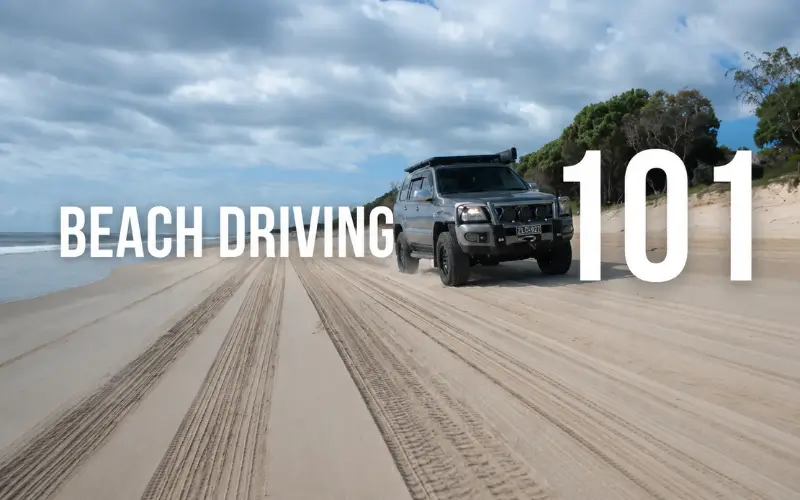
Beach sand is wet, salt-laden, and constantly shifting with the tides. The grains are sharper because they haven’t been weathered as long. The moisture content changes by the hour. The surface temperature stays in the 80s even in August because the ocean keeps it cool. And every salt molecule you pick up wants to corrode every metal part of your recovery gear.
What this means for the driver
A truck that handles Glamis dunes at 18 PSI will dig itself in at a Padre Island beach at the same pressure. The wet sand in the wash zone — where the waves come up — has the consistency of a wet cement mix. It looks solid. It will swallow a tire to the axle in one rotation.
Three mistakes that turn a beach day into a $600 tow:
Mistake 1: Driving in the wave wash zone instead of the soft-pack above it. New beach drivers tend to drive on the wet, hard-looking sand close to the water because it looks more like a road. That’s the trap. Wet sand near the waterline is the most stuck-prone surface on any beach. Drive on the soft, lighter-colored sand above the high-tide line. It looks worse and drives better.
Mistake 2: Stopping for a photo. Once you stop on beach sand, you start sinking. Even a 30-second stop is enough to settle a 6,000-lb pickup an inch deeper. Take photos from a moving truck or get out and walk.
Mistake 3: Underestimating the tide. Most beach permit areas have access roads that flood at high tide. If you don’t know what time the tide turns, you’re betting your truck against an ocean that doesn’t negotiate.
Tire pressure rules specifically for beach driving (these are different from desert numbers):
Above the high-tide line, dry: 18-20 PSI
Wet pack just below the high-tide line: 14-16 PSI
Very soft, freshly-uncovered sand at low tide: 12-14 PSI
These run lower than desert pressures. Wet sand doesn’t pack as densely as dry sand at the same PSI, so you need a bigger contact patch to compensate.
Recovery gear that actually survives on a beach is its own category. Salt water doesn’t care about your warranty. Aluminum recovery boards corrode along the cleated edges and pit within a couple of seasons. Plastic boards swell and lose their teeth. Steel rusts quickly without proper coating, but galvanized or coated steel handles salt better than the alternatives over the long haul.
For coastal use specifically, the gear that holds up tends to be
- Stainless or zinc-coated steel claws (galvanized finishes resist salt the longest)
- Synthetic winch line over steel cable (steel cable rusts and frays from inside)
- Recovery straps with corrosion-resistant hardware
- Tire deflators that won’t seize after a salt-water exposure
- The full off-road recovery gear lineup covers what holds up under coastal conditions and what doesn’t.
What to do when the tide is coming in and you can’t wait
This is the scenario where DIY recovery beats waiting for a tow. Tide tables are non-negotiable. If the tide is coming up and you have less than an hour before the access road floods, you don’t have time for the local wrecker to drive 40 minutes from town and figure out how to reach you.
The workflow
Stop spinning. Every revolution digs you deeper.
Walk away from the truck for 60 seconds. Look at the situation. Identify which wheel has the best chance of getting traction back.
Dig a slope in front of the chosen wheel — sand falls back into the hole behind the tire faster than you’d think, so make the slope shallow.
Install a tire-mounted recovery tool on that wheel.
Low-range, gentle throttle. The tire will rotate once, the truck will lift forward, the rear wheel will catch the dug slope, and you’ll be out.
A few habits that prevent the beach-stuck moment entirely:
Always know the tide schedule before you drive on. Print it, screenshot it, tape it to your dash.
Drive ABOVE the high-tide line, not below.
Don’t stop in soft sand. If you have to stop, stop on hard pack.
Rinse every piece of recovery gear with fresh water within 24 hours of beach use. Salt that sits is salt that pits.
Beach driving is one of the most rewarding kinds of off-roading, and one of the easiest to get wrong. Treat the sand as a different terrain than what you’ve driven before, run lower PSI than your desert numbers, and carry recovery gear rated for salt exposure. Do those three things and the only thing you’ll bring home from the beach is a sunburn.