Renewal notices have a way of arriving at the worst possible moment, usually in the middle of a week that is already full. The number on the page looks close enough to last year’s, the envelope goes on the counter, and three weeks later the policy renews itself for another twelve months. Nobody decided anything. The policy simply continued.
That is a defensible way to handle a utility bill and a poor way to handle auto insurance, because the price you pay is built on assumptions about your life that quietly stop being true. Hamilton is a useful case in point. It is a city where the driving looks very different depending on which part of it you live in, and where a lot of households have changed how they commute over the past few years without ever mentioning it to their insurer.
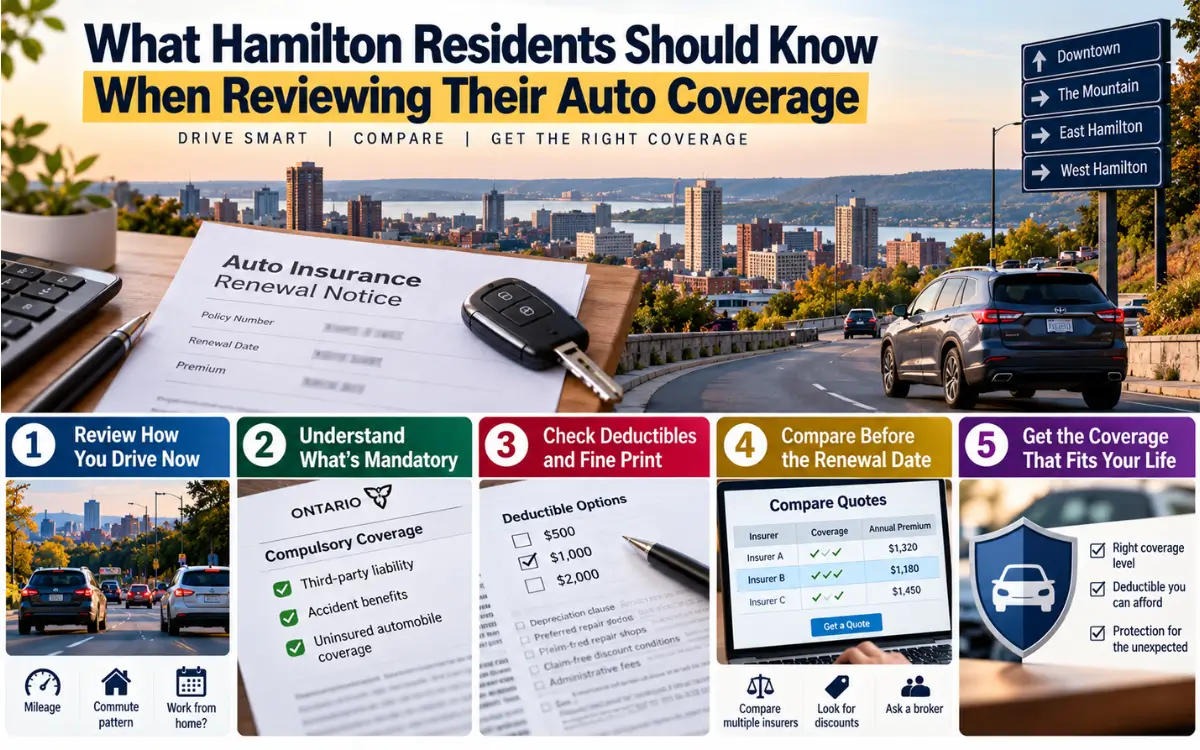
None of what follows requires becoming an insurance expert. It requires about forty minutes with the renewal notice in front of you and a willingness to ask a few blunt questions before the policy rolls over on its own.
Start With How You Actually Drive Now
Mileage and commuting patterns feed directly into what you pay, and they are also the details most likely to have shifted. The city’s transportation master plan, City in Motion, describes a network built around balancing car travel with transit and cycling across a geography that includes dense lower-city streets, the mountain, and the former towns out past the escarpment. A driver on the mountain who now works from home three days a week is simply not the same risk the policy was priced for.
So start there. Estimate your annual kilometers honestly, note whether you still drive during rush hour, and flag any vehicle in the household that has become a weekend-only car. The Insurance Bureau of Canada lists how frequently you drive and how many kilometers per year among the factors insurers weigh, alongside your record, your vehicle and where you live. Those are reportable changes, not trivia.
Know Which Parts of the Policy Are Not Optional
Ontario does not leave coverage entirely to personal preference. The province has compulsory automobile insurance, and the MTO driver’s handbook is blunt about it: every vehicle registered in Ontario must be insured, and you have to show proof before you can register a vehicle or renew a registration. Third-party liability, accident benefits and uninsured automobile coverage all sit in the mandatory tier.
What that leaves is a surprisingly large optional layer, and the optional layer is where comparison actually happens. Collision and comprehensive coverage, higher liability limits above the statutory minimum, loss of use, and endorsements for things like rental vehicles or depreciation waivers on a newer car are all choices. Two quotes with identical premiums can carry wildly different versions of that layer.
Read the Deductibles and the Fine Print Together
A deductible is the easiest lever on the whole policy and the one most often set once and forgotten. Moving a collision deductible from $500 to $1,000 lowers the premium immediately, which is a good trade if you keep enough in savings to absorb it and a bad one if a surprise $1,000 would land on a credit card.
The broader habit worth borrowing comes from a different corner of personal finance. Investors have learned to look past the headline fee to the charges buried in the terms, and this breakdown of the costs that get missed when opening an investment account shows how much of the real price lives in the fine print. Insurance works the same way. Depreciation clauses, repair-shop restrictions, claim-free discounts that vanish after one incident and administrative fees for mid-term changes all affect what a policy costs you over its life.
Compare Before the Renewal Date, Not After
Rates move for reasons that have nothing to do with you. The Insurance Bureau of Canada points to repair costs climbing as vehicles fill up with sensors and cameras, to supply and labor pressure in the repair market, and to rising auto theft and fraud, all of which get priced into premiums across the board. Your insurer’s response to those pressures may differ sharply from the next insurer’s.
This is the argument for shopping the policy a few weeks out rather than on the day it lapses. Pulling quotes on identical coverage from several insurers, or asking a broker reviewing Hamilton car insurance options to do it across their markets, turns a vague suspicion that you are paying too much into a number you can act on. Ask about telematics while you are there if the household drives modest distances or mostly off-peak.
What a Good Review Looks Like
A proper coverage review is shorter than people expect. Write down your real annual mileage, confirm who in the house actually drives which car, check the liability limit against what you would want if you caused a serious collision, pick a deductible you could cover tomorrow, and then get two or three competing quotes on exactly that package.
The point is not to find the cheapest number. Cheap coverage reveals itself at the worst possible time, usually in a tow yard, and the gap between a policy that looks fine and one that behaves well under stress only becomes visible during a claim. The point is to pay for the coverage that matches the life you are living now rather than the one you were living when the policy was first written.
So pull the renewal notice off the counter before the deadline this time. Forty minutes now is cheaper than a year of paying for assumptions nobody checked.