Walk into any clothing store today and you’ll probably spot a tag that says “eco-friendly,” “made from recycled materials,” or “ethically sourced.” That’s not a coincidence. Sustainability in the apparel industry has gone from a niche concern to one of the biggest conversations shaping how clothes are designed, made, and sold.
And there’s good reason for that shift. The apparel industry is one of the most resource-intensive sectors on the planet. It’s responsible for a significant share of global carbon emissions, consumes staggering amounts of water, and generates mountains of textile waste — much of it ending up in landfills within just a few years of being worn. At the same time, the industry employs millions of people, many of whom work in conditions that raise serious ethical concerns.
So what does it actually mean for an apparel company to be “sustainable”? It’s not just about swapping polyester for organic cotton or slapping a green label on a t-shirt. Real sustainability in the apparel industry touches every stage of a garment’s life — from how the raw fiber is grown, to how it’s dyed and stitched together, to how it’s packaged, shipped, worn, and eventually disposed of (or, ideally, reused).
In this guide, we’ll break down exactly what sustainability means in this context, why it matters so much right now, and what’s actually being done about it — by brands, by regulators, and by everyday shoppers. We’ll look at the materials and technologies driving change, the certifications worth knowing, the brands genuinely walking the walk, and the greenwashing traps to watch out for. By the end, you’ll have a clear, practical understanding of where the apparel industry stands on sustainability today — and what a more responsible wardrobe can actually look like.
What Is Sustainability in the Apparel Industry?
At its core, sustainability in the apparel industry means producing clothing, footwear, and accessories in ways that protect the environment, treat people fairly, and still make sense as a business. It’s a simple idea in theory, but it plays out across an incredibly complex, global supply chain — one that touches everything from cotton farms in India to dye houses in Bangladesh to distribution centers in the U.S.
Let’s break down what this really involves.
The Triple Bottom Line: People, Planet, Profit
Most experts frame apparel sustainability around what’s called the triple bottom line — three pillars that have to work together, not against each other.
Environmental responsibility is usually what comes to mind first: reducing water use, cutting carbon emissions, minimizing waste, and avoiding harmful chemicals in dyeing and finishing processes. This is the pillar most sustainability marketing focuses on, because it’s the easiest to visualize — organic cotton fields, recycled ocean plastic, water-saving denim treatments.
Social equity is just as important, even though it gets less attention. This covers fair wages, safe working conditions, reasonable hours, and the elimination of child and forced labor throughout the supply chain — not just at the factory that sews the final garment, but at every tier before it, including fiber farms and textile mills.
Economic viability is the pillar people sometimes forget entirely. A sustainability initiative only works long-term if the business behind it can actually survive. That means sustainable practices have to be built into a company’s cost structure and business model, not treated as a side project or a marketing campaign that gets cut the moment profits dip.
A genuinely sustainable apparel company is working on all three fronts simultaneously. A brand that uses organic cotton but pays factory workers unlivable wages isn’t sustainable — it’s just green-tinted. Likewise, a brand with excellent labor practices that dumps untreated dye wastewater into rivers isn’t sustainable either.
The “Farm to Closet” Lifecycle
Another useful way to understand apparel sustainability is to trace the entire lifecycle of a garment — often called the “farm to closet” journey (a nod to the “farm to table” concept in food).
Here’s roughly what that lifecycle looks like:
- Raw material production — growing cotton, harvesting hemp, extracting petroleum for synthetic fibers, or raising animals for wool and leather.
- Fiber and fabric processing — spinning fibers into yarn, weaving or knitting fabric, dyeing and treating it.
- Garment manufacturing — cutting, sewing, and assembling the final product, usually in factories.
- Packaging and distribution — shipping garments from factories to warehouses to stores or directly to consumers.
- Use and care — how long a garment is worn, and how it’s washed and maintained (washing synthetic fabrics, for instance, releases microplastics).
- End of life — whether the garment is resold, recycled, repurposed, or thrown away.
Every one of these stages has its own environmental and social footprint, and a truly sustainable approach has to address the whole chain — not just one flashy stage, like using recycled fabric while ignoring what happens to the garment once a customer is done with it.
Sustainability vs. Sustainable Fashion vs. Ethical Fashion
These terms get used interchangeably a lot, but they’re not quite the same thing, and it’s worth untangling them:
- Sustainability in apparel is the broadest term — it refers to the overall goal of minimizing environmental harm and supporting social equity across the industry, at a systemic level.
- Sustainable fashion usually refers to specific products, collections, or brands built around eco-friendly materials and low-impact production methods.
- Ethical fashion tends to emphasize the social and labor side specifically — fair wages, safe conditions, and human rights — sometimes without the same environmental focus.
In practice, the best brands aim to cover all three. But when you see marketing language, it’s worth asking which of these a brand is actually claiming, because a company can be strong on one dimension and weak on another.
Why Sustainability Matters in Apparel (The Scale of the Problem)
To understand why sustainability has become such an urgent conversation in this industry, it helps to look at the numbers. The scale of the apparel industry’s impact — both environmental and social — is genuinely hard to overstate.
Environmental Impact
Water Consumption & Pollution
Clothing production is enormously thirsty. A single conventional cotton t-shirt can take roughly 2,700 liters of water to produce — that’s about what one person drinks over two and a half years. Multiply that across the billions of garments made every year, and the scale becomes staggering. Textile production alone accounts for a meaningful share of global freshwater withdrawals, and the fashion industry as a whole ranks among the largest consumers of water worldwide.
It’s not just how much water gets used — it’s what happens to it afterward. Textile dyeing and treatment processes are responsible for a significant share of global industrial water pollution. In regions with heavy textile manufacturing, untreated dye wastewater has been linked to contaminated rivers and damaged local ecosystems, with leather tanning alone linked to pollution in a notable share of China’s waterways.
Carbon Emissions
The apparel and textile industry is a major contributor to global greenhouse gas emissions — by some estimates, more than international flights and maritime shipping combined. If current production and consumption patterns continue without major changes, apparel manufacturing and retail emissions are projected to keep climbing through 2030.
Textile Waste & Landfills
Here’s a sobering fact: less than 1% of all textiles produced are recycled back into new clothing. The vast majority — roughly three-quarters of textile waste globally — ends up in landfills, while only a modest portion gets reused or recycled in any form. Meanwhile, global fiber production has more than doubled since 2000, meaning more clothing is being made, worn briefly, and discarded than ever before.
Microplastics & Synthetic Fibers
Synthetic fibers like polyester — which now make up the majority of the global textile fiber market — don’t biodegrade. They can persist in the environment for centuries, shedding microplastic fibers every time they’re washed. These microfibers are now recognized as one of the largest sources of ocean microplastic pollution, entering waterways every time a load of synthetic laundry goes through the wash.
Social & Labor Impact
The environmental headlines tend to dominate, but the human cost of apparel production is just as significant.
Fair Wages & Working Conditions
Much of the world’s clothing is manufactured in countries where labor is inexpensive and regulatory oversight is limited. Workers in these supply chains often face long hours, unsafe factory conditions, and wages that fall well short of a livable income — even when they’re producing garments for major global brands. Because apparel supply chains run through so many layers of subcontractors, it can be genuinely difficult for a brand to even know the working conditions at every tier of its own supply chain, let alone guarantee fair treatment.
Child Labor & Human Rights Risks
Child and forced labor remain persistent risks in parts of the textile and garment industry, particularly at the raw material stage — cotton picking, for instance — where oversight is weakest. Organizations like UNICEF have estimated that child labor affects tens of millions of children worldwide, with the textile and garment sector being one of the industries where this risk shows up most often.
The Fast Fashion Problem
Overproduction & Disposable Culture
A lot of the pressure driving these environmental and social issues traces back to one business model: fast fashion. Fast fashion brands are built around rapid trend cycles, low prices, and constant new inventory — which means garments are designed to be cheap and quickly replaceable rather than durable. The average person now consumes over 11 kilograms of clothing a year, much of it worn only a handful of times before being discarded.
Why Fast Fashion Undermines Sustainability Goals
The core problem is structural: fast fashion’s entire business model depends on selling more clothes, more often. Even when a fast fashion brand introduces a “conscious” or “recycled” collection, it’s often just a small percentage of overall production, layered on top of a business that’s still fundamentally built around overconsumption. Researchers at Stanford’s Graduate School of Business have pointed out that the industry as a whole isn’t becoming meaningfully more sustainable — largely because fast fashion’s popularity keeps expanding faster than sustainable alternatives can offset it. Real progress requires brands to find new revenue models — like resale, rental, or repair — that don’t depend on simply making and selling more garments every season.
Key Pillars of Sustainable Apparel Practices
Now that we’ve covered why sustainability matters, let’s get into the how. These are the core strategies apparel companies actually use to reduce their environmental and social footprint.
Sustainable & Low-Impact Materials
The fabric a garment is made from is often the single biggest factor in its environmental footprint — which is why material innovation gets so much attention.
Organic Cotton, Hemp, Bamboo
Organic cotton is grown without synthetic pesticides or fertilizers, which significantly reduces water pollution and protects soil health. It also cuts “blue water” consumption — water drawn from rivers, lakes, and groundwater — by a substantial margin compared to conventional cotton. Hemp and bamboo are gaining ground too, since both grow quickly, require far less water than cotton, and don’t typically need pesticides to thrive. The tradeoff: organic and alternative fibers usually cost more to produce, which is part of why sustainable clothing tends to carry a higher price tag.
Recycled Polyester & Regenerated Fibers
Recycled polyester — made from post-consumer plastic bottles or textile waste — has become one of the most widely adopted sustainable materials, especially in activewear. Several major brands now produce garments made from a high percentage of post-consumer recycled polyester, and some have set public targets to increase that percentage over the next several years. Regenerated fibers, made by breaking down existing textiles and respinning them into new yarn, are also gaining traction as “fiber-to-fiber” recycling technology improves.
Alternative & Vegan Leathers
Traditional leather production is water- and chemical-intensive, and tanning processes are linked to serious water pollution in manufacturing regions. In response, the industry has seen a wave of alternative materials — leather made from cactus, mushroom mycelium, apple waste, and other plant-based sources. Cactus-based leather, for example, uses dramatically less water than both animal leather and petroleum-based vegan leather alternatives, making it one of the more promising innovations in this space.
Ethical & Transparent Supply Chains
Sustainable materials only address part of the picture — the social side of sustainability depends on supply chain transparency. This means brands actually tracing where their raw materials come from, auditing factory conditions, and being willing to share that information publicly rather than keeping it hidden behind vague marketing language. The percentage of apparel companies actively tracing their raw material suppliers has climbed meaningfully in recent years, though there’s still a long way to go before full supply chain visibility becomes standard practice across the industry.
Energy-Efficient & Low-Impact Manufacturing
Beyond materials and sourcing, how a garment is actually manufactured matters. This includes switching to renewable energy in factories, adopting water-saving dyeing and finishing techniques, and investing in equipment that reduces fabric waste during cutting and production. Digital printing technology, for instance, is helping reduce both waste and energy consumption compared to traditional textile printing methods.
Circular Fashion Models
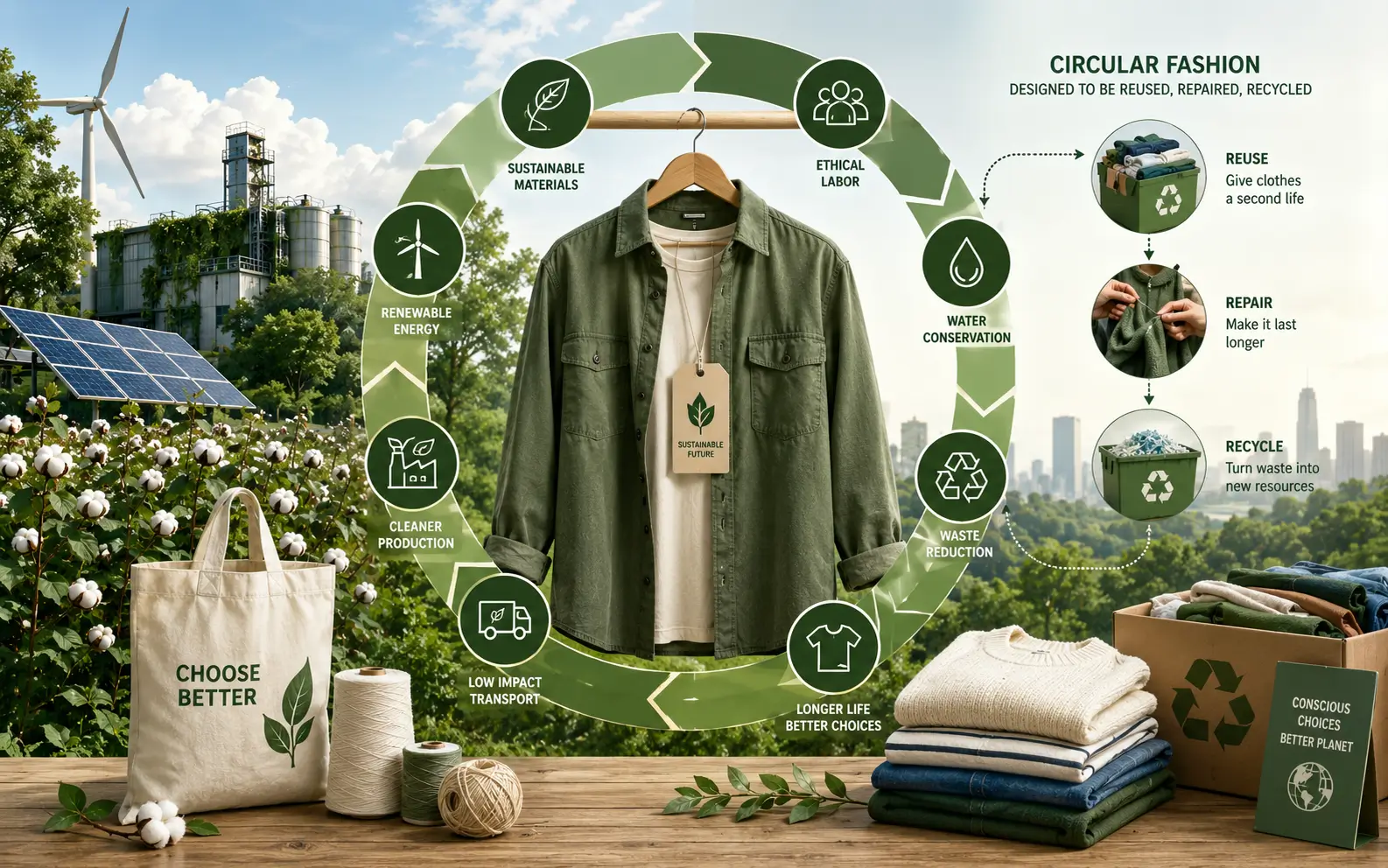
Perhaps the most significant shift in sustainable apparel thinking is the move toward circularity — designing garments and business models around reuse rather than disposal.
Resale & Secondhand
Platforms like ThredUp and Poshmark have turned secondhand shopping into a mainstream retail category rather than a niche thrift-store activity. The resale and thrift apparel market has been growing rapidly, projected to reach hundreds of billions of dollars in value within the next few years — outpacing growth in traditional retail.
Rental Fashion
Clothing rental subscriptions let consumers wear garments — especially occasion wear they might use only once or twice — without owning them outright. This model has seen real traction among younger, urban consumers looking to reduce both cost and environmental impact.
Repair Programs
Brands like Patagonia, through its Worn Wear program, actively encourage customers to repair rather than replace damaged clothing, sometimes offering free or discounted repair services. This directly counters the fast fashion mindset of treating clothes as disposable.
Fiber-to-Fiber Recycling
The long-term goal for many sustainability advocates is a true closed-loop system, where old garments are broken down and respun into new fibers rather than downcycled into lower-value products or landfilled. This technology is improving but still faces real technical hurdles, particularly with blended fabrics that mix natural and synthetic fibers, which are notoriously difficult to separate and recycle.
Certifications & Standards to Know
With so many brands making sustainability claims, certifications exist to help separate genuine practices from marketing spin. Here are the ones worth actually recognizing when you see them on a label.
GOTS (Global Organic Textile Standard)
GOTS is one of the most rigorous and widely respected certifications in the textile industry. It doesn’t just verify that a fabric started as organic fiber — it tracks the entire production process, including dyeing, manufacturing, and labor conditions, ensuring environmental and social criteria are met at every stage. Brands like Nudie Jeans use GOTS certification specifically to back up their organic cotton claims.
OEKO-TEX
OEKO-TEX certification focuses primarily on product safety — testing garments and textiles for harmful substances like chemical residues, heavy metals, and allergens. It’s less about the environmental footprint of production and more about ensuring the final product itself isn’t harmful to the person wearing it, which makes it a useful complement to certifications that focus on sourcing or labor.
Cradle to Cradle (C2C)
Cradle to Cradle takes a full circular-economy approach, assessing products across five categories: material health, material reuse potential, renewable energy and carbon management, water stewardship, and social fairness. It’s a more holistic certification than most, since it evaluates whether a garment is genuinely designed to be reused or recycled at the end of its life — not just how it was made.
Fair Trade Certified
Fair Trade certification centers on the social side of sustainability — ensuring workers receive fair wages, work in safe conditions, and that communities involved in production benefit economically. Patagonia, among others, sources from Fair Trade Certified factories as part of its broader sustainability commitments. This certification is particularly relevant for shoppers prioritizing labor ethics over (or alongside) environmental factors.
B Corp Certification
B Corp isn’t apparel-specific — it applies to for-profit companies across all industries — but it’s become a strong signal in the fashion space. To earn B Corp status, a company must meet high verified standards across its entire social and environmental impact, from supply chain practices to employee treatment to corporate governance. Brands like Eileen Fisher, Athleta, Cotopaxi, and Bombas all carry B Corp certification, and it’s often used as shorthand for “this brand has been independently vetted, not just self-declared sustainable.”
Higg Index / Cascale
The Higg Index, developed by what was formerly known as the Sustainable Apparel Coalition (now rebranded as Cascale), is less of a consumer-facing label and more of an industry measurement tool. It gives brands, retailers, and manufacturers a standardized way to score their sustainability performance across environmental and social metrics. Because it’s used internally by companies rather than printed on garment tags, you probably won’t see it directly when shopping — but it’s influential behind the scenes, shaping how major brands track and report their progress.
A quick note on reading certifications: no single certification covers everything. GOTS won’t tell you about labor conditions the way Fair Trade does, and OEKO-TEX won’t tell you anything about a brand’s carbon footprint. If a brand’s sustainability claims rest on just one certification, it’s worth asking what that certification actually covers — and what it doesn’t.
Technology & Innovation Driving Change
Materials and certifications are only part of the story. A growing wave of technology is helping apparel companies actually execute on their sustainability goals — often in ways that weren’t feasible even five or ten years ago.
AI in Demand Forecasting & Waste Reduction
One of the fashion industry’s quietest but most impactful sustainability problems is overproduction — brands manufacturing more garments than they can sell, based on rough guesses about demand. Artificial intelligence is changing that equation. AI-driven demand forecasting allows brands to predict what will actually sell with far more precision, reducing the amount of unsold inventory that ends up discounted, discarded, or destroyed.
AI is also being used directly on the production floor. Platforms like Lectra’s Valia Fashion streamline the entire production process — from order intake to fabric cutting — using AI to minimize fabric waste and optimize how patterns are laid out on rolls of material. Small efficiency gains here add up quickly across an industry producing billions of garments a year. AI is also playing a growing role in supply chain transparency, helping brands trace materials back to their source and verify ethical sourcing and compliance claims more efficiently.
Digital Printing & Low-Impact Dyeing
Traditional textile printing and dyeing are notoriously resource-heavy, using large volumes of water and energy while generating significant chemical wastewater. Digital printing technology offers a real alternative — it applies dye directly and precisely, cutting down on both water usage and energy consumption compared to conventional methods. It’s become a meaningful part of the industry’s shift toward eco-friendly production standards, particularly as textile companies face increasing pressure to meet stricter environmental regulations.
Water-Saving Technologies
Some of the most measurable sustainability wins in apparel have come from water innovation. Levi’s Water<Less techniques, for example, reduce water usage by up to 96% for certain denim finishing processes — the company has reported saving billions of liters of water and recycling well over a billion more through this program alone. These kinds of targeted process innovations show that meaningful reductions are achievable even within conventional manufacturing, without requiring a complete overhaul of materials or supply chains.
Traceability Tech
Perhaps the most important technological shift is happening behind the scenes: traceability. Blockchain and digital product passport systems are increasingly being used to track a garment’s journey from raw fiber to finished product, creating a verifiable record that’s much harder to fake than a marketing claim on a hangtag. This kind of traceability is becoming less optional and more necessary, as regulators — particularly in the EU — start requiring brands to prove their sustainability claims rather than simply asserting them. As supply chains grow more complex, this kind of digital paper trail is quickly becoming the backbone of credible sustainability reporting.
Market Size & Growth Trends
Numbers help put the sustainability shift into perspective — and they show an industry moving in a genuinely different direction, even if it still has a long way to go.
Global Market Value & CAGR Projections
The sustainable apparel and fashion market has grown substantially over the past several years, and most industry analysts expect that growth to continue at a healthy pace through the next decade. Market estimates vary depending on how “sustainable” is defined and which product categories are included, but the overall trend is consistent: multiple research firms project the sustainable apparel market climbing from tens of billions of dollars today to well over a hundred billion dollars within the next several years, with compound annual growth rates commonly estimated in the high single digits to mid-teens.
For context, sustainable fashion accounted for only around 1% of total apparel production back in 2019. That share has been climbing steadily since, and market share projections suggest sustainable clothing could represent somewhere around 6% of the overall apparel market by the latter half of this decade — still a minority, but a meaningful and fast-growing one.
Regional Trends
Sustainability adoption isn’t uniform across the globe. Europe has generally led the way, driven by strong regulatory pressure and consumer awareness that pushes brands toward more sustainable sourcing and supply chain practices. North America has also emerged as a major market, supported by high consumer awareness and growing demand for eco-conscious products.
Asia-Pacific, meanwhile, represents one of the fastest-growing regions for sustainable apparel, even though it currently holds a smaller overall market share than Europe or North America. Rising incomes, an expanding urban middle class, and increasing awareness of environmental and social issues are all fueling that growth — and given that Asia-Pacific is also home to much of the world’s garment manufacturing, sustainability progress in this region has an outsized impact on the industry as a whole.
Consumer Demand Statistics
Consumer sentiment data tells a clear story: awareness is high, and interest is real, but there’s a persistent gap between intention and action.
A large majority of consumers say they’re aware of the sustainability and environmental issues tied to the fashion industry, and a solid majority express interest in buying more sustainable clothing. A meaningful share of global consumers even say they’re willing to pay more for it. Younger shoppers — particularly Gen Z — tend to spend disproportionately more on sustainable fashion compared to older generations, and secondhand and thrift shopping have seen especially strong growth among millennial and Gen Z consumers.
That said, the gap between interest and action is real. A notable percentage of consumers who say they want to shop sustainably also admit they don’t know where to find genuinely sustainable brands, and confusion around greenwashing remains a real barrier. This tells us something important: consumer demand for sustainability isn’t the limiting factor anymore — it’s clarity, trust, and accessibility that the industry still needs to solve for.
Regulations Shaping the Industry
For years, sustainability in apparel was largely voluntary — brands could choose how much to invest in it, and how much to advertise it. That’s changing fast. Governments are now writing sustainability requirements directly into law, and the compliance clock is already running for many companies.
EU ESPR (Ecodesign for Sustainable Products Regulation)
The EU’s Ecodesign for Sustainable Products Regulation is arguably the most consequential piece of apparel legislation in the world right now. It entered into force on July 18, 2024, replacing the older Ecodesign Directive and expanding its scope from energy products to nearly all physical goods sold in the EU, including apparel and textiles. Textiles fall under customs classifications covering knitted clothing, woven clothing, and footwear. Importantly, this applies to any brand whose products reach an EU consumer — it doesn’t matter where the company is headquartered or where the garment is manufactured.
Two pieces of ESPR are worth knowing specifically:
- The destruction ban — Starting July 19, 2026, large companies are prohibited from destroying unsold apparel, clothing accessories, and footwear, a direct response to the industry’s long-standing practice of burning or landfilling unsold inventory. Medium-sized companies get more time, with the ban applying to them from 2030, while small and micro enterprises are exempt. Large companies discarding unsold stock will also have to publicly disclose the volume and weight of what they discard each year.
- The Digital Product Passport (DPP) — Essentially a digital ID card for every garment, containing information about the product’s environmental impact throughout its lifecycle, accessible via a QR code or similar scannable tag. The specific textile requirements are still being finalized, with the delegated act expected around late 2026 or early 2027, but the underlying DPP registry infrastructure is set to go live around mid-2026.
On top of this, a separate Green Claims rule is arriving too — from September 2026, EU rules will ban vague environmental marketing claims like “eco-friendly” or offset-based “climate neutral” labels unless brands can actually substantiate them. In short: if a brand can’t prove it, it won’t be allowed to say it — which should meaningfully cut down on greenwashing in the years ahead.
California SB 707 (Responsible Textile Recovery Act)
While Europe has moved fastest, the U.S. isn’t standing still. In September 2024, California enacted the Responsible Textile Recovery Act (SB 707), establishing the nation’s first Extended Producer Responsibility (EPR) program for textiles — making apparel producers accountable for the collection, reuse, and recycling of their products.
This makes California the first U.S. state to introduce an EPR framework specifically for apparel and textiles, and it’s widely expected to become a template other states follow. Under the law, qualifying apparel and textile producers must form and join a Producer Responsibility Organization (PRO), which is required to submit a plan for the collection, repair, reuse, and recycling of textiles. As of early 2026, CalRecycle selected Landbell USA as the state’s official PRO, moving the law from planning into active implementation. Producers with more than $1 million in annual global sales that sell products in California are required to register with the PRO starting July 1, 2026. Companies that willfully ignore the law face steep consequences — penalties of up to $50,000 per day for intentional violations.
The Bigger Picture: Extended Producer Responsibility (EPR)
Both of these laws point to the same underlying shift: Extended Producer Responsibility, or EPR — the principle that companies, not taxpayers or municipalities, should bear the cost and responsibility for what happens to their products after a customer is done with them. France has actually run a textile EPR system since 2007, making it the longest-standing model in the world, and the EU’s revised Waste Framework Directive now requires all EU member states to establish similar textile EPR schemes within 30 months of its October 2025 entry into force.
For apparel companies, the message is clear: sustainability claims are moving from a marketing choice to a legal obligation. Brands that build traceability, durability, and circularity into their products now will have a real head start — those still relying on vague, undocumented claims are going to find that approach increasingly untenable.
Brands Leading the Way (Real-World Examples)
Talking about sustainability in the abstract only goes so far — it helps to see what these practices actually look like when a real company puts them into action. Here are some of the brands most frequently cited as genuine leaders in the space, along with what makes them credible rather than just well-marketed.
Luxury & Established Players
Patagonia is probably the name that comes up most often in any conversation about sustainable apparel, and for good reason. The outdoor brand uses organic cotton, recycled materials, and Fair Trade Certified factories throughout much of its supply chain, and it backs this up with programs like Worn Wear, which encourages customers to repair rather than replace damaged gear. Patagonia’s approach to its Reclaimed Wool line is a good example of the depth involved — a large majority of its wool products, by weight, now come from recycled sources rather than virgin wool, directly reducing the need for new wool production.
Eileen Fisher has built its entire brand identity around simplicity and longevity rather than trend-chasing, which is itself a sustainability strategy — clothes designed to be worn for years put far less pressure on the resource-intensive production cycle. The brand is also a certified B Corp, meaning its social and environmental impact has been independently verified rather than self-reported.
Stella McCartney has pushed sustainability into luxury fashion specifically, an area where it’s historically been rare, by championing alternative materials and refusing to use leather or fur — proving that high-end design and lower-impact production aren’t mutually exclusive.
Emerging & Direct-to-Consumer Brands
A newer generation of brands has built sustainability into their foundation from day one, rather than retrofitting it onto an existing business model.
Outerknown, founded with what it describes as a total commitment to sustainability from the outset, focuses on circular design principles and works exclusively with Fair Trade Certified factories.
Everlane built its reputation on radical supply chain transparency — publishing detailed information about its factories and production costs — and has been recognized by organizations like the Carbon Trust for its sustainability efforts.
Cotopaxi takes a slightly different angle, combining sustainable outdoor gear production with a direct commitment to reducing global poverty, allocating a portion of its annual revenue to its own foundation.
Nudie Jeans is a strong example in the denim space specifically — a notoriously water- and chemical-intensive category. The brand uses GOTS-certified organic cotton, incorporates recycled post-consumer materials into its denim, and offers a free repair service designed to extend the life of every pair of jeans it sells.
Athleta and Bombas round out the B Corp-certified group, each combining performance-focused product design with verified social impact commitments — Athleta through community and inclusivity programs, and Bombas through its “one purchased, one donated” model targeting homeless shelters, where socks are consistently one of the most requested items.
What Makes These Brands Credible
Notice the pattern across all of these examples: none of them rely on a single sustainability claim. They combine verified certifications (B Corp, GOTS, Fair Trade) with structural business decisions (repair programs, transparent supply chains, recycled materials at scale) and long-term design philosophy (built to last, not built to trend).
That combination is what separates a genuinely sustainable brand from one that’s simply attached a “green” collection to an otherwise unchanged business. A single organic cotton t-shirt line doesn’t offset a business model built around rapid, high-volume turnover — which is exactly the distinction worth understanding before we get into greenwashing next.
The Challenge of Greenwashing
Here’s the uncomfortable truth about sustainability marketing in apparel: the words “eco-friendly,” “green,” and “conscious” have no legal definition in most markets — at least not yet. That’s created a huge opening for greenwashing: the practice of making a product or company appear more environmentally responsible than it actually is.
It’s a bigger problem than most shoppers realize. Even reputable data sources note that sustainability terminology can be genuinely contradictory — an item made from recycled plastic might be marketed as sustainable, while critics point out the plastic itself still poses environmental harm once it eventually breaks down. This ambiguity means brands can technically be truthful in a narrow sense while still leaving customers with a misleading overall impression.
How to Spot Greenwashing
A few warning signs tend to show up again and again:
- Vague, unquantified language — Phrases like “eco-conscious,” “planet-friendly,” or “sustainably made” that aren’t backed by specific numbers, certifications, or third-party verification are a red flag.
- A small “conscious” collection within a much larger, unchanged catalog — If a brand highlights one green product line while the rest of its business still runs on rapid, high-volume production, the sustainable collection may be more marketing than genuine shift.
- Certifications that don’t match the claim — GOTS, Fair Trade, OEKO-TEX, and B Corp all measure different things. A brand stretching one certification to imply broader coverage is overreaching.
- No visibility into the supply chain — Genuinely transparent brands are specific about where and how their products are made.
- Sustainability claims with no end-of-life plan — A brand focused only on materials, with nothing on repair, recycling, or take-back programs, is only addressing part of the lifecycle.
The good news is that regulation is starting to close this gap. As covered in the previous section, the EU’s upcoming Green Claims rules will require brands to substantiate environmental marketing claims starting in September 2026, which should make vague, unverifiable language much riskier for brands to use going forward.
Questions Consumers Should Ask Brands
If you want to cut through the marketing and evaluate a brand’s claims for yourself, a few direct questions tend to be revealing:
- What percentage of your total production uses sustainable materials — not just this one collection, but the whole business?
- What specific certifications do you hold, and what do they actually verify?
- Can you name your factories or suppliers, or at least describe how you audit them?
- What happens to this garment at the end of its life — is there a repair, resale, or recycling program?
- Are your sustainability claims backed by third-party verification, or are they self-reported?
A brand that can answer these questions specifically and confidently is a much stronger bet than one that responds with only broad, feel-good language. That distinction — specificity versus vagueness — is often the fastest way to separate real progress from clever marketing.
How Consumers Can Support Sustainable Apparel
Understanding the problem is one thing — actually shopping differently is another. Here’s what genuinely moves the needle, based on where the industry’s real leverage points are.
Buying Less, Choosing Well
This is the least glamorous piece of advice, and also the most impactful one. No amount of recycled polyester or organic cotton offsets the basic math of overconsumption — the average person buys far more clothing than they actually wear out. Choosing fewer, higher-quality pieces that you’ll actually keep and wear for years does more for sustainability than swapping every fast fashion purchase for a “green” equivalent. A useful mental shift here is thinking in terms of cost-per-wear rather than upfront price: a well-made garment worn 200 times is a far better investment — financially and environmentally — than a cheap one worn twice and discarded.
Shopping Secondhand & Rental
Secondhand and thrift shopping has moved firmly into the mainstream, driven largely by platforms like ThredUp and Poshmark that make buying and selling used clothing simple and normal rather than niche. This is genuinely one of the highest-impact choices available to consumers, since it extends a garment’s life without requiring any new production at all. Rental fashion is a strong option too, particularly for occasion wear or items you’d otherwise only wear once or twice — it lets you access variety without needing to own (and eventually discard) every piece.
Reading Labels & Certifications
Now that you know what GOTS, OEKO-TEX, Fair Trade, B Corp, and Cradle to Cradle actually mean, use that knowledge at the point of purchase. Look for specific, verifiable claims rather than vague marketing language, and remember that no single certification covers everything — a brand that’s strong on materials (GOTS) might say nothing about labor conditions (Fair Trade), so it’s worth checking what’s actually being verified rather than assuming one label covers the whole picture.
Caring for Clothes to Extend Their Life
How you care for clothing matters more than most people realize. Washing garments less frequently, using cold water, air-drying instead of machine-drying, and following care labels properly all extend a garment’s usable life significantly — and for synthetic fabrics specifically, washing less often also reduces the amount of microplastic fiber shed into wastewater with every load. Learning basic repair skills — sewing a button, patching a small tear, taking in a seam — can keep garments in rotation for years longer than they’d otherwise last, and many sustainable brands now offer free or discounted repair services specifically to support this.
Looking for Sales, Discounts, and Accessible Entry Points
Sustainable apparel does tend to cost more upfront, largely because sustainable materials and ethical labor practices genuinely cost more to source and produce — organic cotton, for instance, typically costs meaningfully more than conventionally farmed cotton. That price gap is real, and it’s worth acknowledging rather than pretending sustainable fashion is equally accessible to everyone. Looking for sales on ethical brands, prioritizing secondhand shopping, and building a smaller, more intentional wardrobe over time are all practical ways to participate in sustainable fashion without needing an unlimited budget.
The overarching theme across all of this: individual purchasing choices matter, but they work best in combination — buying less, buying secondhand when possible, choosing verified brands when buying new, and taking care of what you already own. No single habit fixes the industry’s problems on its own, but together they represent real, meaningful demand-side pressure on an industry that responds directly to what consumers are willing to buy.
Challenges Facing Sustainable Apparel Adoption
It would be misleading to end this guide without being honest about the obstacles. Despite real progress, sustainability in the apparel industry still faces serious structural challenges — and understanding them helps explain why change hasn’t happened faster.
Higher Costs for Consumers & Brands
The cost gap between sustainable and conventional apparel is real, not just perceived. Organic cotton typically costs around 30% more than conventionally farmed cotton, and similar premiums apply across most sustainable materials and ethical labor practices. This cost gets passed along the supply chain, which means sustainable apparel brands usually carry a higher price tag than fast fashion equivalents — a reality that inevitably limits who can afford to shop sustainably, even among consumers who genuinely want to.
For brands themselves, the upfront investment required to shift sourcing, retrain suppliers, and pursue certifications is significant, and the payoff isn’t always immediate. This creates a real tension, especially for smaller and mid-sized companies that don’t have the capital reserves of major global brands to absorb years of transition costs before sustainability initiatives start paying for themselves.
Supply Chain Complexity
Apparel supply chains are genuinely difficult to fully trace. A single garment might involve cotton grown in one country, spun into yarn in another, woven into fabric in a third, dyed in a fourth, and finally sewn together in a fifth — with each stage potentially involving multiple subcontracted factories that the original brand has limited direct visibility into. This layered complexity is exactly why traceability technology and Digital Product Passports have become such a regulatory priority — without verifiable data at every tier, brands often can’t fully guarantee their own sustainability claims, even when they’re acting in good faith.
Lack of Standardized Definitions
As discussed in the greenwashing section, there’s still no single, universally agreed-upon definition of what makes a product “sustainable.” Different certifications measure different things, different markets have different regulatory thresholds, and even well-intentioned brands can end up making claims that are technically accurate but incomplete. This lack of standardization makes it hard for consumers to compare brands on equal terms, and it gives less scrupulous companies room to make claims that sound meaningful without being independently verifiable — at least until regulations like the EU’s Green Claims rules close that gap.
Scaling Circularity Globally
Circular fashion — recycling, resale, rental, and repair — sounds simple in principle, but scaling it globally runs into real technical limits. Fiber-to-fiber recycling technology is still developing, and mixed-fiber garments (a cotton-polyester blend, for example) remain genuinely difficult to separate and recycle back into new textile-grade fiber. In practice, a lot of what gets called “recycling” today is actually downcycling — turning old garments into lower-value products like insulation or industrial rags rather than genuinely closing the loop back into new clothing. That’s still better than landfilling, but it’s not the same as true circularity, and the technology needed to close that gap at scale is still years away from widespread commercial viability.
There’s also an infrastructure problem: even where recycling technology exists, most regions simply don’t have the collection systems, sorting facilities, or processing capacity to handle textile waste at the scale it’s being generated. This is precisely the gap that new EPR laws — like California’s SB 707 — are designed to address, by making producers financially responsible for building out that missing infrastructure rather than leaving it to already-overwhelmed municipal waste systems.
None of these challenges are reasons to dismiss the progress being made — but they are honest reminders that sustainability in apparel isn’t a problem that gets solved with a single material swap or marketing campaign. It requires sustained investment, better technology, smarter regulation, and genuine transparency, all moving together.
The Future of Sustainability in the Apparel Industry
So where does all of this lead? Based on where regulation, technology, and consumer behavior are all heading, a few clear trends stand out for the next several years.
Predictions for 2030 and Beyond
Regulation will become the primary driver of change, not marketing. For years, sustainability progress in apparel was largely voluntary — brands moved at whatever pace they chose, based on consumer pressure and PR considerations. That’s shifting fast. Between the EU’s ESPR framework, its Digital Product Passport requirements, California’s SB 707, and similar laws likely to follow in other states and countries, apparel companies are moving into an era where sustainability data has to be verifiable, not just claimed. Brands that build traceable, well-documented supply chains now will have a real head start over those still scrambling to catch up as enforcement deadlines arrive.
Circularity will move from niche to mainstream infrastructure. Resale, rental, and repair are no longer experimental side projects — they’re becoming core parts of how major brands operate, partly because EPR laws are now making producers financially responsible for what happens to their products at end of life. Expect more brands to launch their own resale platforms, expand repair services, and design garments specifically with disassembly and recycling in mind, rather than treating circularity as an afterthought bolted onto an existing product line.
Technology will keep closing the traceability and efficiency gap. AI-driven demand forecasting should continue reducing overproduction, digital product passports will make supply chain data verifiable rather than self-reported, and continued investment in fiber-to-fiber recycling technology should gradually improve the industry’s ability to handle mixed-fiber textiles — one of the biggest remaining technical barriers to true circularity.
The definition of “sustainable” will get sharper — whether brands like it or not. As greenwashing regulations like the EU’s Green Claims rules take effect, vague sustainability marketing will become a genuine legal liability rather than just a reputational risk. This should push the industry toward more standardized, comparable claims, making it easier for consumers to evaluate brands on equal footing.
Consumer demand keeps growing, especially among younger shoppers. Gen Z and millennial consumers continue to show stronger interest in secondhand shopping, transparency, and ethical sourcing than older generations, and that generational shift in purchasing power is likely to keep pushing brands toward more credible sustainability practices over the coming decade, simply because it’s where a growing share of spending is headed.
The Role of Policy, AI, and Consumer Pressure Together
None of these forces work in isolation — and that’s actually the most important takeaway. Regulation forces transparency. Technology makes that transparency achievable and affordable at scale. And consumer demand gives brands a genuine business incentive to embrace all of it rather than treating compliance as a burden to minimize. The apparel industry’s sustainability transformation isn’t going to come from any single breakthrough material or landmark law — it’s going to come from these three forces continuing to reinforce each other, gradually making unsustainable practices harder to hide and less profitable to maintain.
Conclusion
Sustainability in the apparel industry isn’t a single fix — it’s a long-term shift touching everything from the cotton field to the closet to the landfill (or, ideally, the recycling bin). The scale of the problem is real: significant water consumption, meaningful carbon emissions, mountains of textile waste, and labor conditions that too often fall short of basic fairness. But the scale of the response is real too — better materials, smarter technology, credible certifications, genuine circular business models, and now, increasingly, binding regulation that turns sustainability from a marketing choice into a legal requirement.
For brands, the path forward means building transparency and traceability into the business itself, not just the marketing. For shoppers, it means buying less but better, learning to spot genuine claims versus vague ones, and supporting brands that back up their words with verifiable action. Neither side can solve this alone — but together, backed by tightening regulation and improving technology, the apparel industry is genuinely, if gradually, being reshaped into something more sustainable than it’s ever been.
FAQs
What does “sustainability” actually mean in the fashion/apparel industry?
It means producing clothing in ways that are environmentally responsible, socially fair, and economically viable — covering the entire lifecycle of a garment from raw material sourcing through manufacturing, use, and eventual disposal or recycling.
Is sustainable clothing more expensive, and why?
Generally, yes. Sustainable materials like organic cotton typically cost around 30% more than conventional alternatives, and ethical labor practices and smaller-scale production also add cost. That said, buying fewer, longer-lasting pieces can offset the higher upfront price over time.
What are the most sustainable fabrics?
Organic cotton, hemp, bamboo, recycled polyester, and newer alternative materials like cactus-based or mushroom-based leather are among the most commonly cited low-impact options, since they typically require less water, fewer chemicals, or less land than conventional materials.
How can I tell if a brand is truly sustainable or greenwashing?
Look for specific, quantified claims backed by recognized certifications rather than vague terms like “eco-friendly.” Genuine sustainability tends to show up across a brand’s entire catalog and supply chain, not just in one small collection.
What certifications should I look for when buying sustainable apparel?
GOTS (organic materials and production), OEKO-TEX (chemical safety), Fair Trade Certified (labor conditions), B Corp (overall verified social and environmental impact), and Cradle to Cradle (circular design) each cover different aspects — no single one guarantees everything.
How much does the fashion industry contribute to climate change?
The apparel and textile industry is estimated to be responsible for around 10% of global carbon emissions, more than international flights and maritime shipping combined.
What is circular fashion?
Circular fashion is a model built around reuse rather than disposal — including resale, rental, repair, and fiber-to-fiber recycling — designed to keep garments and materials in use for as long as possible instead of ending up in landfills.
Which brands are considered the most sustainable?
Patagonia, Eileen Fisher, Stella McCartney, Outerknown, Everlane, Cotopaxi, Nudie Jeans, Athleta, and Bombas are frequently cited as leaders, largely because they combine verified certifications with structural business practices like repair programs and transparent supply chains.