Every season, a few months before the first jacket reaches a shop, someone has already decided that the colour will be sage green, the sleeve will be wide and the fabric will be heavy cotton twill. Nobody guessed at random. That decision comes from fashion forecasting, the work of studying what people wear, buy and talk about, then predicting what they will want next.
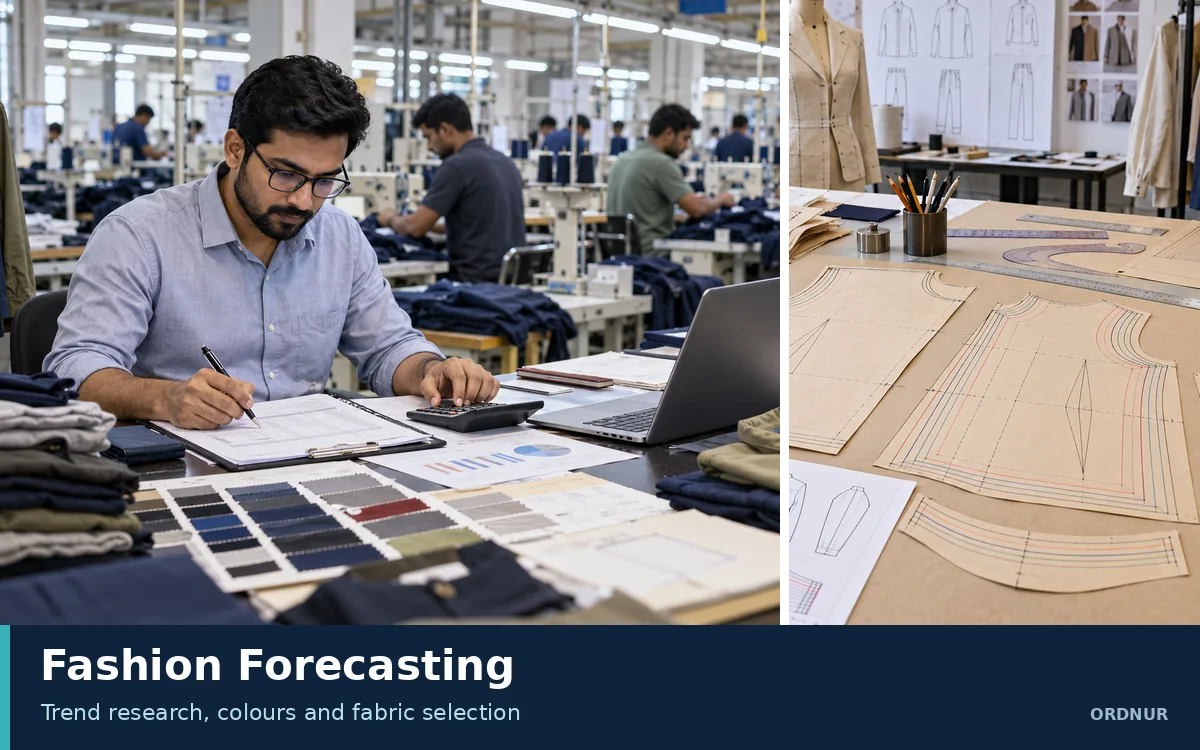
Fashion forecasting matters far beyond the catwalk. It guides which yarns a spinning mill develops, which colours a dye house prepares, which styles a buyer orders and how many pieces a factory should cut in each size. This guide explains what fashion forecasting is, the main types, how the process works from research to final report, where forecasters find their information and how a simple sales forecast is calculated. There is a worked example with real numbers you can copy. If you are new to the business side of fashion, our guide on what merchandising is gives the background.
What is fashion forecasting?
Fashion forecasting is the practice of predicting future trends in clothing, accessories, colours, fabrics, shapes and consumer behaviour, and of estimating how much of each product the market will buy. It combines two kinds of thinking:
- Creative forecasting. What will people want to wear? Which colours, prints, silhouettes and materials will feel fresh?
- Quantitative forecasting. How many units will sell, in which sizes and colours, at what time and place?
A good forecast blends both. A trend without numbers is just an opinion, and numbers without a trend miss the reason people buy.
Why fashion forecasting matters
Fashion has long lead times. A yarn for next autumn may be developed more than a year before the garment is sold. Mistakes are costly:
- If you forecast too low, you run out of stock and lose sales.
- If you forecast too high, you carry unsold goods that must be discounted.
- If you choose the wrong colour or fabric, the whole line may fail.
- If suppliers are not told early, they may not have capacity when you need it.
Good forecasts reduce these risks. They help brands, mills and factories plan materials, labour, machines and shipping.
Types of fashion forecasting
Long-term forecasting
This looks ahead 18 months to several years. It covers broad ideas: colour families, mood, silhouettes, lifestyle shifts and fabric innovations. Yarn and fibre makers, textile mills and trend agencies work at this horizon. The output is often a trend book or a presentation with mood boards.
Short-term forecasting
This looks ahead a few weeks to about a year. It deals with specific styles, colour shades, prints and price points for the next season. Brands and retailers use it to build line plans and place orders.
Trend forecasting
Trend forecasting studies culture, art, technology, politics, economy and social behaviour to find signals of change. It answers “what mood is coming?” and “what will people value?”
Colour forecasting
Colour experts and committees predict the shades of the season. Colour comes first in the chain, because fibres, yarns and fabrics must be dyed in time. Organisations such as Pantone, and trend agencies, publish colour guidance well in advance.
Fabric and yarn forecasting
Fibre makers, spinners and fabric mills predict which materials, textures and finishes will be in demand, for example more recycled fibres, soft hand feel or stretch.
Sales (demand) forecasting
This uses data. It predicts how many units of each style will sell, based on past sales, price, marketing, weather, season and market conditions. It gives the order quantities that merchandisers and planners need.
| Type | Time horizon | Main question | Typical user |
|---|---|---|---|
| Long-term trend | 18 months to years | What mood and direction? | Fibre makers, mills, agencies |
| Colour | 18 to 24 months | Which shades? | Mills, dye houses, designers |
| Fabric and yarn | 12 to 24 months | Which materials? | Spinners, fabric suppliers |
| Short-term trend | 3 to 12 months | Which styles this season? | Brands, retailers |
| Sales | Weeks to a season | How many units? | Merchandisers, planners |
The fashion forecasting process
Different companies work in different ways, but the steps are similar.
Step 1: Define the goal
What are you forecasting? A season, a category such as denim, a colour palette or a sales quantity? For whom? Define the market, the customer, the price level and the time frame.
Step 2: Collect information
Gather data and inspiration from many sources (see the next section). Combine qualitative signals, such as photos and articles, with quantitative data, such as sales and search figures.
Step 3: Analyse and find patterns
Look for repeating signals. If green appears in several runway shows, in street style and in search data, it is more than a coincidence. Separate real trends from short-lived fads.
Step 4: Build the story
Turn the findings into a theme. A theme combines a mood, a colour palette, key silhouettes, fabrics, details and prints. It is usually shown on a mood board.
Step 5: Translate into products
Merchandisers and designers turn the theme into a line plan, with styles, colours, sizes, prices and quantities. They produce tech packs, bill of materials and sample requests. Our guides on the tech pack for clothing and the bill of materials in garments show what comes next.
Step 6: Test and adjust
Sell test quantities, check early sales, and adjust production and reorders. Fast-fashion brands do this in weeks, while traditional brands do it per season.
Step 7: Review accuracy
After the season, compare the forecast to what actually sold. Learn from the gap. This improves the next forecast.
Sources of information
Forecasters look in many places.
- Runway shows and fashion weeks. Early signals of designer direction.
- Trade fairs. Yarn, fabric and trim fairs where mills show new developments.
- Trend agencies and reports. Subscription services publish trend books and data.
- Street style and subcultures. Real people often move ahead of the shops.
- Social media and search. Fast signals of interest, such as hashtags, saves and search volumes.
- Retail data. What sells, what is discounted, what is returned.
- Celebrity and entertainment. Films, music and sports often set trends.
- Art, design and architecture. Source of colours, shapes and textures.
- Economy and events. Recessions, climate, technology and politics change what people buy.
- Customer feedback. Reviews, surveys and returns reasons.
The life cycle of a trend
Trends move through stages. Knowing the stage helps you time your move.
- Introduction. A few designers, influencers or innovators start wearing it.
- Rise. Fashion media and early adopters pick it up.
- Peak. Mass market brands produce it at scale. Everyone sees it.
- Decline. Early adopters move on and sales slow.
- Obsolescence. It looks dated, until it returns years later.
A fad is a very short trend that rises and falls fast. A classic is a style that stays year after year, like a white shirt or blue jeans. Forecasters learn to tell them apart, because a fad needs small, fast orders and a classic can be planned in depth.
A worked example: a simple sales forecast
Let us build a short-term demand forecast for one style of T-shirt. This is a quantity forecast, which is the part merchandisers and factories deal with every day. The sales numbers are invented for the example.
Given
Monthly sales of the style, in units, for the last six months:
| Month | Units sold |
|---|---|
| January | 420 |
| February | 380 |
| March | 460 |
| April | 500 |
| May | 540 |
| June | 580 |
We want to forecast July.
Method 1: Three-month moving average
Take the average of the most recent three months.
Forecast = (April + May + June) ÷ 3 = (500 + 540 + 580) ÷ 3 = 1,620 ÷ 3 = 540 units
This method is simple, but it lags when sales are rising. The forecast of 540 is lower than the last month (580).
Method 2: Weighted moving average
Give more weight to recent months. Use weights of 0.5 for June, 0.3 for May and 0.2 for April.
Forecast = 0.5 × 580 + 0.3 × 540 + 0.2 × 500
= 290 + 162 + 100 = 552 units
The result is closer to the recent upward trend.
Method 3: Add a seasonal index
Suppose past years show that July sales are 10 percent higher than the average of the previous three months, because of summer demand. The seasonal index for July is 1.10.
Forecast with season = 552 × 1.10 = 607 units (607.2 rounded)
This is a reasonable plan, but not a guarantee. A promotion, weather or a competitor’s price cut could change it.
Splitting the forecast by size
Say the forecast of 607 units is the order quantity. The size ratio from past sales is:
| Size | Share | Units |
|---|---|---|
| S | 10% | 60.7 → 61 |
| M | 25% | 151.75 → 152 |
| L | 30% | 182.1 → 182 |
| XL | 25% | 151.75 → 152 |
| XXL | 10% | 60.7 → 61 |
| Total | 100% | 608 |
The rounded units add up to 608, one more than 607, which is acceptable. A planner may also add a small safety buffer.
Checking accuracy
After July, actual sales are 575 units. The forecast of 607 was too high by 32 units.
Error = 607 minus 575 = 32 units
Percentage error = 32 ÷ 575 = 0.0557, or 5.6 percent
The three-month moving average of 540 would have been off by 35 units (575 − 540), or 6.1 percent. In this single case, the seasonal forecast was slightly better. In practice, forecasters check many items and many months before trusting a method. A common measure is mean absolute percentage error (MAPE), which averages these percentage errors.
Tools and technology
Forecasters now use many digital tools.
- Trend platforms. Subscription services with data, images and reports.
- Social listening. Tools that track hashtags, mentions and engagement.
- Search analytics. Search volume data shows rising interest.
- Retail analytics. Sales, stock and returns data.
- AI and machine learning. Used to find patterns in images and sales, though human judgement is still needed.
- 3D design and sampling. Digital samples allow quicker testing of ideas. Our article on 3D sampling and merchandiser time and cost saved explains how this helps.
Fashion forecasting in garment export
For a garment exporter in a country like Bangladesh, most forecasting is done by the buyer. The buyer shares colour palettes, style directions and rough quantity forecasts. The factory’s role is to read these early and prepare.
A merchandiser can help the factory by:
- Reading buyer trend reports and colour cards early
- Checking fabric and trim availability for the new colours
- Planning capacity for expected peak months
- Keeping some flexible capacity and open material for repeat orders
- Sharing lead-time limits so the buyer’s plans match reality
Our guide on the responsibilities of an apparel merchandiser shows where these tasks fit. Factories may also create their own trend boards to pitch styles to buyers, which can win business.
Common mistakes
- Confusing a fad with a trend. Heavy investment in a short-lived fad leaves stock behind.
- Following only one source. One runway or one influencer is not a trend.
- Ignoring the customer. A trend that suits a fashion capital may not suit your market, climate or budget.
- Forecasting without data. Use sales history, returns and stock levels.
- Ignoring lead time. A good idea that arrives late is a lost sale.
- Never checking accuracy. Without review, the same errors repeat.
- Over-trusting one method. Combine methods and apply judgement.
Skills of a good forecaster
- Curiosity and wide interests
- Pattern recognition
- Basic statistics and spreadsheets
- Knowledge of fabrics, colours and construction
- Communication and visual presentation skills
- Understanding of the customer and the market
Final thoughts
Fashion forecasting turns signals into decisions. Creative forecasting finds the direction in colour, fabric and style, and quantitative forecasting turns that direction into units, sizes and dates. The best forecasters use many sources, watch the life cycle of each trend, test early and check their accuracy. Our worked example showed how a simple weighted average and a seasonal index can produce a sensible order quantity, and how a quick error check keeps the method honest.
Whether you design, merchandise or manufacture, learn to read the signals early. Time is the most valuable material in fashion.
Frequently asked questions
Fashion forecasting is predicting future trends in colours, fabrics, styles and consumer behaviour, and estimating how much of each product will sell. It helps brands, mills and factories plan ahead.
The main types are long-term trend forecasting, short-term forecasting, colour forecasting, fabric and yarn forecasting and sales (demand) forecasting.
Colour, fibre and fabric forecasts usually look 18 to 24 months ahead. Short-term trend and sales forecasts look a few weeks to a year ahead.
A trend rises and stays for a season or more. A fad rises and falls quickly. Classics, such as white shirts, stay for years.
They use runway shows, trade fairs, trend agencies, street style, social media, search data, retail sales and customer feedback.
Common methods include moving averages, weighted averages and seasonal indices. For instance, a weighted average of the last three months multiplied by a seasonal index gives the forecast for the next month.
It helps factories plan materials, capacity and labour in advance, so they can meet delivery dates and avoid shortages or idle lines.