A flat piece of cloth can be turned into something with texture, volume and shadow, without adding a single bead or print. Fold it, gather it, twist it, stitch it in a pattern and pull it tight, and the surface starts to look sculpted. That craft has a name: fabric manipulation. It is the reason a plain cotton skirt can look rich, a bodice can seem to be made of waves, and a simple cushion cover can look like a work of art.
This guide explains what fabric manipulation is, the main techniques with examples, which fabrics suit each one, how to calculate the extra fabric these methods use and how factories handle them at scale. There is a worked example with measurements for a pleated skirt and a smocked panel. If you want to understand pattern making first, our guide to pattern making in fashion designing is a useful companion.
What is fabric manipulation?
Fabric manipulation is the process of changing the surface or shape of a fabric by folding, gathering, twisting, cutting, stitching or pressing it, to create texture, dimension or pattern. The fabric stays the same material, but its look and feel change.
Designers use it to:
- Add visual interest to plain fabrics
- Create volume and shape without using a lot of padding
- Replace or support prints and embroidery
- Control how a garment fits, with built-in stretch and shaping
- Make original textures that cannot be copied easily
Fabric manipulation can be done by hand or by machine. Some techniques are traditional, such as smocking and pleating, and others come from modern fashion design and sculptural experiments.
The main fabric manipulation techniques
1. Gathering
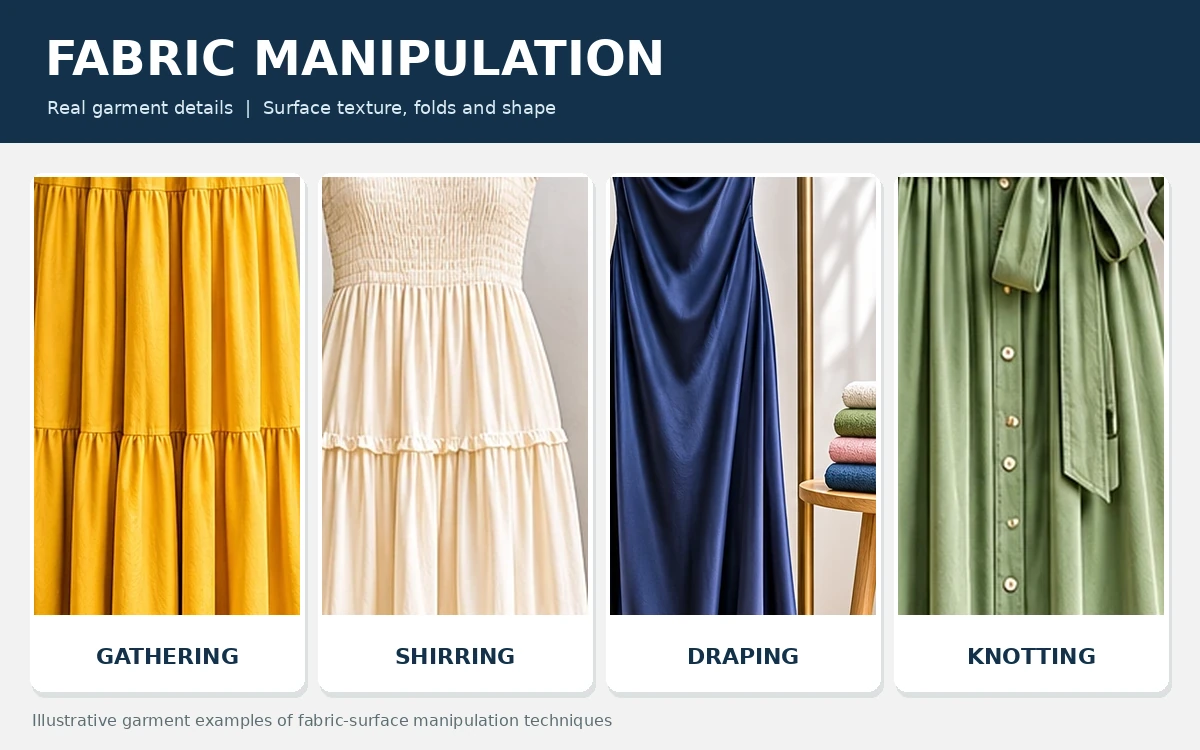
Gathering draws a long length of fabric into a short length with small folds. Two rows of long stitches are sewn along the edge, and the threads are pulled. The fabric bunches into soft folds. It is used at waists, cuffs, sleeve heads and ruffles.
- Gather ratio. The fabric is usually cut 1.5 to 3 times the finished length. Thin fabrics take a higher ratio, while thick ones take a lower one.
2. Shirring
Shirring is a set of parallel rows of gathering, usually sewn with elastic thread in the bobbin. The rows pull the fabric into a stretchy, textured panel. It is common in summer dresses, tops and children’s wear.
3. Ruching
Ruching gathers fabric along one or both edges, or along a centre line, to create soft ripples. It is used on bodices, sleeves, side seams and swimwear. Ruching also hides figure lines and adds shaping.
- Ratio. Around 2 to 1 is a common starting point.
4. Pleating
Pleats are folds that are pressed or stitched in place. Common types:
| Type | Look | Common use |
|---|---|---|
| Knife pleat | Folds all in one direction | Skirts, school uniforms |
| Box pleat | Two folds facing away from each other | Skirts, back yokes, jackets |
| Inverted pleat | Two folds facing each other | Shirt backs, skirts |
| Accordion pleat | Narrow, evenly spaced folds, like a fan | Sheer skirts, scarves |
| Sunray pleat | Folds that widen from waist to hem | Flowing skirts |
| Pin tuck | Very thin, stitched folds | Shirts, blouses |
Pleats can be sharp, set with heat and pressing, or soft. In industry, permanent pleating is common on polyester because the fibre keeps a heat-set fold. Cotton pleats need to be stitched or treated with a finish.
5. Tucking
Tucks are small folds that are stitched down along their length. Pin tucks are very narrow. Wider tucks can be repeated in groups. They are used on shirt fronts, children’s dresses and trims.
6. Smocking
Smocking is a traditional technique in which fabric is gathered into tiny pleats and stitched in patterns, so that the folds are held and stretch like springs. It is used on yokes, cuffs and baby clothes, and it can be done with a needle and thread, or on a special pleating machine.
- Fabric needed. Usually about 3 times the finished width, which is a large amount.
There are also decorative forms such as Canadian smocking and lattice smocking, which pull fabric into diamond and honeycomb patterns for cushions and fashion pieces.
7. Quilting
Quilting stitches together two or three layers: a top fabric, a padding and a backing. The stitching lines make a pattern and trap the padding to give warmth and relief. It is used for jackets, bed covers, bags and home goods.
8. Draping
Draping places fabric directly on a dress form and arranges folds, cowls and twists. It is a design method, as well as a way to make a final surface. Draping lets designers see how fabric hangs before they finalise a pattern.
9. Fabric twisting and knotting
Strips of fabric are twisted, knotted or braided to make cords and surface textures. The result looks sculptural. It suits evening wear and accessories.
10. Slashing and cutwork
The top layer of fabric is cut in patterns, so the layer underneath shows through. Fraying, layering and sewing the cut edges can produce a rich texture.
11. Appliqué and patchwork
Pieces of fabric are laid on a base and stitched. This adds colour, pattern and texture. Patchwork joins many small pieces into a larger surface.
12. Pintucks, origami and folded geometry
Folding methods inspired by paper craft, such as origami, make three-dimensional patterns like diamonds and tessellations. They need crisp fabric and careful measuring, and they are often found in couture.
13. Burning, crinkling and heat setting
Synthetic fabrics can be crushed, twisted and heat set, so the crinkles stay. This is how crinkle chiffon and plissé fabrics are made. Care is needed, because heat can also damage fabric.
14. Embossing and moiré effects
Heat and pressure from engraved rollers can push patterns into fabric. Our article on moiré fabric explains a classic surface effect made in a similar way.
Fabrics that suit manipulation
The fabric you choose changes the result.
| Technique | Good fabrics | Poor fabrics |
|---|---|---|
| Gathering and shirring | Light cotton, voile, lawn, rayon, chiffon | Thick denim, heavy canvas |
| Pleating (sharp) | Polyester, wool crepe, taffeta, gabardine | Soft knits, loose weaves |
| Smocking | Light cotton, gingham, voile, silk | Stiff fabrics |
| Ruching | Jersey, stretch knits, light chiffon | Stiff woven fabrics |
| Tucking | Poplin, lawn, cotton shirting | Slippery or bulky fabrics |
| Quilting | Cotton, satin, polyester shells | Very thin sheers |
| Origami-style folds | Crisp taffeta, organza, paper-like synthetics | Soft knits |
Our table of fabric types, names and GSM will help you match fabric weight to the effect you want. Always test a small swatch first.
A worked example: how much fabric do manipulations use?
Manipulation techniques use more fabric than flat pieces. Before cutting, calculate the extra amount. Here are two examples.
Example 1: a knife-pleated skirt
Given
- Finished waist: 74 cm
- Pleat ratio: 3 to 1 (the fabric is cut 3 times the finished width, which is common for knife pleats where each fold covers the same width as the visible part)
- Skirt length: 60 cm finished
- Hem allowance: 4 cm
- Waist seam allowance: 1.5 cm
- Fabric width: 150 cm
- Seam allowances for side seams: 1.5 cm on each side
Step 1: Width of fabric needed across the skirt.
74 × 3 = 222 cm of pleated width
Add side seam allowances: 222 + 3 = 225 cm
Step 2: Number of fabric widths.
225 ÷ 150 = 1.5. One width is not enough, so the skirt needs two pieces joined side by side. The second piece is trimmed to 75 cm.
Step 3: Cut length.
Length = 60 + 4 + 1.5 = 65.5 cm
Step 4: Total fabric.
Cut both pieces across the full fabric width, one after the other along the length of the roll. That uses 2 × 65.5 = 131 cm of fabric. Round up and buy 1.4 m. The offcut from the second piece (75 cm × 65.5 cm) can be used for a waistband or pockets.
A flat skirt with an easy fit, say 74 × 1.5 = 111 cm plus 3 cm of seam allowance, fits inside one 150 cm width. It needs only one length of 65.5 cm. So the pleated skirt uses twice as much fabric.
Example 2: a smocked panel
Given
- Finished smocked width: 40 cm
- Fabric ratio: 3 to 1
- Finished smocked height: 15 cm, with a 1 cm allowance at the top and 1 cm at the bottom
Step 1: Raw width before smocking.
40 × 3 = 120 cm
Step 2: Raw height.
15 + 1 + 1 = 17 cm
Step 3: Area comparison.
- Raw fabric area = 120 × 17 = 2,040 cm²
- Finished area = 40 × 15 = 600 cm²
- Ratio = 2,040 ÷ 600 = 3.4
So you use 3.4 times the area of the visible smocked panel. When pricing a smocked garment, this extra material cost is part of the reason it is more expensive than a plain one. For help converting between centimetres, metres and yards, see our guide on how to measure a yard of fabric.
How to do basic manipulation at home
Simple gathering
- Set the machine to the longest stitch and loosen the top tension a little.
- Sew two parallel rows along the edge, 0.5 cm and 1 cm from it. Do not backstitch.
- Pull the bobbin threads at both ends to gather.
- Spread the gathers evenly to the length you need.
- Pin to the other piece, sew between the two rows, and remove the visible gathering threads if they show.
Simple pin tucks
- Mark the tuck lines on the fabric with chalk.
- Fold along each line, wrong sides together.
- Stitch 3 to 5 mm from the fold.
- Press all tucks in the same direction.
Shirring with elastic thread
- Wind elastic thread by hand on the bobbin, without stretching it.
- Use regular thread in the needle and a longer stitch.
- Sew the first row, then sew the next rows parallel, spaced 0.7 to 1 cm apart.
- Steam the shirred panel and the elastic will draw up.
Always test the tension and spacing on a scrap. Our guide to sewing machine bed types can help if you are choosing a machine for tubes and cuffs.
Fabric manipulation in factories
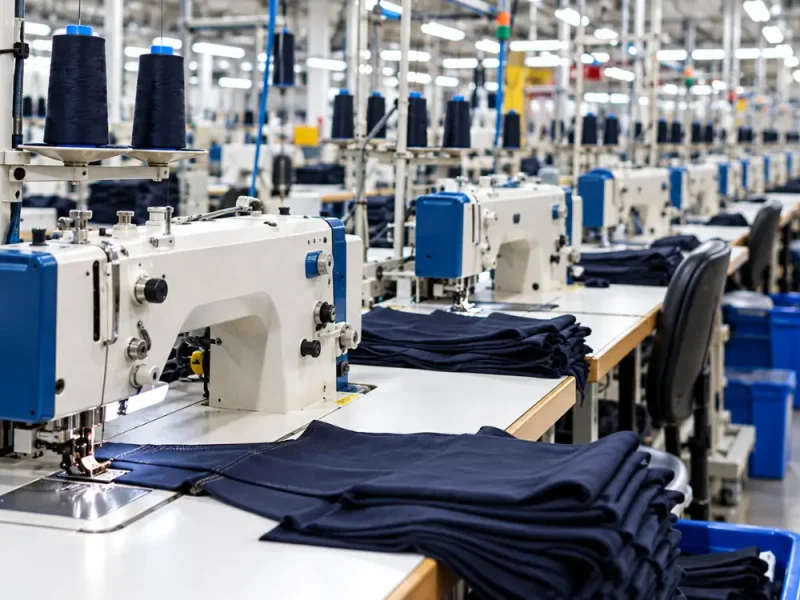
Industrial garment makers use machines to repeat manipulation techniques at scale.
- Pleating machines. Fabric is folded between heated plates or paper moulds, then set with heat.
- Smocking and shirring machines. Several needles gather fabric in parallel with elastic or ordinary thread.
- Quilting machines. Multi-needle machines stitch big quilted panels in set patterns.
- Embroidery machines. Computer-controlled stitching to add texture. See our guide to embroidery thread types.
- Heat press and engraved rollers. For embossing, crinkles and permanent pleats.
Factory teams must plan for extra consumption in the BOM, longer operation times, and special quality checks. Our guide to the bill of materials in garments shows where consumption fits. Seam types also matter when attaching manipulated parts. See our overview of types of seams in garments.
Tips for better results
- Use the right fabric. Weight and drape decide whether the effect works.
- Test on a swatch. Fabric reacts differently than expected.
- Be careful with grain. Fold and gather along the straight grain unless you want a bias effect.
- Press often. Steam and heat set folds.
- Use the right thread. Strong thread for tucks and smocking, elastic thread for shirring.
- Mind the seam bulk. Many folds can create thick seams. Trim and grade the seam allowances.
- Plan the pattern. Add allowance at the pattern stage, not after cutting.
- Balance the design. A strongly textured area looks best next to plain areas.
Common problems
| Problem | Cause | Fix |
|---|---|---|
| Uneven gathers | Stitch too short, tension too tight | Longer stitch, even spacing |
| Pleats opening up | No heat set or stitching | Press with steam, topstitch, or use polyester |
| Puckering | Tension too tight or wrong needle | Adjust tension, use a fine needle |
| Fabric too bulky | Heavy fabric, too much ratio | Lighter fabric, lower ratio |
| Shirring does not draw up | Elastic stretched while winding | Wind without tension, steam |
| Distortion after washing | Fabric shrinks unevenly | Pre-wash, choose stable fabric |
Final thoughts
Fabric manipulation is a way of giving cloth a new surface using only folds, stitches and pressure. It ranges from simple gathers and pin tucks to complex smocking, quilting and folded geometry. The right fabric, the right ratio and careful testing decide whether the effect looks rich or messy.
Always remember the cost side. Manipulation uses a lot more fabric, as our skirt and smocked panel examples showed, and it takes more sewing time. Plan the extra material in the pattern and the costing before you cut, and the finished piece will look the way you imagined.
Frequently asked questions
Fabric manipulation is changing the surface or shape of fabric by folding, gathering, twisting, cutting or stitching it, to create texture and dimension.
Examples include gathering, shirring, ruching, pleating, tucking, smocking, quilting, draping, appliqué and origami-style folding.
It depends on the technique. Gathers often use 1.5 to 3 times the finished length, ruching about 2 times and smocking about 3 times the finished width.
Light, soft, plain-weave fabrics such as cotton lawn, voile, gingham and light silk work best. Stiff fabrics do not gather well.
Yes. Basic gathering, tucking and shirring can be done on a home sewing machine. Factories use special pleating, smocking, quilting and embroidery machines.
Gathering draws fabric along an edge, usually to attach it to another piece. Ruching gathers fabric along one or both edges or a centre line, to create soft ripples on the surface.
Synthetic fabrics such as polyester hold heat-set pleats very well. Natural fibres like cotton need stitching or special finishes to keep pleats.