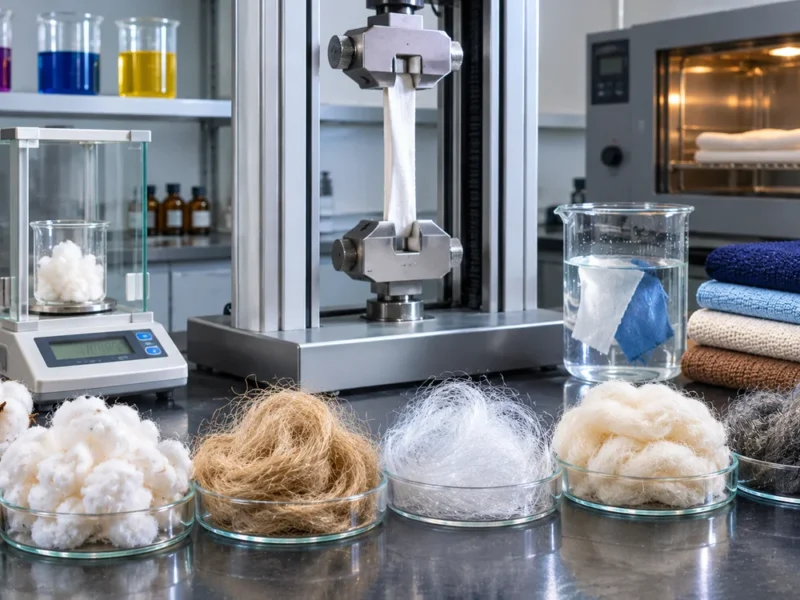
Search for “fibre in milk” and you will find two very different answers. If you mean the food, ordinary cow’s milk has no dietary fibre in it at all. Fibre in the diet comes from plants. If you mean the textile, then yes, there is a fibre made from milk. It is called milk fibre or casein fibre, and it is spun from the main protein of milk. This guide covers both meanings, with most of the space on the textile side, since that is where the story is.
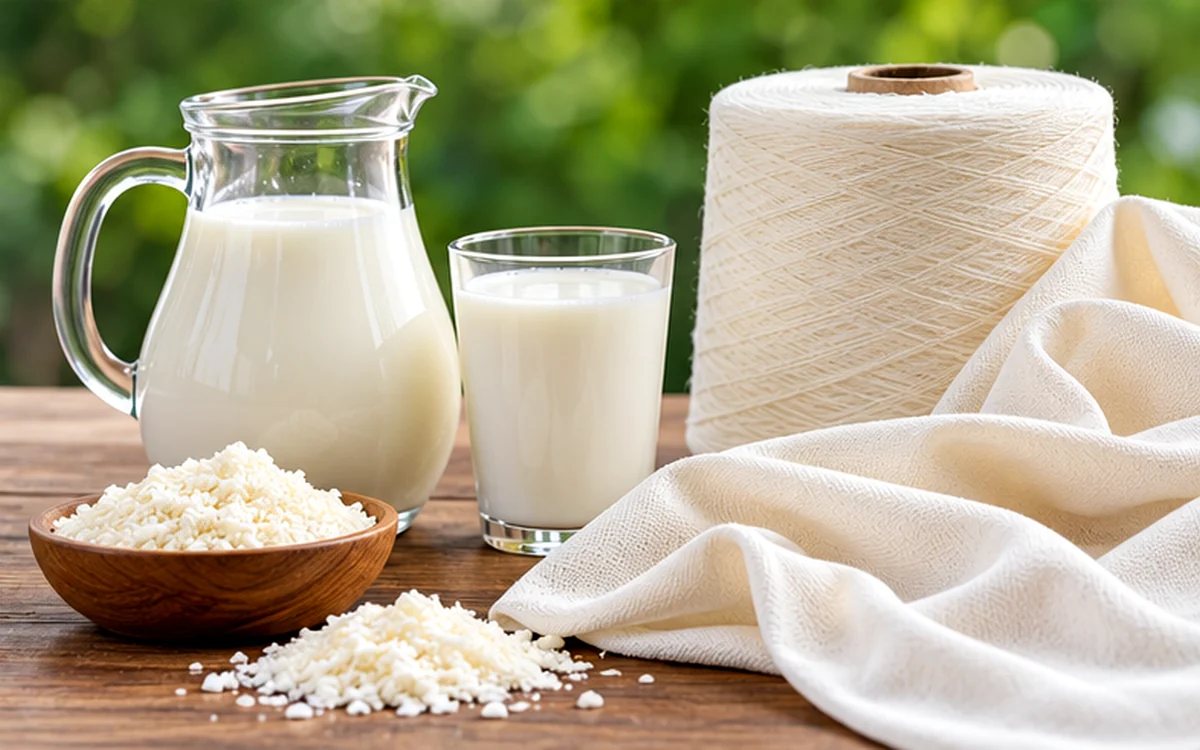
You will learn how milk becomes a thread, what the fabric feels like and where it is used. You will also see a worked example of how much milk goes into one T-shirt, along with its limits and care. For a view of where it sits among other fibres, see our guide on the different types of textile fibres.
Fibre in milk as food
Dietary fibre is the part of plant food that the body does not digest. It is found in vegetables, fruit, grains, beans and nuts. Cow’s milk, goat’s milk and other animal milks have no dietary fibre. They contain protein, fat, milk sugar (lactose), minerals and vitamins. If you want fibre, you can add it with cereal, fruit or oats.
Plant drinks differ. Some oat or soy drinks have a little fibre, and many have none. Labels vary by brand, so check the nutrition panel. For personal diet advice, ask a doctor or dietitian.
What is milk fibre in textiles
Milk fibre is a man-made fibre made from milk protein. It belongs to the group of regenerated protein fibres. These are made by dissolving a natural protein and spinning it into filaments. Silk is a natural protein fibre, and wool is another. Milk fibre is the same family in chemistry, but it is made in a factory. For the natural protein example, see our page on what silk is made of.
Milk is about 3 percent protein, and roughly 80 percent of that protein is casein. Casein is the part that clumps when milk turns sour or when acid is added. Textile makers collect it from skimmed milk, mostly from milk that is not used for food, such as surplus or spoiled milk.
A short history
Casein fibre is not new. In the 1930s, an Italian chemist named Antonio Ferretti developed a casein fibre that was sold under the name Lanital. It was used as a wool substitute, especially during times when wool was scarce. The early fibre was weak when wet and fell out of favour once nylon, polyester and acrylic arrived.
Interest returned in the 2000s. In China, producers made milk protein fibre by combining casein with acrylic polymer. In Germany, a designer and microbiologist developed a casein fibre made from waste milk, sold under the name QMILK, and said to be made without the harsh chemicals of older versions. The details differ between makers, so ask each supplier what is in their fibre.
How milk fibre is made
There are two main routes.
Route 1: pure casein fibre
- Skimming. Fat is removed from milk, leaving skim milk.
- Precipitating casein. Acid is added, so casein separates as curds.
- Washing and drying. The curds are washed and dried into a powder.
- Dissolving. Casein powder is dissolved in a mild alkali to make a thick liquid, called the spinning dope.
- Wet spinning. The dope is pushed through the tiny holes of a spinneret into a bath that makes it solid.
- Hardening. The filaments are treated to make them firm and less soluble in water. Older processes used formaldehyde for this. Some modern makers state that they use other methods. Ask which one is used.
- Drawing, washing and cutting. The fibres are stretched, washed and cut into staple lengths.
Route 2: milk protein graft fibre
Casein is chemically combined with acrylonitrile, the building block of acrylic. The result is a fibre that contains some milk protein and a large share of synthetic polymer. It is stronger than pure casein fibre. Different brands use different proportions, so the milk content must be checked on the data sheet.
Properties of milk fibre
| Property | Typical description |
|---|---|
| Handle | Soft, smooth and silky |
| Lustre | Gentle, natural sheen |
| Colour | Creamy white, can be dyed |
| Moisture absorption | Good for a protein fibre, around that of wool or silk |
| Breathability | Good |
| Strength when dry | Moderate |
| Strength when wet | Lower, especially for pure casein fibre |
| Abrasion resistance | Fair to poor |
| Elasticity | Fair |
| Drape | Soft and flowing |
| Dyeing | Takes acid dyes, as other protein fibres do |
| Heat | Sensitive. Do not iron hot |
| Claims about skin benefits | Suppliers often say it is gentle and has natural antibacterial effects. Check test data before repeating such claims |
Values change with the grade and the maker. Ask for a data sheet and test reports for any claim you plan to print on a label.
Milk fibre compared with other fibres
| Point | Milk fibre | Cotton | Silk | Polyester |
|---|---|---|---|---|
| Origin | Milk protein, regenerated | Plant | Silkworm | Petrochemical |
| Feel | Silky, soft | Soft | Very smooth | Varies |
| Moisture absorption | Good | Good | Good | Very low |
| Wet strength | Lower | Higher when wet | Lower | Same as dry |
| Price | Higher | Low | High | Low |
| Care | Gentle | Easy | Gentle | Easy |
| Availability | Limited | Wide | Limited | Wide |
Worked example: how much milk goes into one T-shirt
Let us estimate for a T-shirt made from 100 percent pure casein fibre. These are rough numbers to show the scale, not production data.
- T-shirt weight: 150 g
- Skim milk protein content: about 3.2 percent
- Casein share of protein: about 80 percent
- Casein in milk: 3.2 × 0.80 = 2.56 percent
- Assume 90 percent of the casein is recovered and turned into fibre: 2.56 × 0.90 = 2.30 percent
Milk needed
- Casein needed = 150 g
- Milk = 150 ÷ 0.0230 = 6,522 g, or about 6.5 kg
- Milk density is about 1.03 kg per litre, so volume = 6.5 ÷ 1.03 = about 6.3 litres
So a pure casein T-shirt would need about 6 litres of milk. That is a lot, and it shows why most milk fibre products are blends. In a 30 percent milk fibre blend, the same shirt would hold 45 g of milk fibre and need about 45 ÷ 0.0230 = 1,957 g, or roughly 1.9 kg of milk.
Real factories lose some material in dissolving, spinning and washing, so the real amount is higher. Also, these quantities only matter if the milk would otherwise be wasted. Using milk that people could drink raises fair questions, which is why many projects focus on surplus or waste milk.
Uses of milk fibre
- Baby and children’s wear: soft against the skin
- Underwear and loungewear: smooth and light
- T-shirts and tops: often blended with cotton, viscose or bamboo
- Scarves and knitwear: a silky handle
- Bedding and towels: blends for softness
- Socks: with cotton and elastane
- Facial masks and beauty textiles: some products use milk protein for a soft feel
- Home textiles: blended fabrics for a luxury feel
Most products are blends. Typical blends are milk fibre with cotton, with viscose, with wool, or with polyester or elastane for stretch. A blend balances softness, strength and price.
Advantages of milk fibre
- Soft, smooth and comfortable next to the skin
- Good moisture absorption and breathability
- Can use surplus milk that would be thrown away
- Takes colour well in bright shades
- Gentle drape and natural shine
- Appeals to buyers looking for new, bio-based materials
Limitations of milk fibre
- Pure casein fibre is weaker when wet
- Needs gentle washing and heat control
- Costs more than cotton or polyester
- Limited supply and few mills
- Some processes use chemicals that need careful control. Ask for the details
- Graft types contain acrylic, so they are not fully natural
- Marketing claims can run ahead of the evidence
- May be an allergy concern for people allergic to milk protein. Check with a doctor, and test before selling to sensitive groups
Dyeing and finishing milk fibre
Milk fibre is a protein fibre, so it behaves a little like wool and silk in the dye house. Acid dyes work well, at a mild temperature and a weakly acid pH. Reactive dyes can also be used on blends with cotton, but the protein part and the cellulose part may take colour differently, so the shade needs a trial. Keep the temperature moderate, usually below about 90 degrees Celsius, because heat and strong alkali can weaken the fibre. Use gentle agitation, since wet fibre is weaker. Our guide on acid dyes explains the dye class and the bath conditions.
For finishing, soft finishes and light calendering are enough. Avoid hard resin finishes, which hide the soft handle that buyers want.
Where milk fibre fits in the market
Milk fibre is a niche material. It appeals to brands that want a story about new bio-based materials and a soft, silky feel. It competes with other soft fibres such as modal, bamboo viscose and fine cotton, which are cheaper and easier to find. For most mills, the practical route is a blend with cotton or viscose at a modest percentage. A small percentage still allows a claim on the label if the rules in your market permit it, but the fabric will not show much difference in feel at very low levels. Test before you promise.
Anyone starting a product should begin with a small trial lot of yarn, knit a sample, wash it ten times and check the shrinkage, strength and colour. That costs far less than discovering problems after a full order.
Care of milk fibre garments
- Follow the care label. If it has none, wash by hand in cool water with mild soap.
- Do not wring or twist.
- Avoid bleach.
- Dry flat or in the shade.
- Iron on a low heat setting, with a cloth between the iron and the garment.
- Store dry, folded and away from damp.
For general tips on avoiding shrinkage, read our guide on how to prevent clothes from shrinking.
How to check a milk fibre claim
A label that says “milk fibre” can mean different things. Ask these questions.
- What is the percentage of milk protein in the fibre?
- Is it pure casein or a graft with acrylic?
- Which hardening chemical is used, and are there test results for formaldehyde on the fabric?
- What is the fibre length and fineness?
- What is the wet strength?
- Which certifications and lab reports exist?
- Where does the milk come from?
- What is the minimum order and the lead time?
For regulated markets, the fibre name on the label must follow the rules for fibre names in that country. Check with your compliance team or a testing lab. For help with the supplier side, see our guide to properties of textile fibres and the page on acrylic fibre, which explains the polymer used in graft types.
Final thoughts
The phrase fibre in milk has two answers. In your food, milk has none. In textiles, milk protein can be spun into a soft, silky fibre. It is still a small niche, with limits in strength and cost, so most fabrics are blends. If you plan to buy or sell milk fibre products, ask for clear data on the fibre type, the chemicals and the tests. Then you can offer a soft fabric that lives up to what the label says.
Frequently asked questions
In the diet, no. Animal milk has no dietary fibre. In textiles, yes, milk protein can be made into a fibre called milk fibre or casein fibre.
It is made from casein, the main protein in milk. Some types are combined with acrylic polymer.
It starts from a natural material, but it is made by a factory process. It is a regenerated protein fibre. Graft types include synthetic polymer.
Yes. It is known for a silky and smooth feel.
Yes, but gently. Use cool water, mild soap and low heat. Pure casein fibre is weaker when wet.
Not enough evidence for a general rule. People with milk protein allergy should check with a doctor before using such products.
It can be a good use of waste milk, but it depends on the milk source, the chemicals and the energy used. Ask for data, not slogans.