
Scalpers should compare prop firms by drawdown type, consistency rules, and execution speed, which are the factors that affect short-term strategies. TradeDay, MyFundedFutures, Apex, Tradeify, Take Profit Trader, Topstep, and Alpha Futures each structure these differently, and funded-stage rules can differ meaningfully from the evaluation.
Introduction
A futures prop firm provides a structured way for traders to seek access to a large futures trading account without depositing the full amount themselves. Futures are standardized contracts for buying or selling assets such as equity indexes, currencies, interest rates, or energy products at specified prices and dates. They allow traders to speculate on price movements, with Micro versions available for smaller dollar movements.
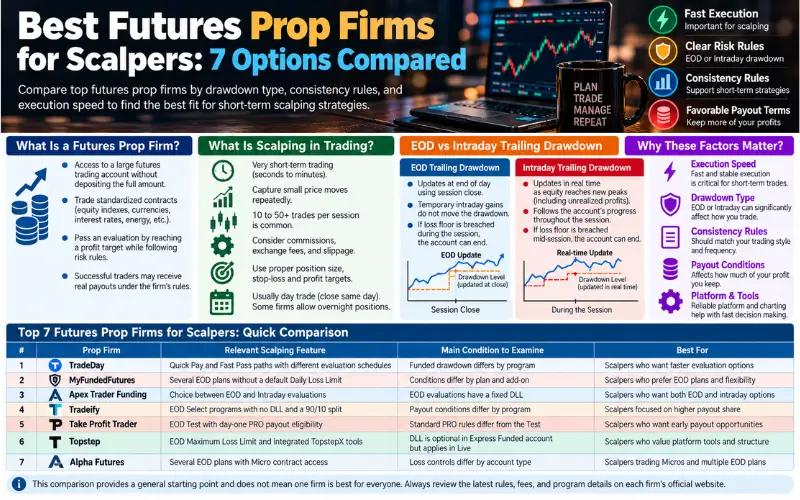
To qualify for a funded stage, a trader normally purchases an evaluation and must reach a profit target while following the firm’s risk rules, which are designed to assess the trader’s ability to generate results while controlling risk. Successful traders are then placed into a simulated funded stage. Though trades are executed in a simulated environment, eligible profits may qualify for real payouts under the firm’s rules.
What Is Scalping in Trading?
Scalping is a short-term trading method in which positions are opened and closed within seconds or minutes. Instead of waiting for a large market move, a scalper tries to capture smaller changes repeatedly. An active scalper may place 10 to 50 or more trades during one session.
Because the target on each trade is usually small, scalpers account for commissions, exchange fees, and slippage, which is the difference between the expected and actual fill price. These costs make risk management important, so scalpers use suitable position sizes, stop-loss orders, profit targets, and a defined limit for the trading session.
Scalpers usually day trade, meaning they open and close their positions within the same trading session. Some prop programs permit positions to remain open overnight, while others require every position to be closed before a specified cutoff.
EOD and Intraday Trailing Drawdown
Drawdown is the drop in an account’s value, and prop firms usually use a maximum drawdown as a risk threshold. A trailing drawdown’s loss floor rises as the account hits new equity peaks, but it generally does not fall back down after a loss. This means the permitted loss boundary follows the account’s progress.
An end-of-day, or EOD, trailing drawdown updates the floor from qualifying account results at the session close, so temporary intraday gains do not move it. An intraday trailing drawdown updates in real time as account equity reaches new peaks, including unrealized profits on open positions. In both cases, if the established loss floor is breached mid-session, the account can end.
Top 7 Futures Prop Firms for Scalpers
| Prop firm | Relevant scalping feature | Main condition to examine |
| TradeDay | Quick Pay and Fast Pass paths with different evaluation schedules | Funded drawdown differs by program |
| MyFundedFutures | Several EOD plans without a default Daily Loss Limit | Conditions differ by plan and add-on |
| Apex Trader Funding | Choice between EOD and Intraday evaluations | EOD evaluations have a fixed DLL |
| Tradeify | EOD Select programs with no DLL and a 90/10 split | Payout conditions differ by program |
| Take Profit Trader | EOD Test with day-one PRO payout eligibility | Standard PRO rules differ from the Test |
| Topstep | EOD Maximum Loss Limit and integrated TopstepX tools | DLL is optional in Express Funded account but applies in Live |
| Alpha Futures | Several EOD plans with Micro contract access | Loss controls differ by account type |
The table provides a general starting point and does not mean that every feature applies to every account offered by the firm.
1. TradeDay — EOD Continuity Through the Fast Pass Route
TradeDay offers Quick Pay and Fast Pass evaluations. Quick Pay requires five trading days and applies a 30% consistency condition, while Fast Pass uses three trading days and a 45% condition. Consistency measures the largest profitable day against total evaluation profit.
Fast Pass is the more relevant route for scalpers who want EOD drawdown behavior to continue after qualification, because Quick Pay starts with EOD and transitions to intraday at the funded stage. EOD matters when numerous short trades create several equity peaks during one session. The funded stage also removes the evaluation consistency condition, allowing the strategy to be judged through its net results.
A scalper choosing Quick Pay should test how repeated equity highs and profit givebacks affect the funded threshold. The profit split, payout limits, and qualifying conditions also differ between Quick Pay and Fast Pass.
2. MyFundedFutures — EOD Drawdown Without a Default Daily Loss Limit
MyFundedFutures offers several evaluations with EOD Maximum Loss Limits and no default Daily Loss Limit. Its Rapid and Pro plans follow this structure, while Builder offers an optional soft daily pause. The absence of a separate DLL on applicable plans means that a session is controlled primarily by the overall loss floor. This can accommodate scalpers that take several independent setups and might experience normal intraday variation between entries.
Open equity still counts when the account is tested against its established loss floor, so EOD calculation does not protect a position that breaches the active threshold intraday. Builder, Rapid, and Pro also differ in minimum days, consistency, scaling, and payout conditions.
3. Apex Trader Funding — A Choice Between EOD and Intraday Scalping
Apex Trader Funding is one of the few firms in this list to let traders choose between EOD and Intraday evaluations outright, so the drawdown model can be matched to the strategy rather than fixed by the firm. EOD can suit a method that produces several temporary profit peaks before the session closes. Intraday may fit a strategy built around very short holding periods and tightly controlled exits, keeping a shorter time gap for unrealized profits to reverse before the trade closes. Apex also requires traders to define a stop-loss on each position, a rule built into its platforms that supports planned exits on every scalp.
EOD evaluations apply a fixed DLL, scaling from $500 on a $25,000 account to $2,000 on a $150,000 account, which gives scalpers a known, predictable session boundary; traders who prefer no fixed daily figure can choose the Intraday evaluation instead, which has none.
After passing, both funded account types use tier-based Daily Loss Limits and contract scaling. A scalper should therefore compare the funded tier with the number and size of trades normally placed in one session. Evaluations have no consistency rule, but funded accounts require consistency for payouts. Approved payouts are paid at 100% of eligible profits, subject to the applicable maximum payout caps.
4. Tradeify — EOD Risk Rules With Chart-Based Execution
Tradeify’s Select programs combine EOD drawdown with no separate Daily Loss Limit or consistency rule. The firm offers different paths, including Growth and Select through evaluations and direct funding Lightning accounts without any evaluations.
Tradeify’s platform access depends on the connection selected at checkout, and third-party software or market-data costs may remain separate. Select Flex and Select Daily also use different payout frequencies, winning-day conditions, and caps. A scalper should compare those requirements with the strategy’s average daily profit rather than choosing solely bypayout frequency.
5. Take Profit Trader — EOD Testing With Day-One PRO Withdrawals
Take Profit Trader uses EOD trailing drawdown during its Test and requires the largest profitable day to remain below 50% of total net profit. A result above that level does not automatically fail the Test, but the trader must earn more profit before qualifying.
A scalping strategy may fit the Test’s consistency calculation because the rule measures daily distribution rather than individual trade frequency. After passing, standard PRO removes funded consistency, and its drawdown is monitored through intraday trailing. It also permits eligible withdrawals from the first trading day once profit has been built above the required buffer. Standard PRO uses an 80% trader share, while PRO+ provides a separate EOD structure with a 90/10 split.
A scalper should replay the strategy under the standard PRO calculation and include the required buffer before treating day-one eligibility as immediately withdrawable profit.
6. Topstep — Integrated Execution and Session-Level Risk Controls
Topstep’s Maximum Loss Limit rises with qualifying end-of-day balances. The firm’s integrated platform TopstepX combines charting, order entry, trade copying, and personal risk settings within one environment. A scalper can set a personal daily limit to liquidate positions or block additional entries after a defined session loss.
A DLL is optional under current Topstep’s Express Funded (Standard and Consistency) paths but is assigned in Live Funded Accounts. An enabled DLL pauses trading rather than ending the account; the Maximum Loss Limit remains the account-ending threshold. Standard and Consistency payout routes also use different qualifying conditions, so the selected path should match the strategy’s daily profit distribution.
7. Alpha Futures — EOD Plans for Micro-Contract Scalping
Alpha Futures offers Zero, Standard, and Advanced evaluations with different Daily Loss Guards, consistency rules, and position limits. All plans have end-of-day (EOD) drawdowns. The Advanced evaluation has no Daily Loss Guard, applies 40% consistency, and permits up to 50 Micros on its $50,000 account. Its corresponding funded account removes consistency.
Alpha’s plans are not interchangeable. The Zero evaluation allows a one-day pass without evaluation consistency, but it applies a plan-specific Daily Loss Guard and consistency after qualification. High Micro limits should also be treated as maximum capacity rather than a suggested trade size because several Micros can combine into substantial exposure.
Which Futures Prop Firm Best Fits Your Scalping Style?
The most suitable firm is the one whose rules match how your strategy actually behaves. If open trades frequently show temporary profits before closing for less, an EOD structure may be easier to manage than an intraday trailing threshold. If revenge trading is the larger problem, a firm or platform with a defined daily pause may provide a useful boundary.
Platform comfort also matters. TradingView and browser-based tools may be enough for chart-based scalping, while a trader who relies on a Depth-of-market (DOM) ladder or detailed order flow may prefer a specialized desktop platform like NinjaTrader. The longest compatibility list has little value if the exact account connection does not support the required tool.
Before purchasing, practice trading on a simulator or demo account and answer four questions with your trading data:
- Would the strategy have passed the evaluation without exceeding its drawdown?
- Would it remain above the funded-stage threshold during unrealized pullbacks?
- Would the trading days and consistency satisfy payout eligibility?
- How much usable loss room would remain after a withdrawal?
Risk Disclosure: Futures trading and prop evaluations involve substantial risk and fees. Funded-stage accounts are often simulated, and passing an evaluation does not guarantee payouts or live funding. Rules referenced here were checked against official guidance available in September 2026; confirm the current terms for the exact program before purchasing.