A roll of denim is running through the inspection table under fluorescent light. Three yards in, the checker’s eye catches a slub, barely a thumbnail’s width, easy to miss if you’re rushing. She marks it, keeps the roll moving, and by the time it’s done unspooling she has a tally sheet with eleven marks on it. The question isn’t whether the roll has flaws. Almost every roll does. The question is whether those flaws add up to something a buyer will accept, and that’s exactly what the 4-point system was built to answer.
If you inspect fabric for a living, you already know the system by feel even before you know the name. This guide breaks down how the scoring actually works, how to run the math without second-guessing yourself, and where inspectors tend to get tripped up.
What the 4-Point System Actually Measures
The 4-point system is a scoring method for grading fabric rolls from a visual inspection. It doesn’t grade the fabric’s quality directly. It grades the defects, assigning each one a penalty score from 1 to 4 based on size and severity, then rolls those scores up into a rate per 100 square yards. That rate is what buyers and suppliers compare against an agreed threshold to decide whether a roll passes.
It’s built under ASTM D5430, and the scoring convention traces back to the American Apparel Manufacturers Association, which is why you’ll sometimes see it called the AAMA system in older documentation. No single defect can score higher than 4 points, no matter how bad it looks. That ceiling is the whole reason it’s called a four-point system in the first place.
How Penalty Points Get Assigned
Every defect gets measured along its length, whether that length runs with the fabric or across it. The scoring doesn’t care which direction. It only cares how long the flaw is.
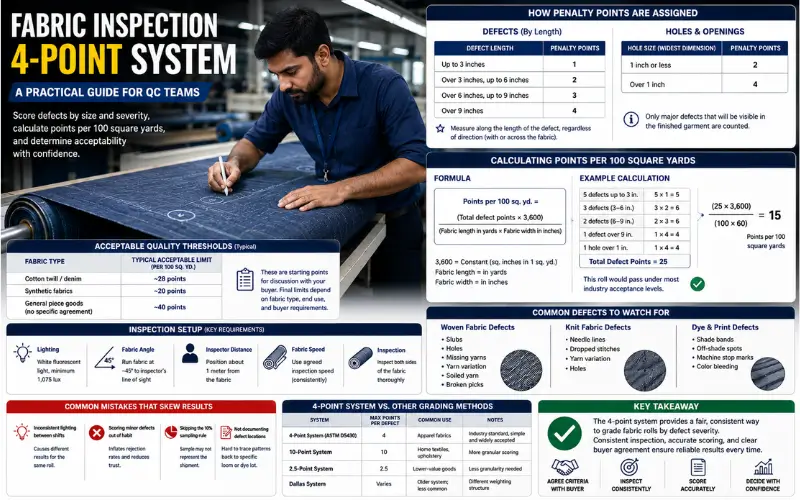
| Defect Length | Penalty Points |
| Up to 3 inches | 1 |
| Over 3 inches, up to 6 inches | 2 |
| Over 6 inches, up to 9 inches | 3 |
| Over 9 inches | 4 |
Holes and openings get scored separately, by their widest dimension rather than length:
| Hole Size | Penalty Points |
| 1 inch or less | 2 |
| Over 1 inch | 4 |
Only major defects count. A minor irregularity that won’t show up in the finished garment typically doesn’t get penalized at all, though what counts as “minor” is something buyer and supplier need to agree on ahead of time, not something the inspector should be guessing at mid-shift.
Calculating Points per 100 Square Yards
Raw point totals aren’t useful on their own, because a 200-yard roll will naturally rack up more defects than a 50-yard roll. The system normalizes for that with a simple formula:
Points per 100 sq. yd. = (Total defect points × 3,600) ÷ (Fabric length in yards × Fabric width in inches)
Here’s how that plays out with real numbers. Say a 100-yard roll, 60 inches wide, comes back from inspection with the following:
- 5 defects up to 3 inches: 5 × 1 = 5 points
- 3 defects between 3 and 6 inches: 3 × 2 = 6 points
- 2 defects between 6 and 9 inches: 2 × 3 = 6 points
- 1 defect over 9 inches: 1 × 4 = 4 points
- 1 hole over 1 inch: 1 × 4 = 4 points
Total defect points: 25
Plug that into the formula: (25 × 3,600) ÷ (100 × 60) = 90,000 ÷ 6,000 = 15 points per 100 square yards.
That roll would pass under almost any threshold in use today. It’s a clean example on purpose. Real rolls rarely come out this round, but the math never changes.
Acceptable Quality Thresholds
There’s no universal cutoff written into the standard itself. Forty points per 100 square yards gets cited constantly as an industry rule of thumb, and plenty of factories still use it as a default. But buyers set their own limits, and those limits often depend on the fabric.
| Fabric Type | Typical Acceptable Limit (per 100 sq. yd.) |
| Cotton twill / denim | ~28 points |
| Synthetic fabrics | ~20 points |
| General piece goods (no specific agreement) | ~40 points |
Treat these as starting points for a conversation with your buyer, not fixed law. A garment brand producing evening wear will tolerate far less than a workwear manufacturer buying heavyweight canvas, and that gap is exactly why the acceptance level needs to be settled before the first roll ever hits the inspection table, not after a shipment gets flagged.
Setting Up the Inspection Correctly
The scoring system only works if the inspection itself is consistent, and that consistency comes down to a handful of physical conditions that are easy to overlook once a shift gets busy.
Lighting matters more than most QC teams give it credit for. The room needs white fluorescent lighting at a minimum of 1,075 lux, positioned perpendicular to the fabric surface. The fabric itself should run at roughly a 45-degree angle to the inspector’s line of sight, which cuts glare and makes surface defects easier to catch. The inspector should be positioned about one meter from the moving fabric, no closer, no farther, and the roll should move at a speed both sides have agreed on in advance rather than whatever pace feels convenient that day.
Skip any one of these and you introduce variability that has nothing to do with the fabric and everything to do with how it happened to be checked.
Common Fabric Defects to Watch For
Defect types vary by fabric construction, but a few categories come up constantly on the inspection table:
- Woven fabric defects: slubs, holes, missing yarns, yarn variation, soiled yarn, broken picks
- Knit fabric defects: needle lines, dropped stitches, yarn variation, holes
- Dye and print defects: shade bands, off-shade spots, machine stop marks, color bleeding
Knowing what a defect looks like before it’s on the table is half the job. An inspector who’s only ever read a definition will hesitate on a borderline case in a way that someone who’s actually handled a hundred rolls of the same fabric won’t.
Common Mistakes That Skew Results
A few habits quietly undermine even a well-run inspection program.
Inconsistent lighting between shifts. A defect that’s obvious under proper lux levels can disappear under dimmer bulbs, which means the same roll can pass on one shift and fail on another for reasons that have nothing to do with the fabric.
Scoring minor defects out of habit. Some inspectors default to penalizing anything that catches their eye, even flaws that would never surface in the finished garment. That inflates rejection rates and erodes trust with suppliers who are, correctly, applying the agreed criteria.
Skipping the 10% sampling rule. The standard calls for inspecting at least 10% of total rolls per order per color, with a minimum of one roll per color. Cutting corners here to save time means the sample stops representing the shipment.
Not documenting defect locations. A tally sheet with point totals but no notes on where defects occurred makes it nearly impossible to trace a pattern back to a specific loom or dye lot later.
4-Point System vs. Other Grading Methods
The 4-point system dominates the apparel industry, but it isn’t the only option on the table. The 10-point system uses a wider point scale and tends to show up more in home textiles and upholstery fabric. The 2.5-point system compresses the scale even further and sees occasional use for lower-value goods where less granularity is acceptable. The Dallas system, older and less common now, uses a different weighting structure entirely.
None of these has displaced the 4-point system, mostly because it’s simple enough to train new inspectors on quickly while still giving buyers a number they can hold suppliers to.
Frequently Asked Questions
What does “4-point” actually refer to?
It refers to the maximum penalty score any single defect can receive. No matter how severe a flaw looks, it caps out at 4 points.
Is the 4-point system the same as ASTM D5430?
ASTM D5430 is the formal standard the 4-point system operates under. The two terms get used interchangeably in practice, but the standard is the documented method and the “4-point system” is the common industry name for it.
Can a fabric roll fail on one section even if the overall score passes?
Yes. Some buyers add a rule that any stretch of fabric with continuous defects beyond a certain length (commonly four continuous yards) causes automatic rejection, regardless of the roll’s overall points-per-100-yard score.
Does the 4-point system apply to both woven and knit fabric?
Yes. The scoring method itself doesn’t change based on construction, though the specific defects an inspector watches for will differ between woven and knit goods.
Who decides the acceptable points threshold?
The buyer and supplier agree on it before production, usually as part of the sourcing contract. There’s no regulatory body enforcing a single number across the industry.
How much of a fabric shipment actually needs to be inspected?
Common practice is 10% of total rolls per order per color, with at least one roll from every color inspected regardless of order size.
What happens to a roll that fails inspection? It depends on the agreement in place. Some buyers reject the roll outright, others renegotiate price, and some allow the supplier to sort and re-submit affected sections. This is worth settling in writing before inspection starts, not after a roll fails.
Final Thoughts
The 4-point system isn’t complicated once you’ve run the math a few times, but it only works when the inspection behind it is disciplined: consistent lighting, agreed sampling rates, and a shared understanding with your supplier about what actually counts as a defect. Get those three things locked down, and the numbers on the tally sheet will mean the same thing every time, on every shift, regardless of who’s standing at the table.