Artificial intelligence has become a cornerstone of modern business strategy, promising efficiency gains, competitive advantages, and genuinely transformative outcomes. But not every AI initiative lives up to its potential — not by a long shot. Many organizations pour significant resources into AI tools and platforms only to watch results plateau, teams lose interest, or costs spiral well beyond initial projections. Recognizing when your strategy has drifted off course isn’t a sign of failure — it’s an essential step toward course-correcting and finally unlocking the value your AI investments were always supposed to deliver.
Warning Sign #1: Your AI Models Are Making Decisions No One Can Explain
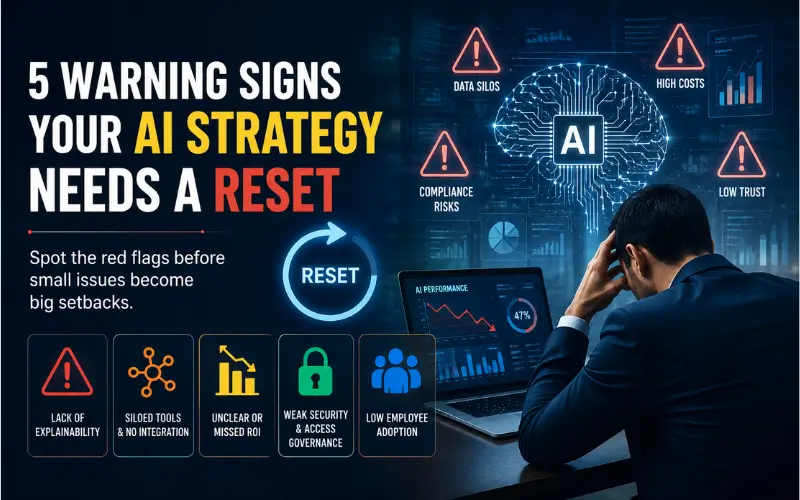
One of the clearest red flags emerges when business leaders, compliance teams, or end users can’t explain how AI-driven decisions are actually being made. A lack of transparency erodes trust, creates regulatory exposure, and seriously limits your ability to audit outcomes effectively. When stakeholders start describing AI outputs as a “black box,” that’s a strong signal your strategy lacks the explainability frameworks modern governance demands. Decisions that affect customers, finances, or security must be traceable and interpretable — full stop. If your team can’t articulate the logic behind a recommendation or automated action, it’s time to revisit your approach from the ground up.
Warning Sign #2: Siloed AI Tools Are Multiplying Without Integration
Another telling warning sign is the unchecked proliferation of AI tools across departments with little coordination or shared infrastructure holding things together. When marketing, operations, finance, and IT each deploy their own AI solutions independently, the inevitable result is data duplication, inconsistent outputs, and wasted spending. That kind of fragmentation makes it nearly impossible to build a unified data strategy — let alone enforce meaningful governance across the organization. What’s more, siloed AI deployments routinely create security vulnerabilities because access controls and data permissions get managed inconsistently from one platform to the next.
Warning Sign #3: ROI Metrics Are Vague or Consistently Missed
A healthy AI strategy is anchored by clear, measurable performance indicators that leadership reviews on a regular cadence. If your team struggles to define what success actually looks like — or keeps shifting the goalposts on return-on-investment targets — that’s a serious problem worth confronting. AI projects without well-defined metrics tend to drift into “proof of concept” purgatory, consuming resources without ever delivering meaningful business impact. Organizations frequently fall into the trap of measuring activity, such as the number of models deployed, rather than actual outcomes like cost savings, revenue growth, or customer satisfaction.
Warning Sign #4: Security and Access Governance Are Afterthoughts
AI systems routinely process sensitive data, generate consequential recommendations, and interact with critical business infrastructure — which makes security and access governance far too important to treat as secondary concerns. When these elements are bolted on after the fact rather than built in from the start, the organization takes on significant and largely unnecessary risk. Common symptoms include employees accessing AI tools or underlying datasets well beyond their role requirements, inconsistent permission structures scattered across platforms, and a notable absence of audit trails for AI-driven actions. Implementing robust policy-based access control services ensures that the right individuals interact with the right systems under the right conditions — nothing more, nothing less. Without that foundation in place, even the most sophisticated AI capabilities become a liability rather than an asset.
Warning Sign #5: Employee Adoption Is Low Despite Heavy Investment
Technology adoption is always a change management challenge, but persistently low engagement with AI tools is a strategic warning sign that deserves serious attention. When employees bypass AI-powered workflows, revert to manual processes, or openly question the reliability of AI-generated outputs, the root cause is rarely technical. More often, it reflects inadequate training, poor user experience design, or a failure to clearly communicate how AI tools actually support people in their day-to-day responsibilities. Low adoption means the investment is generating minimal return while cultural resistance quietly deepens over time. Turning that around requires honest feedback loops, iterative tool refinement, and visible leadership commitment to AI-enabled ways of working.
Conclusion
Spotting the warning signs of a struggling AI strategy is the first — and arguably most important — step toward meaningful improvement. Whether the issues involve transparency, integration, measurement, security, or adoption, each challenge has a workable solution, but only if leadership is willing to confront problems honestly and act with real decisiveness. A strategic reset doesn’t mean abandoning AI ambitions; it means building a stronger, more disciplined foundation capable of supporting sustainable, scalable success. Organizations that regularly audit and refine their AI strategy will consistently outperform those that assume momentum alone is enough to carry them forward.