
Enterprise data has never been more valuable, and it has never been more exposed. As organizations continue migrating workloads, applications, and sensitive records to cloud environments, the attack surface they present to adversaries expands in proportion. A strong cloud security posture is no longer a matter of technical compliance, it is a fundamental business requirement. Yet knowing what effective cloud security looks like in practice, especially across hybrid environments that span both on-premises infrastructure and public cloud platforms, is where many organizations still struggle.
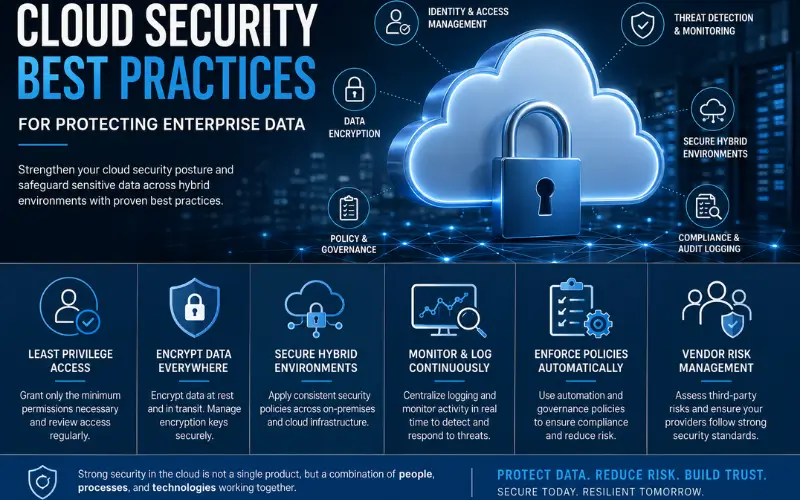
This article outlines the core best practices that enterprise security teams should build into their cloud strategy, from access control and encryption through to logging, governance, and vendor accountability.
One of the most consequential misunderstandings in cloud security is the assumption that the cloud provider is responsible for securing everything. In reality, responsibility is divided. Cloud providers secure the underlying infrastructure, the physical hardware, the global network fabric, and the hypervisor layer. The organization retains full responsibility for what it deploys on top: its data, its user accounts, its application configurations, and its access policies.
This shared model means that even when an organization’s cloud provider maintains robust infrastructure controls, the customer’s own misconfigurations, excessive permissions, or unmonitored access paths can leave sensitive data completely exposed. Understanding exactly where the provider’s responsibility ends and the customer’s begins is the starting point for building any enterprise cloud security strategy.
For a comprehensive overview of the disciplines and controls that underpin modern cloud security, the resource on cloud security strategies for hybrid environments provides a structured breakdown of key concepts across deployment models.
Apply the Principle of Least Privilege Across All Identities
Excessive permissions are among the most commonly exploited vulnerabilities in cloud environments. When users, applications, and service accounts are granted broader access than their functions require, a single compromised credential can provide an attacker with disproportionate reach across the environment.
Least privilege access means granting each identity only the minimum permissions required to perform its specific tasks, and reviewing those permissions regularly to remove rights that are no longer needed. This applies not just to human users but to service accounts, automated pipelines, and any third-party integrations that touch cloud resources.
Role-based access control frameworks allow security teams to define permissions at the role level rather than the individual level, making it far easier to manage access consistently across large organizations. When combined with multi-factor authentication, these controls reduce the risk of credential-based attacks considerably.
Enforce Encryption for Data at Rest and in Transit
Encryption is one of the most reliable safeguards available for protecting enterprise data in the cloud. Data at rest, stored in cloud databases, object storage, or file systems, should be encrypted using strong, current algorithms with well-managed encryption keys. Data in transit between users and cloud services, or between different cloud components, should be protected through robust transport protocols.
Key management deserves particular attention. Many organizations implement encryption but store encryption keys in ways that undermine its value, for example, keeping keys in the same systems as the data they protect. Dedicated key management services that maintain clear separation between keys and encrypted data offer significantly stronger protection.
Research into how enterprises handle corporate data within cloud-based applications consistently finds that encryption combined with data loss prevention controls and single sign-on represents the most effective combination for limiting exposure, yet many organizations remain inconsistent in applying these measures. The risks of leaving sensitive files unencrypted across collaborative cloud applications are documented in depth in this analysis of corporate data cloud risks.
Secure the Hybrid Environment with Consistent Controls
Hybrid environments present unique challenges that neither purely on-premises nor purely cloud-based architectures face in isolation. When workloads and data flow between private infrastructure and public cloud platforms, security teams must ensure that policies apply consistently across both sides of that boundary.
Identity and access controls must work across both environments. Monitoring and logging must capture activity in both on-premises systems and cloud workloads. Network segmentation, which limits the ability of an attacker to move laterally through an environment, must account for the pathways that exist between cloud and on-premises resources.
Organizations that manage hybrid environments often find that fragmented security tooling, separate products for each part of the environment, creates gaps in visibility and enforcement. Consolidating security operations onto platforms that provide unified visibility across hybrid infrastructure helps security teams detect anomalies and respond to threats without having to correlate data from disconnected systems manually.
Identity Remains the Control Plane
In hybrid environments, identity is effectively the security perimeter. When data moves across infrastructure boundaries, the question of who can access it and under what circumstances becomes more complex. Implementing a zero trust model, in which no user or device is trusted by default, regardless of whether they are inside or outside the corporate network, addresses this directly.
Under a zero trust approach, every access request is verified based on identity, device state, location, and behavioral context before access is granted. Resources are segmented so that a breach in one area cannot automatically enable access to another. Continuous monitoring detects deviations from normal behavior and triggers alerts or automated responses. For an in-depth breakdown of how this framework applies across cloud and hybrid contexts, this resource on zero trust access controls explains the core architecture and implementation principles.
Eliminate Misconfiguration as a Risk Vector
Misconfiguration is consistently identified as one of the leading causes of cloud security incidents. Publicly accessible storage buckets, overly permissive firewall rules, disabled logging, and default credentials left unchanged are all examples of misconfigurations that can expose enterprise data without any malicious actor needing to exploit a software vulnerability.
Cloud Security Posture Management tools continuously scan cloud environments for configuration issues and compare existing settings against security baselines and regulatory requirements. They surface misconfigurations in real time, allowing security teams to remediate them before they can be exploited. Integrating posture management into the standard development and deployment workflow, rather than treating it as a periodic audit activity, significantly reduces the window of exposure.
Organizations should also implement infrastructure-as-code practices that enforce security configurations as part of the provisioning process, making it structurally difficult to deploy insecure resources in the first place.
Establish Logging, Monitoring, and Incident Response Capabilities
Without adequate logging and monitoring, cloud security incidents can go undetected for extended periods. Activity logs, access records, and audit trails are essential not just for detecting incidents in progress but for forensic investigation after the fact and for demonstrating compliance with regulatory requirements.
Effective monitoring goes beyond generating logs, it requires the ability to analyze log data in near real time, correlate events across multiple sources, and alert security teams when activity deviates from established baselines. Automated detection capabilities, tuned to the specific patterns that indicate credential misuse, data exfiltration, or lateral movement, reduce the time between a breach occurring and a response beginning.
Incident response plans should account for the specific characteristics of cloud environments, including the ability to isolate affected resources, revoke compromised credentials, and preserve evidence in ways that do not disrupt unaffected workloads.
Frequently Asked Questions
What is the biggest security risk in hybrid cloud environments?
Inconsistent application of security controls across on-premises and cloud infrastructure is one of the most significant risks. When policies, monitoring, and access controls are not unified across both sides of a hybrid environment, gaps emerge that adversaries can exploit. Identity management vulnerabilities and misconfigured network pathways between cloud and on-premises systems are particularly common sources of exposure.
How often should cloud security configurations be reviewed?
Cloud security configurations should be reviewed continuously using automated posture management tools, with structured manual audits conducted at least quarterly. Because cloud environments change frequently, new resources are provisioned, applications are updated, and user roles shift, security configurations can drift from intended baselines rapidly. Relying on infrequent manual reviews alone is insufficient for maintaining a secure posture.
Does encryption alone make cloud data secure?
Encryption is a critical control, but it does not constitute a complete security strategy on its own. Its effectiveness depends entirely on how well encryption keys are managed and protected. Without strong access controls, continuous monitoring, identity verification, and misconfiguration management working alongside encryption, sensitive data remains vulnerable to threats that bypass the encryption layer entirely, such as compromised credentials or misconfigured permissions.