The global apparel market is more competitive than ever, and choosing the right custom clothing manufacturer is one of the most important decisions for any fashion business. Whether you’re launching a new clothing brand, scaling an existing one, or exploring private label opportunities, your manufacturer directly impacts your product quality, pricing, and brand reputation.
Today, businesses are no longer limited to mass-produced apparel. Modern custom clothing manufacturers offer flexible solutions—from low minimum order quantities (MOQs) for startups to large-scale production for established brands. But with so many options available worldwide, finding the right partner can feel overwhelming.
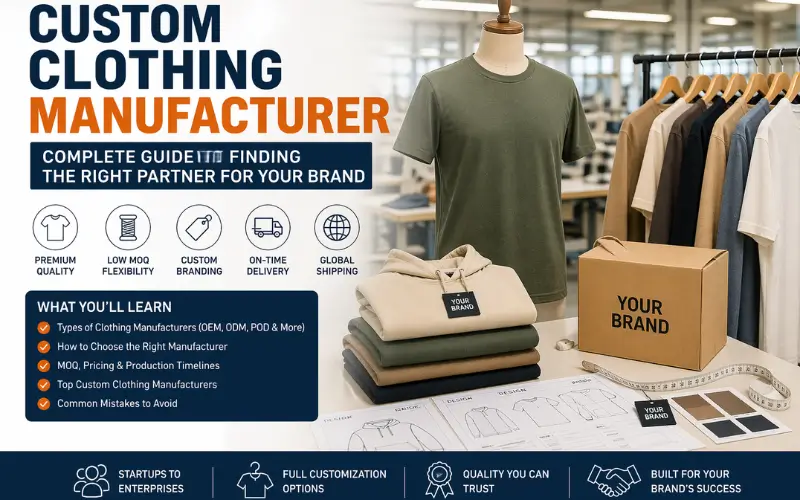
This guide is designed to simplify that process.
What You’ll Learn in This Guide
In this comprehensive article, you’ll discover:
- What a custom clothing manufacturer actually does
- Different types of clothing manufacturers (OEM, ODM, POD, etc.)
- How to choose the right manufacturer for your business
- Key factors like MOQ, pricing, and production timelines
- A curated list of the top custom clothing manufacturers
- Common mistakes to avoid when working with suppliers
Why Choosing the Right Manufacturer Matters
Many new brands focus heavily on design and marketing—but overlook manufacturing. That’s a mistake.
A reliable custom clothing manufacturer ensures:
- Consistent product quality
- On-time delivery
- Accurate customization
- Scalability as your business grows
On the other hand, the wrong manufacturer can lead to delays, poor-quality products, and financial losses.
Who This Guide is For
This article is especially useful if you are:
- Starting a clothing brand
- Looking for private label manufacturers
- Running an eCommerce apparel business
- Scaling production from small to bulk
- Searching for low MOQ clothing manufacturers
Quick Comparison of Top Custom Clothing Manufacturers
Here’s a quick overview to help you compare some of the best options available:
| Manufacturer | Location | MOQ | Specialty | Best For |
| Billoomi | India | 25–100 | Women/Kidswear | Startups |
| MakersValley | Italy | 100–500 | Luxury | Premium brands |
| Printful | USA & EU (Global Fulfillment) | No MOQ | Print-on-Demand | Ecommerce |
| Affix Apparel | USA | 50–300 | Streetwear | Growing brands |
| Alanic | USA (Global) | 500+ | Sportswear | Bulk orders |
| Zega Apparel | USA | 50–150 | Private Label | Startups |
| Lefty Production | USA | 100–500 | Premium | Mid-tier brands |
| Tack Apparel | Pakistan | 50–300 | Budget | Cost-focused |
| Royal Apparel | USA | 100–500 | Sustainable | Eco brands |
| Indie Source | USA | 100–500 | Full Package | Scaling brands |
What is a Custom Clothing Manufacturer?
A custom clothing manufacturer is a company that produces garments based on your specific requirements—rather than selling pre-made designs. This means you have full control over how your clothing looks, feels, and represents your brand.
Unlike standard wholesalers, custom manufacturers allow you to personalize:
- Fabric and materials
- Colors and sizing
- Patterns and cuts
- Logos, labels, and tags
- Packaging and branding
In simple terms, they turn your ideas into finished products.
How Custom Clothing Manufacturing Works
Understanding the process helps you avoid costly mistakes. Most manufacturers follow a structured workflow:
1. Design & Concept Development
You provide:
- Sketches, references, or tech packs
- Fabric preferences
- Branding details
Some manufacturers also offer design assistance if you’re just starting out.
2. Sampling
Before bulk production, a sample is created.
This step allows you to:
- Check quality
- Test fit and sizing
- Make adjustments
👉 Skipping sampling is one of the biggest mistakes new brands make.
3. Production
Once the sample is approved:
- Materials are sourced
- Bulk manufacturing begins
- Quality checks are performed
4. Branding & Packaging
Most custom clothing manufacturers offer:
- Private labeling
- Custom tags
- Branded packaging
5. Shipping & Delivery
Final products are shipped to your warehouse, fulfillment center, or directly to customers (in some cases).
Types of Custom Clothing Manufacturers
Not all manufacturers operate the same way. Understanding the different types will help you choose the right partner for your business model.
1. OEM (Original Equipment Manufacturer)
What it means:
You provide the complete design, and the manufacturer produces it exactly as specified.
Best for:
- Established brands
- Unique, original designs
Pros:
- Full creative control
- Strong brand identity
Cons:
- Requires detailed tech packs
- Higher upfront effort
2. ODM (Original Design Manufacturer)
What it means:
The manufacturer already has pre-designed products, which you can customize slightly (e.g., logo, color).
Best for:
- Faster product launches
- Businesses with limited design resources
Pros:
- Quick turnaround
- Lower development cost
Cons:
- Limited uniqueness
- Less control over design
3. Print-on-Demand (POD)
What it means:
Products are printed and shipped only after a customer places an order.
Best for:
- eCommerce businesses
- Dropshipping models
Pros:
- No inventory needed
- No minimum order quantity
Cons:
- Lower profit margins
- Limited customization (mostly prints)
4. Private Label Manufacturers
What it means:
You sell products under your own brand, but manufacturing is handled by a third party.
Best for:
- Building a brand without owning a factory
Pros:
- Easy brand creation
- Scalable
Cons:
- Less control than OEM
- Dependence on supplier
5. Full-Package Manufacturers (FPP)
What it means:
They handle everything—from design and sourcing to production and delivery.
Best for:
- Beginners
- Brands wanting a hands-off approach
Pros:
- End-to-end solution
- Saves time and effort
Cons:
- Higher costs
- Less direct control
Which Type is Right for You?
Here’s a quick breakdown:
- Startups: POD or Private Label
- Growing brands: OEM or Full Package
- Luxury brands: OEM (high control)
- Fast launch: ODM
How to Choose the Right Custom Clothing Manufacturer (Expert Guide)
Choosing the right custom clothing manufacturer isn’t just about price—it’s about finding a long-term partner who can support your brand’s growth.
Here’s a step-by-step framework to help you make the right decision.
1. Define Your Product and Niche First
Before contacting any manufacturer, you need clarity on what you’re producing.
Ask yourself:
- What type of clothing am I creating? (streetwear, activewear, luxury, kidswear)
- What is my target price range?
- What level of quality do I expect?
👉 Not all manufacturers specialize in every category. Choosing one aligned with your niche saves time and avoids poor results.
2. Check Manufacturer Specialization
A common mistake is choosing a “general” manufacturer.
Instead, look for:
- Streetwear specialists → hoodies, oversized fits
- Activewear manufacturers → performance fabrics
- Luxury producers → premium materials and finishing
👉 A specialized manufacturer will always deliver better results than a generic one.
3. Evaluate MOQ (Minimum Order Quantity)
MOQ directly impacts your budget and inventory risk.
- Low MOQ (25–100 pcs): Best for startups
- Medium MOQ (100–500 pcs): For growing brands
- High MOQ (500+ pcs): For large-scale production
👉 Always confirm:
- MOQ per design
- MOQ per size/color
4. Request Samples (Non-Negotiable)
Never skip this step.
Samples help you evaluate:
- Fabric quality
- Stitching and durability
- Fit and sizing accuracy
👉 If a manufacturer refuses sampling, consider it a red flag.
5. Assess Communication and Responsiveness
This is underrated—but critical.
Pay attention to:
- Response time
- Clarity in answers
- Willingness to explain processes
👉 Poor communication early = bigger problems later.
6. Understand Pricing Structure
Don’t just look at the price per unit—understand what’s included.
Ask:
- Does pricing include fabric sourcing?
- Are there extra costs for customization?
- What are sampling fees?
👉 Cheapest option is rarely the best. Focus on value, not just cost.
7. Check Production Capacity & Lead Time
Timing can make or break your business.
Typical timelines:
- Sampling: 1–3 weeks
- Production: 3–8 weeks
👉 Always confirm:
- Production lead time
- Ability to handle scaling
8. Verify Certifications & Ethical Standards
Modern consumers care about sustainability and ethics.
Look for:
- Ethical labor practices
- Eco-friendly materials
- Certifications (if relevant)
👉 This is especially important for premium and eco-conscious brands.
9. Read Reviews & Ask for References
Don’t rely only on the manufacturer’s website.
Check:
- Google reviews
- LinkedIn presence
- Client testimonials
👉 If possible, ask for:
- Past client references
- Sample case studies
🚩 Red Flags to Avoid
Be cautious if you notice:
- Extremely low pricing (too good to be true)
- No clear MOQ or pricing structure
- Poor or delayed communication
- No samples offered
- Lack of online presence
👉 These are often signs of unreliable manufacturers.
🧠 Pro Tip: Start Small, Then Scale
Even if you plan large production, start with a small batch.
This allows you to:
- Test product quality
- Validate demand
- Reduce financial risk
Pricing, Costs & MOQ Explained (What to Expect)
Understanding pricing is essential when working with a custom clothing manufacturer. Many beginners underestimate costs, which can lead to budgeting issues and unexpected expenses.
Let’s break it down clearly.
What Determines Clothing Manufacturing Costs?
There’s no fixed price for custom clothing. Costs vary based on several key factors:
1. Fabric and Material
Fabric is often the biggest cost driver.
- Basic cotton → lower cost
- Organic or sustainable fabrics → higher cost
- Performance fabrics (activewear) → premium pricing
👉 Higher quality fabric = higher product value (and selling price).
2. Order Quantity (MOQ Impact)
Your cost per unit depends heavily on how much you order.
- Small orders (low MOQ): Higher cost per piece
- Large orders (bulk): Lower cost per piece
👉 Example:
- 50 pieces → €12–€25 per unit
- 500 pieces → €6–€15 per unit
(Varies by product and manufacturer)
3. Design Complexity
Simple designs are cheaper.
Costs increase with:
- Embroidery
- Custom patterns
- Multiple colors
- Unique cuts
👉 The more customization, the higher the production cost.
4. Manufacturing Location
Where your manufacturer is based matters:
- Asia (India, Pakistan, China): Lower cost
- Europe / USA: Higher cost but faster shipping & easier communication
👉 It’s a trade-off between cost, quality control, and logistics.
5. Branding & Packaging
Custom branding adds extra cost:
- Woven labels
- Hang tags
- Custom packaging
👉 These are essential for building a strong brand—but should be budgeted early.
Typical Cost Breakdown (Example)
Here’s a rough idea for a basic custom t-shirt:
- Fabric: €3–€6
- Manufacturing: €2–€5
- Printing/branding: €1–€4
- Packaging: €0.50–€2
👉 Estimated total cost per unit: €7–€17
(Prices vary depending on quality and volume)
Understanding MOQ (Minimum Order Quantity)
MOQ is the minimum number of units you must order per design.
Why MOQ Exists
Manufacturers set MOQs to:
- Cover production setup costs
- Ensure profitability
- Optimize factory efficiency
Typical MOQ Ranges
- Low MOQ: 25–100 pieces
- Medium MOQ: 100–500 pieces
- High MOQ: 500+ pieces
MOQ Per Variation (Important!)
Many beginners miss this:
MOQ may apply per:
- Size (S, M, L, XL)
- Color
- Design
👉 Example:
If MOQ = 100, you might need:
- 25 small
- 25 medium
- 25 large
- 25 extra large
Hidden Costs to Watch Out For
Always ask about these upfront:
- Sampling fees (€50–€200+)
- Shipping costs
- Import duties/taxes
- Payment processing fees
👉 These can significantly impact your total budget.
How to Reduce Manufacturing Costs
Here are practical ways to stay within budget:
- Start with simple designs
- Choose standard fabrics
- Order slightly higher quantities (if possible)
- Work with manufacturers offering low MOQs
- Negotiate after your first order
Top 11 Custom Clothing Manufacturers (Detailed Breakdown)
Choosing the right custom clothing manufacturer depends on your budget, business model, and product type. Below is a curated list of reliable manufacturers, along with detailed insights to help you compare them effectively.
1. The Evans Group (TEG) (USA)
Overview:
The Evans Group (TEG) is a Los Angeles-based fashion development and clothing manufacturing company that specializes in helping emerging and established designers bring their collections to life. They offer a full-service approach, from design and sourcing to production and brand development.
Specialties:
- Fashion design & development
- Fabric and trim sourcing
- Pattern making & sample development
- Cut-and-sew manufacturing
- Womenswear, menswear, activewear, bridal & couture
- Small-batch and large-scale production
MOQ: Low-volume production available; suitable for startups and growing brands.
Why Choose Them:
TEG provides end-to-end support, ethical Los Angeles-based manufacturing, and extensive experience working with thousands of fashion brands. Their hands-on guidance makes them a strong partner for designers who need both development and production expertise.
Best For: Emerging designers, premium fashion brands, and businesses seeking U.S.-based apparel manufacturing.
2. Billoomi Fashion (India)
Overview:
Billoomi Fashion is a well-established custom clothing manufacturer known for working with startups and small brands.
Specialties:
- Women’s wear
- Kidswear
- Sustainable clothing
MOQ: 25–100 pieces
Why Choose Them:
They offer low MOQs and strong support for new businesses, making them ideal for first-time founders.
Best For: Startups and small fashion brands
3. MakersValley (Italy)
Overview:
MakersValley connects brands with premium Italian manufacturers, focusing on high-end production.
Specialties:
- Luxury apparel
- High-quality craftsmanship
MOQ: 100–500 pieces
Why Choose Them:
Access to “Made in Italy” manufacturing, which is highly valued in the fashion industry.
Best For: Luxury and premium brands
4. Printful (USA & EU)
Overview:
Printful is a leading print-on-demand platform that handles production, printing, and shipping.
Specialties:
- Print-on-demand apparel
- Dropshipping
MOQ: No minimum
Why Choose Them:
No inventory required—perfect for testing designs and running an online store.
Best For: eCommerce and POD businesses
5. Affix Apparel (USA)
Overview:
Affix Apparel provides full-service custom clothing manufacturing with strong branding capabilities.
Specialties:
- Streetwear
- Casual apparel
MOQ: 50–300 pieces
Why Choose Them:
They offer a balance between customization and scalability.
Best For: Growing brands
6. Alanic Clothing (USA / Global)
Overview:
Alanic is a large-scale manufacturer specializing in bulk apparel production.
Specialties:
- Sportswear
- Activewear
MOQ: 500+ pieces
Why Choose Them:
High production capacity makes them suitable for large orders.
Best For: Bulk production and established brands
7. Zega Apparel (USA)
Overview:
Zega Apparel focuses on helping startups launch private label clothing lines.
Specialties:
- Streetwear
- Private label
MOQ: 50–150 pieces
Why Choose Them:
They provide end-to-end support, including tech packs and sampling.
Best For: New clothing brands
8. Lefty Production Co. (USA)
Overview:
Lefty Production Co. offers premium apparel manufacturing with a focus on quality and craftsmanship.
Specialties:
- High-end fashion
- Premium garments
MOQ: 100–500 pieces
Why Choose Them:
Strong reputation for quality and attention to detail.
Best For: Mid-tier to premium brands
9. Tack Apparel (Pakistan)
Overview:
Tack Apparel is known for cost-effective custom clothing manufacturing.
Specialties:
- Streetwear
- Sportswear
MOQ: 50–300 pieces
Why Choose Them:
Affordable pricing makes them attractive for budget-conscious brands.
Best For: Cost-focused businesses
10. Royal Apparel (USA)
Overview:
Royal Apparel focuses on sustainable and ethically produced garments.
Specialties:
- Organic clothing
- Eco-friendly apparel
MOQ: 100–500 pieces
Why Choose Them:
Strong emphasis on sustainability and “Made in USA” production.
Best For: Eco-conscious brands
11. Indie Source (USA)
Overview:
Indie Source provides full-package apparel manufacturing services.
Specialties:
- Product development
- Full-package production
MOQ: 100–500 pieces
Why Choose Them:
They handle everything from concept to final production.
Best For: Brands looking for a complete solution
🏆 Best Custom Clothing Manufacturers by Category
To make your decision easier:
- Best for startups: Billoomi Fashion, Zega Apparel
- Best for luxury brands: MakersValley
- Best for print-on-demand: Printful
- Best for bulk production: Alanic Clothing
- Best for sustainability: Royal Apparel
- Best full-service option: Indie Source
Common Mistakes to Avoid When Choosing a Clothing Manufacturer
Even with the right information, many brands make costly mistakes when working with a custom clothing manufacturer. Avoiding these can save you time, money, and serious frustration.
1. Choosing Based on Price Alone
One of the biggest mistakes is going for the cheapest option.
👉 Why it’s risky:
- Lower prices often mean lower quality
- Poor stitching, bad fabric, or inconsistent sizing
- Delays and communication issues
Better approach:
Focus on value, not just cost. A slightly higher price often means better reliability and quality.
2. Skipping the Sampling Process
Some beginners skip samples to save money or time.
👉 This is a huge risk.
Without samples, you can’t verify:
- Fabric quality
- Fit and sizing
- Overall finish
Result: You may end up with unusable inventory.
3. Not Understanding MOQ Properly
Many brands misunderstand how MOQ works.
👉 Common mistake:
Assuming MOQ applies to total order only.
In reality, it may apply per:
- Size
- Color
- Design
Tip: Always confirm MOQ breakdown in detail before ordering.
4. Poor Communication with the Manufacturer
Communication issues can lead to:
- Wrong designs
- Production delays
- Cost misunderstandings
👉 Warning signs:
- Slow responses
- Vague answers
- Lack of clarity
Tip: Choose a manufacturer who communicates clearly and consistently.
5. Not Having a Tech Pack or Clear Specifications
If you don’t provide clear instructions, you won’t get the product you expect.
👉 A proper tech pack includes:
- Measurements
- Materials
- Design details
- Stitching instructions
Without it: manufacturers will make assumptions—and that leads to mistakes.
6. Ignoring Production Timelines
Many brands underestimate how long production takes.
👉 Reality:
- Sampling: 1–3 weeks
- Production: 3–8 weeks
- Shipping: additional time
Mistake: Planning launches too early without buffer time.
7. Not Checking Manufacturer Credibility
Some businesses trust suppliers without proper research.
👉 Always check:
- Reviews
- Website authenticity
- Previous work
Tip: Ask for references or past client examples if possible.
8. Overordering Too Early
It’s tempting to order in bulk to reduce costs—but it’s risky.
👉 Problem:
- Unsold inventory
- Cash flow issues
Smart approach:
- Start small
- Test demand
- Scale gradually
9. Ignoring Hidden Costs
Many brands only consider unit price.
👉 But total cost includes:
- Sampling fees
- Shipping
- Customs/import duties
- Packaging
Tip: Calculate your true cost per unit, not just manufacturing price.
10. Not Building a Long-Term Relationship
Treating manufacturers as one-time vendors is a mistake.
👉 A good relationship leads to:
- Better pricing over time
- Priority production
- Improved product quality
Final Thoughts: Choosing the Right Custom Clothing Manufacturer
Finding the right custom clothing manufacturer is one of the most important steps in building a successful apparel brand. From product quality to pricing and scalability, your manufacturer plays a critical role in your long-term success.
As you’ve seen throughout this guide, there’s no one-size-fits-all solution. The best manufacturer for you depends on your:
- Business stage (startup vs established brand)
- Budget and MOQ capacity
- Product type (streetwear, luxury, activewear, etc.)
- Level of customization required
The key is to start with clear goals, do proper research, and test before scaling.
👉 Remember: a reliable manufacturer is not just a supplier—they are a strategic partner in your brand’s growth.
🚀 Next Step
If you’re ready to move forward:
- Shortlist 2–3 manufacturers from this guide
- Request samples
- Compare quality, pricing, and communication
- Start with a small order and scale gradually
❓ Frequently Asked Questions (FAQs)
What is a custom clothing manufacturer?
A custom clothing manufacturer is a company that produces garments based on your specific designs, materials, and branding requirements, allowing full customization of the final product.
What is the minimum order quantity (MOQ) in clothing manufacturing?
MOQ (Minimum Order Quantity) is the smallest number of units a manufacturer requires per order. It typically ranges from 25 to 500+ pieces, depending on the manufacturer and product type.
Can I start a clothing brand with low MOQ?
Yes, many custom clothing manufacturers offer low MOQs (25–100 pieces), making it possible for startups to launch without large upfront investment.
How much does it cost to manufacture custom clothing?
Costs vary depending on fabric, design complexity, and order quantity, but typically range from €7 to €30+ per unit for most apparel items.
What is the difference between OEM and private label manufacturing?
- OEM (Original Equipment Manufacturer): You provide the design, and the manufacturer produces it.
- Private Label: You sell pre-designed or semi-custom products under your own brand.
How long does clothing manufacturing take?
Typical timelines:
- Sampling: 1–3 weeks
- Production: 3–8 weeks
- Shipping: varies by location
Is print-on-demand better than bulk manufacturing?
It depends on your business model:
- Print-on-demand: No inventory, low risk
- Bulk manufacturing: Higher profit margins, better branding control
How do I find a reliable custom clothing manufacturer?
To find a reliable manufacturer:
- Check reviews and testimonials
- Request samples
- Evaluate communication
- Start with a small order