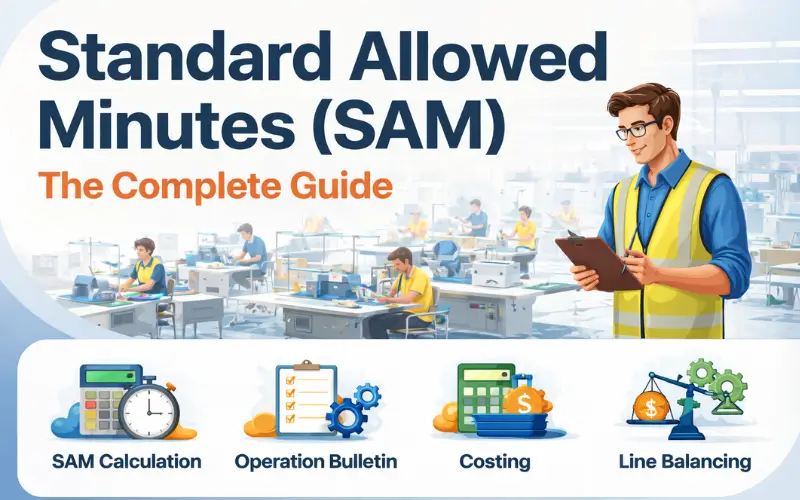
If you’ve ever argued about “what’s a fair target,” wondered why two factories quote different labor costs for the same style, or struggled to balance a sewing line that looks “fine on paper” but collapses on the floor—this is where Standard Allowed Minutes (SAM) becomes the most useful (and most misunderstood) number in apparel production.
This guide is written for production managers, industrial engineers, merchandisers, planners, and factory owners who want a practical, end-to-end understanding of SAM—how it’s created, how to calculate it, how to use it, and how to keep it honest over time.
What is Standard Allowed Minutes (SAM)?
Standard Allowed Minutes (SAM) is the allowed time (in minutes) for a trained operator to complete a specific operation at a normal pace, using an approved method, under defined conditions, including allowances (personal needs, fatigue, and unavoidable delays).
One line version:
SAM = normal working time + allowances
In garments, SAM becomes the backbone for:
- Costing (labor minutes → labor cost)
- Planning (capacity and loading)
- Target setting (UPH / PPH)
- Line balancing and bottleneck control
- Efficiency reporting
- Incentive systems (when used carefully)
SAM vs SMV vs Standard Time (clear the confusion)
Different teams and regions use different terms. Here’s the clean way to think about it:
| Term | What it usually means in garments | Includes allowances? | Used for |
| Observed time | What you measure with a stopwatch | No | Raw input |
| Normal time | Observed time adjusted for pace/rating | No | “True” working time |
| SAM | Allowed minutes for operation | Yes | Targets, planning, costing |
| SMV | Often used interchangeably with SAM | Usually yes | Same as SAM (in many factories) |
| Standard time (IE concept) | Normal time + allowances | Yes | Generic manufacturing standard |
Reality check: Many factories say “SMV” but mean “SAM,” and vice versa. The key is to confirm: did they include allowances?
Why SAM matters (and why it can go wrong)
When SAM is done correctly, it helps you answer:
- “How many operators do we need?”
- “What should be the daily output target?”
- “What is the labor cost per piece?”
- “Why is this line late even though we loaded correctly?”
When SAM is done poorly, it becomes:
- A source of conflict (operators vs IE)
- A tool for unrealistic targets
- A reason efficiency reports don’t match reality
- A silent driver of quality loss and turnover
So the goal is not just “calculate SAM.”
The goal is set a defendable, repeatable standard.
The foundation: time study and work measurement
SAM is not a “guess.” It comes from work measurement methods such as:
- Stopwatch time study (most common in garments)
- PMTS (predetermined motion time systems) like MTM/MODAPTS/MOST (used where discipline and resources exist)
- Historical standard libraries (only valid if methods and conditions match)
For most garment factories, the standard process is stopwatch time study.
Allowances: the most important part people skip
Allowances exist because humans are not machines and factories are not perfect environments.
Common allowance types:
- Personal needs (water, restroom)
- Fatigue (physical/mental rest)
- Unavoidable delays (thread break, bobbin change, minor bundle issues, machine adjustment, waiting for WIP)
In many factories, allowances are handled as a single percentage (example: 10%–20% depending on the factory, operation type, and conditions). The exact number should be a policy, not a mood.
Allowance factor: the simple approach
If allowances are A%, a common approach is:
- Standard time = Normal time × (1 + A%)
Example:
Normal time = 0.50 min
Allowances = 15%
SAM = 0.50 × 1.15 = 0.575 min
The core SAM formula (the one you should teach everyone)
A practical garment-friendly formula:
- Average observed time (from multiple cycles)
- Apply performance rating (pace) → normal time
- Add allowances → SAM
Formula layout
- Normal time = Observed time × Rating factor
- SAM = Normal time × (1 + Allowance%)
Rating factor examples
- 100% = normal pace → factor 1.00
- 110% = slightly faster → factor 1.10
- 90% = slower → factor 0.90
Step-by-step: How to calculate SAM (worked example)
Let’s calculate SAM for a sewing operation:
Operation: “Attach pocket”
You time 10 cycles (minutes):
0.42, 0.45, 0.41, 0.44, 0.46, 0.43, 0.45, 0.42, 0.44, 0.43
Step 1) Average observed time
Average = (sum of times) / 10
Sum = 4.35
Average observed time = 4.35 / 10 = 0.435 min
Step 2) Apply performance rating
Assume the operator is working at 105% of normal pace.
Rating factor = 1.05
Normal time = 0.435 × 1.05 = 0.45675 min
Step 3) Add allowances
Assume allowance = 15%
SAM = 0.45675 × 1.15 = 0.52526 min
✅ SAM ≈ 0.53 minutes
That’s the allowed minutes for that operation under the defined method and conditions.
How to use SAM in production planning (the practical math)
1) Convert SAM into target output (UPH / daily target)
If an operator works 60 minutes/hour and your SAM is 0.53 min:
Pieces per hour (theoretical) = 60 / SAM
= 60 / 0.53
≈ 113 pieces/hour
But you rarely run at 100% efficiency all day. Use realistic efficiency:
Actual UPH = (60 / SAM) × Efficiency
If line efficiency expectation = 55%:
Actual UPH = 113 × 0.55 ≈ 62 pieces/hour
2) Use SAM for line capacity
If a line has 30 operators, 8 hours/day:
Available minutes/day = 30 × 8 × 60 = 14,400 minutes
If your garment SAM (total) = 12.5 minutes:
At 100% efficiency: 14,400 / 12.5 = 1,152 pcs/day
At 55% efficiency: 1,152 × 0.55 = 634 pcs/day
This is the kind of planning that prevents wishful loading.
SAM for costing (how merchandisers and factories quote labor cost)
Once you have garment SAM, you can estimate labor cost per piece:
Labor cost per piece = (Garment SAM × Cost per minute)
Cost per minute comes from wage + benefits + overhead allocation, depending on your system.
Example:
Garment SAM = 12.5 minutes
Cost per minute = $0.045
Labor cost/piece = 12.5 × 0.045 = $0.56
This is why accurate SAM directly impacts pricing and negotiation.
Building an Operation Bulletin (OB) using SAM
An Operation Bulletin is the operation list with SAM for each operation, usually including:
- Operation sequence
- Machine type
- Skill grade
- SAM for each operation
- Total garment SAM
- Allocation to workstations (for balancing)
Good OB practices
- Freeze method before finalizing SAM
- Control versions (style rev changes = OB rev changes)
- Record assumptions: machine type, attachments, bundle size, seam type, SPI, fabric behavior, quality requirements
- Review after pilot, then after first 2–3 production days
Line balancing using SAM (how to stop bottlenecks)
Balancing is simply ensuring no station’s workload time exceeds the pace needed for your target.
Quick balancing logic
- Identify target output per hour (e.g., 300 pcs/hour line target)
- Determine takt time in minutes:
- Takt time = 60 / target UPH
- If target = 300 pcs/hr → takt = 60/300 = 0.20 min/pc
- Group operations into workstations so each station’s total SAM is close to takt time
If one station has 0.35 min load while takt is 0.20, that station becomes your bottleneck.
Fix options
- Split the operation
- Add helper (preparation tasks)
- Use a faster machine / attachment
- Improve method (motion reduction)
- Reassign elements across stations
PMTS in garments (MTM/MODAPTS/MOST) — when it helps
PMTS (predetermined motion time systems) estimate time based on motion data rather than a stopwatch.
Why factories like PMTS:
- Less subjective rating
- Faster to estimate during pre-costing
- Standardized across IE teams
Why factories avoid PMTS:
- Requires training and discipline
- Can drift if actual method differs
- Still needs floor validation
Best practice: PMTS for early estimation + time study validation during pilot.
Common mistakes (and how to avoid them)
1) Timing the best operator and calling it “standard”
Fix: Use trained, representative operators and average across cycles (and sometimes across operators).
2) Too few cycles
Fix: Use enough observations to stabilize variance (10–20 is common for stable operations; more if variability is high).
3) Method drift
If the method changes, SAM becomes invalid.
Fix: Freeze method, audit method, update OB when changes are approved.
4) Allowance chaos
Different lines using different allowances destroys planning.
Fix: Create an allowance policy: baseline + exceptions.
5) Using SAM as punishment
If SAM becomes a weapon, operators hide issues and quality drops.
Fix: Use SAM for planning + improvement, not blame.
“What is a good SAM?” (benchmarking without lying)
SAM is not a universal number. It varies with:
- Fabric type and behavior (stretch, thick, slippery)
- Machine type and speed
- Sewing method and quality requirements
- Bundle size and handling method
- Operator training and skill
- Layout and WIP control
Instead of asking “what’s a good SAM,” ask:
- “Is this SAM method-based and validated?”
- “Does actual output align with planned efficiency?”
- “Are bottlenecks consistent with OB predictions?”
- “Does SAM reflect the required quality method?”
Mini toolkit: simple SAM calculator (manual)
If you want a quick SAM calculation:
- Average observed time = T
- Rating % = R (e.g., 105%)
- Allowance % = A (e.g., 15%)
SAM = T × (R/100) × (1 + A/100)
Example:
T = 0.435
R = 105
A = 15
SAM = 0.435 × 1.05 × 1.15 = 0.525
Final thoughts
SAM is powerful because it translates work into a shared language: minutes. But the power only holds if the standard is:
- method-based,
- well-observed,
- correctly rated,
- allowance-aware,
- validated on the floor,
- and updated when reality changes.
If you build SAM like that, you get accurate costing, realistic targets, stable planning, and a healthier production system.
FAQs
Is SAM the same as SMV?
In many garment factories they are used interchangeably, but always confirm whether allowances are included.
How do I calculate line efficiency using SAM?
A common method:
- Efficiency % = (Total SAM produced / Total minutes available) × 100
Total SAM produced = (pieces produced × garment SAM)
How often should SAM be updated?
Update when the method or conditions change, such as:
- Machine change
- Attachment change
- Operation merge/split
- Quality requirement change
- Layout/bundle handling change
- New fabric behavior causing consistent time shift
What allowance percentage should we use?
There is no one-size-fits-all. The right approach is a documented policy: baseline allowance + justified exceptions (high fatigue, heat, standing work, high handling, etc.).
Can SAM be used for incentive wages?
It can, but it’s risky if standards are not trusted. If used, standards must be transparent, validated, and reviewed regularly with a fair process.